
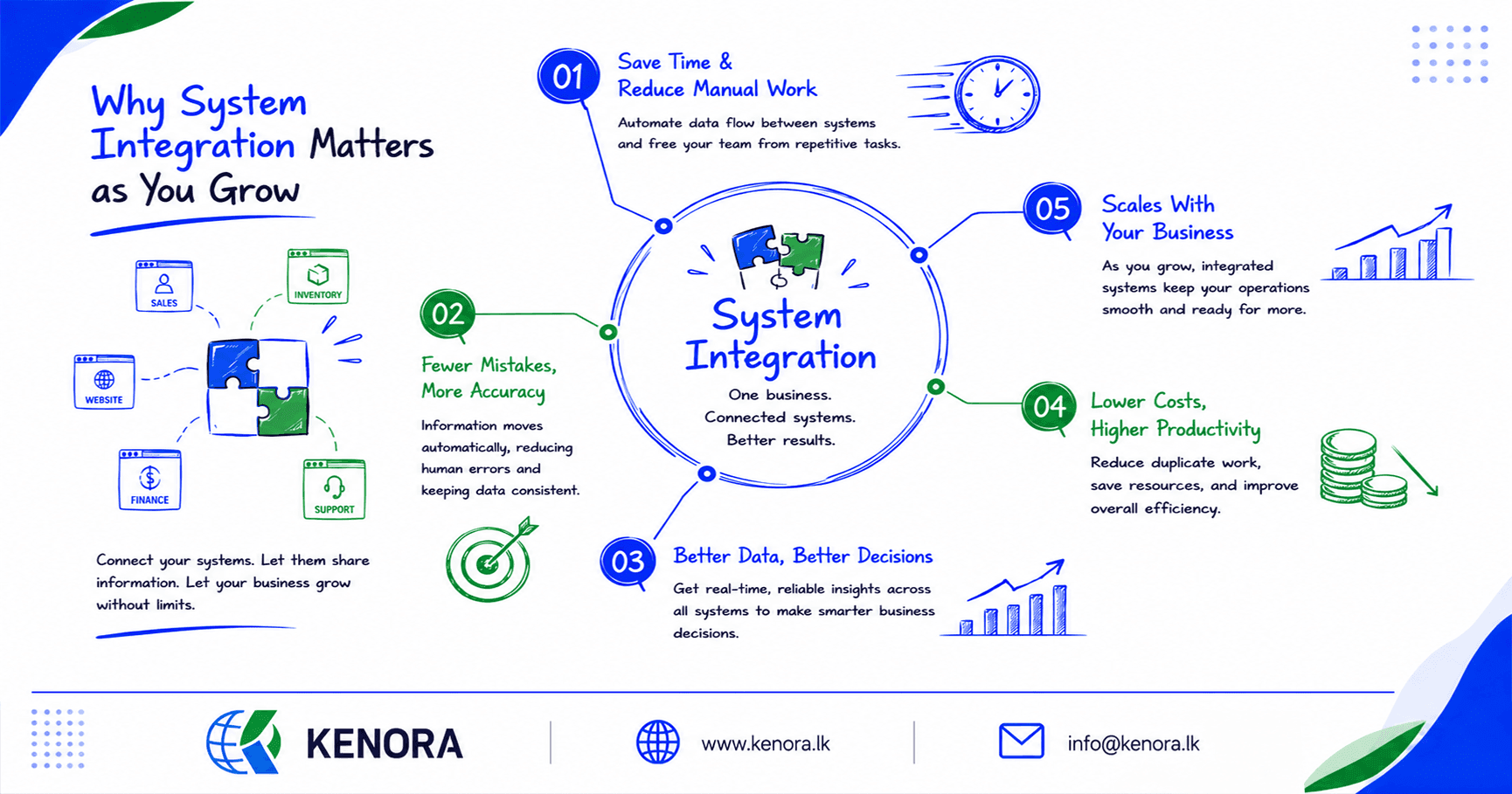
Why Every Growing Business Needs System Integration
Growth sounds simple from the outside. More customers, more sales, more staff, more work. But there's another side to growth that most business owners only discover later: more software.
In the beginning, a company can often run on just a few tools. Maybe a spreadsheet for sales, another one for expenses, and a simple app to manage customers. It works fine.
Then the business grows. The sales team starts using a CRM. Finance gets its own accounting software. Operations picks up another platform. Customer support gets a separate system. The website starts collecting customer details, and marketing adds a few more tools on top.
Each tool solves its own problem. But eventually, a new problem shows up: the systems don't talk to each other. That's when a growing business starts losing time without even noticing it.
The Problem Nobody Notices at First
Picture a customer visiting your website and filling out a form. The sales team gets the details and someone enters them into the CRM. Later, another employee copies the same information into a spreadsheet. When the customer places an order, it gets entered into yet another system. Then finance needs it, and so does customer support.
One customer. The same information. Several systems, several people, and several chances to make a mistake.
When you only have ten or twenty customers, this isn't a big deal. But now imagine doing this hundreds or thousands of times. Employees end up spending hours on work that a connected system could handle on its own. This is one of the main reasons growing businesses start looking into system integration.
So, What Is System Integration, Really?
The idea itself is simple. System integration means connecting different software systems so they can share information and work together, instead of running as separate islands.
Think of your business like a team. Your sales system knows your customers. Your accounting system knows your payments. Your inventory system knows what's in stock. Your support system knows about customer issues, and your website knows what visitors are doing. Each system holds useful information, but without integration, they behave like separate teams that never talk to each other.
With integration, they share the right information at the right time. A new customer added to the CRM can automatically show up in another system. A new order can update inventory. A payment can update a customer's account. A website form can create a new sales lead, all without anyone typing the same details twice. That's the whole idea behind integration: let the systems handle the communication in the background.
Growth Makes the Problem Bigger
This is exactly why integration matters more as a company grows. A small business can often get by with manual processes for a while. A growing business usually can't keep it up for long.
Say a company gets 20 orders a month. Entering each one by hand might take a few minutes. Now say that same company grows to 2,000 orders a month. The business hasn't just grown 100 times bigger, the manual work around those orders has grown just as much, if not more. More orders mean more data, more data means more updates, and more updates mean more room for mistakes.
This is the point where many businesses realise their old process just can't keep up anymore. It's not that the employees are slow. It's that the process was built for a much smaller business.
Your Employees Shouldn't Be the Link Between Systems
This might be the most important point here. If two systems need to share information, an employee shouldn't have to be the one connecting them by hand. When staff spend their day moving data from one platform to another, they basically become the bridge between two pieces of software, and that's unnecessary work.
Say an employee spends two hours every morning copying customer details from one platform to another. That's ten hours a week, or close to 40 hours a month, almost a full working week just moving information around. Now multiply that by five employees doing something similar, and the cost adds up fast. Worse, none of this work actually helps the business grow. It just keeps disconnected systems running.
Integration Cuts Down Human Error
Everyone makes mistakes at work. Someone types the wrong number, misses a field, forgets to update a record, or copies old data instead of the latest version. The more times the same data gets entered by hand, the more likely these small errors become.
Integration helps because information moves automatically instead of being retyped. If a customer's address changes in one system, that change can pass straight through to every connected system. Instead of three employees updating the same record separately, it just happens once. Automation won't remove every mistake, but cutting out repetitive manual work removes a lot of the small errors that tend to snowball into bigger problems later.
Better Data Means Better Decisions
Disconnected systems create another problem: nobody's sure which numbers are correct. Sales might have one customer count, finance might have another, and operations might have a third. Someone eventually asks, “which one is right?” and now people are stuck comparing reports instead of doing actual work.
This isn't just an IT headache, it affects real business decisions. A manager can't make a good call if the information behind it is outdated or incomplete. When systems are properly connected, information flows between them cleanly, which makes reporting and analysis far easier, and gives leadership a clearer, more accurate picture of what's actually happening in the business.
Integration Improves the Customer Experience Too
Customers will probably never know your systems are integrated, and that's fine, they don't need to. They'll just notice things working better.
Say a customer contacts your support team. Instead of asking them to explain their whole history again, the support agent can already see their account, recent orders, and past support requests. They can understand the issue faster and solve it without making the customer repeat themselves three times. That's really what good technology should do: make the experience simpler for the people on the other end.
APIs: The Tech Behind Most Integrations
You'll hear the term “API” a lot when people talk about integration. It stands for Application Programming Interface, which sounds complicated, but the idea behind it isn't.
Think of ordering food at a restaurant. You tell the waiter what you want, the waiter passes it to the kitchen, the kitchen prepares it, and the waiter brings it back to you. You never need to walk into the kitchen and explain how to cook anything yourself. An API works the same way: one system sends a request, another system processes it, and the result gets sent back. This lets two systems work together without either one needing to fully understand the other. APIs are what connect websites, mobile apps, CRMs, payment platforms, cloud services, databases, and pretty much everything else.
You Don't Need to Connect Everything
Here's an important point: system integration doesn't mean connecting every single tool your company owns. Trying to do that can actually create more problems than it solves.
The first question shouldn't be “what systems can we connect?” It should be “what business problem are we actually trying to solve?” Maybe sales is wasting hours moving customer data around. Maybe finance is stuck waiting on numbers from another department. Maybe inventory counts are always a day behind. Maybe a report that should take ten minutes ends up eating half a day. Start with the problem first, then figure out which systems are involved. That approach makes any integration project far more useful.
Start Small and Build From There
You don't need to overhaul the whole business in one big project either. In most cases, starting small is the smarter move.
Pick one process that causes a lot of repeated work. Understand how it works today, figure out where the data starts and where it needs to end up, and identify which systems are involved. Then build a connection between just those two. Once that's working well, move on to the next process. A business might start by connecting its website to its CRM, then later connect the CRM to its accounting software, then connect the order system to inventory. Over time, this builds a fully connected setup instead of trying to change everything overnight, and it's a lot easier for the team to adjust to as well.
What Happens If You Ignore the Problem?
Some businesses stick with manual processes simply because they're familiar. The team knows how to do it, and nobody wants to change what already “works.” But familiar doesn't always mean efficient, and a process that worked fine five years ago might not hold up today.
As the company keeps growing, the pressure builds. Staff spend more time on data entry, reports take longer to put together, customers wait longer for answers, and mistakes get harder to catch. Managers start losing confidence in their own numbers. Eventually, some businesses end up hiring more people just to handle work that better systems could have handled on their own, which is a fairly expensive way to solve what's really a technology problem.
Good Integration Is About Business First, Technology Second
This is where a lot of integration projects go wrong. Companies get too focused on the technical side: which API should we use, which platform, which database. Those questions matter, but they shouldn't be the starting point.
The real starting questions are about the business. Where is time being lost? Where do mistakes keep happening? Where does information get stuck? What work keeps getting repeated? What does the customer actually experience? What does management need to see to make good calls? Once those answers are clear, the technology side becomes a lot easier to plan. The best integration setup isn't the one with the most connections, it's the one that actually solves the right problems.
The Bigger Picture
A growing company will always run more than one system, and that's completely normal. No single piece of software does everything perfectly for every business. The goal was never to force everything into one tool. It's to get the systems you already use working together properly.
That's what creates a genuinely connected business: sales working with better information, finance getting the data it needs on time, operations spending less time on repetitive tasks, support responding faster, and managers making decisions with a clearer view of what's going on. And employees get to spend more time on meaningful work instead of shuffling data between screens.
A Connected Business is Easier to Scale
Growing your business shouldn't mean adding more manual work every time you land a new customer. If your company doubles in size, your systems should be able to handle that growth right along with you.
This is really the core reason system integration matters so much. It builds a foundation that supports whatever comes next for the business. You might start with two connected systems, then three, then five. What matters is that your technology grows alongside the business instead of becoming the thing holding it back.
Final Thoughts
System integration isn't about piling on more technology. It's about making the technology you already have work better together. When systems stay disconnected, employees end up becoming the connection themselves, copying information, checking spreadsheets, sending files, preparing reports, and fixing mistakes along the way.
When systems are properly connected, most of that work happens automatically. That gives people back their time, gives the business more reliable information, and gives customers a smoother experience overall. For a small business, integration removes a lot of unnecessary work. For a growing business, it becomes a real part of scaling up. And for a company already juggling too many disconnected tools, it might be time to stop asking “what new software should we buy?” and start asking “how do we make the software we already have work together?”
That one question alone can lead to a much better technology strategy.
At Kenora, we believe technology should fit the way your business works, not the other way around. Whether it's APIs, custom software, cloud systems, automation, or data, our goal stays the same: build technology that helps your business move forward.