
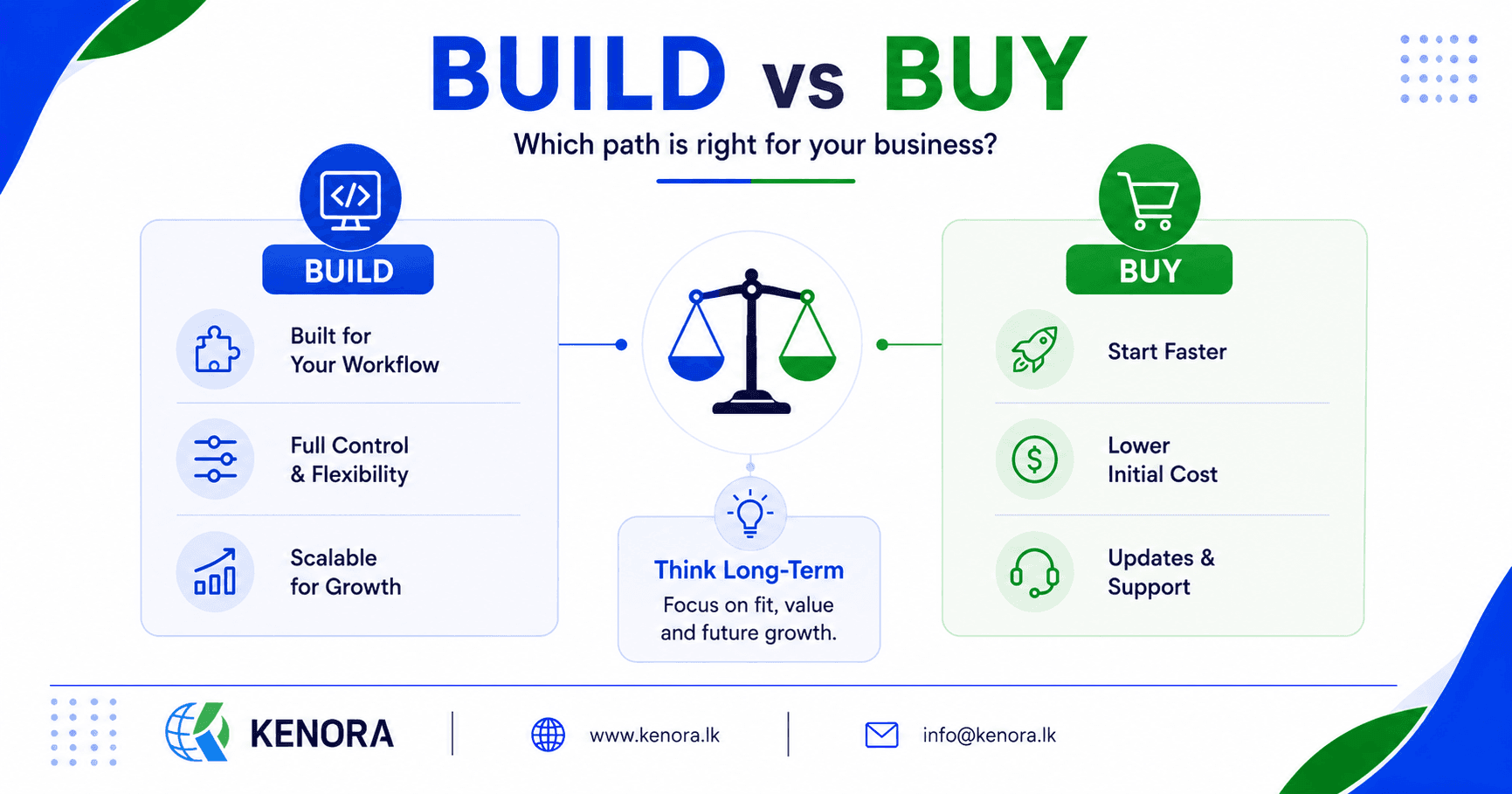
Build vs Buy Software: Which Is Right for Your Business?
Every growing business reaches a point where its current software just isn't enough. Employees copy the same data between different tools by hand. Key tasks still live in spreadsheets. The company has grown, but the software hasn't kept up.
That's when the question comes up: should we buy better software, or build our own?
It sounds simple, but it isn't. Buying software can save you time and money. Building it can give you more control and make daily work easier. The right answer depends on your business, your workflow, your budget, and where you want to be in a few years.
So instead of looking for one option that's always better, let's look at when each one actually makes sense.
Buying Software: The Faster Path
Buying software means using a product another company has already built. Today there's a ready-made tool for almost everything: CRM, accounting, project management, HR, inventory, customer support, communication, and reporting.
For common problems, buying is often the smart choice. Say you need a simple tool to manage customer contacts. Do you really need months of development for that? Probably not. You can pick an existing product, set it up, load your data, train your team, and start using it right away.
That's the biggest advantage of buying: you don't have to build something that already exists.
Why Businesses Choose Ready-Made Software
There are a few solid reasons businesses lean toward buying instead of building.
You can start faster
A ready-made product is already built and tested. Your team could be using it within days or weeks, not months. That speed matters when the business needs a solution right now.
The starting cost can be lower
Building software needs developers, designers, testing, infrastructure, and ongoing support. A ready-made product usually runs on a subscription or license, which is easier for a small or growing company to manage.
Updates are handled for you
Software providers release updates, improvements, and security fixes on their own. Your team doesn't have to build every improvement from scratch.
Support is available
When something breaks, you can contact the provider. That's a big help if you don't have a large in-house tech team.
But buying isn't without its downsides.
The Problem With Buying
Ready-made software is built for many customers, not for your business specifically. That gap can cause real problems.
A product might cover almost everything you need, but the missing pieces are often the ones that matter most. Say your company needs five approval steps before an order is complete, and the software only supports three. Now your team has to patch together the rest, maybe over email, maybe in a spreadsheet, maybe by re-entering the same data somewhere else.
The software that was supposed to make work easier ends up creating more of it. This is one of the biggest risks with off-the-shelf software: your business may end up adjusting its process to fit the tool, instead of the tool fitting the business.
You may pay for features you never use
Many software products come packed with features, which sounds great at first. But more features don't always mean better software. Your team might need ten core functions, and the product gives you fifty. Now employees have more screens to learn and more settings to figure out, most of which they'll never touch. Often, simple software that fits your workflow beats software with hundreds of extras.
Your business depends on the provider
When you buy software, you're also relying on the company behind it. They control pricing, updates, features, and often how your data is handled. What happens if the price goes up, if a feature you rely on gets removed, or if the company changes direction? These are worth thinking through before you commit long term.
Building Software: When Your Business Needs Something Different
Custom software is built around your business, not the other way around. Instead of forcing an existing system to fit, you start by looking at how your business actually works. What does your team do every day? Where do things slow down? Where do mistakes happen? Which systems need to talk to each other? What do you need that no existing product offers?
The answers become the foundation for the software, and that can make a real difference.
Your workflow comes first
Say a company has its own way of handling customer orders, one that touches sales, finance, operations, inventory, and management, and each department needs different information. A standard product might handle a few of these steps well, but rarely the whole process. Custom software can connect every step together. For example:
Customer Order → Approval → Inventory Check → Payment → Delivery → Customer Update
Instead of employees moving information between systems by hand, the whole workflow runs as one connected process. That saves time and cuts down on mistakes.
You decide what matters
One of the biggest advantages of custom software is control. You decide what the system does. Instead of being stuck with features another company thought were important, you build around what actually matters to your team. You can also design different views for different users: one dashboard for employees, another for managers, and maybe a separate portal for customers. The software is shaped around the people who actually use it.
But Custom Software Is Not Always The Answer
This part matters: building software isn't automatically the better choice. If a ready-made product already solves your problem well, building your own version can waste time and money. If your business just needs a basic calendar, there's no real reason to spend months building one. If you need standard accounting software, there are already several strong options out there.
Custom development makes more sense when the problem is unusual, important, or hard to solve with existing tools.
Custom software takes more planning
Good software doesn't come together overnight. Before development starts, the team needs to understand the business: What should the system do? Who will use it? What information does it need? How should different systems connect? What happens when something goes wrong? What should happen as the business grows? Only once these questions are answered does design, development, testing, deployment, security, and support come next, and all of that takes time.
There is an ongoing cost
Building software isn't a one-time project. After launch, it still needs care: security updates, bug fixes, performance improvements, new features, backups, monitoring, and changes as the business grows. That's why it's worth thinking about the full lifetime cost of the software, not just what it costs to build.
Build vs Buy: The Real Question
Many businesses start by asking, “Which option costs less?” That's a fair question, but it's not the full picture. A better one is: “Which option will actually work better for our business over time?”
Cheap software can turn expensive if your team spends hours every week working around its limits. Custom software can cost more up front but save time every single day for years. The reverse happens too: sometimes a company spends heavily on custom software for a problem an existing product could have solved perfectly well. Price alone shouldn't make the decision.
What About a Combination?
There's a third option many businesses overlook: you don't have to choose all-build or all-buy. You can do both.
For example, a company might use an existing accounting platform but build a custom order management system that connects to it through an API. That way, you get the benefit of a proven product plus a custom solution exactly where you need it.
This is often the most practical path for growing businesses.
Buy what already works. Build what makes your business different.
7 Questions to Ask Before Your Decide
Before you choose a direction, run through these seven questions.
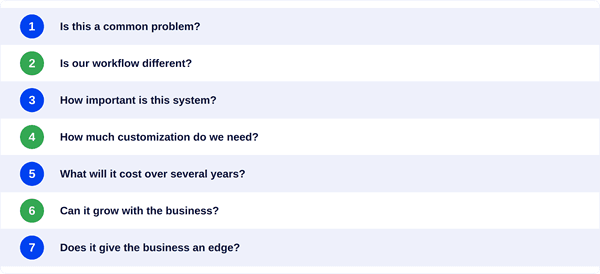
1. Is this a common problem?
If thousands of other businesses share the same need, there's probably already a good product for it.
2. Is our workflow different?
If your process is unusual, check whether existing software can genuinely support it, not just approximate it.
3. How important is this system?
A small internal tool and a system that runs your core operations shouldn't be judged the same way.
4. How much customization do we need?
List the features your business actually needs, then compare that list against real products, not just their feature pages.
5. What will it cost over several years?
Look past the sticker price to subscriptions, setup, training, integrations, customization, support, and future changes.
6. Can it grow with the business?
Your company might double in size, add locations, products, or customers. Make sure the option you pick can keep up.
7. Does it give the business an edge?
This might be the most important question of all. If the software lets your company work in a way competitors can't easily copy, custom development may be worth a lot more than its price tag suggests.
A Simple Example
Take two companies. Company A needs a simple system to track employee leave, and plenty of existing products already handle that well, so buying makes sense here.
Company B runs a unique system for managing thousands of orders across multiple locations, with custom approval rules, inventory checks, payment updates, delivery tracking, and customer notifications. Existing software might cover parts of this, but not the whole workflow, so custom software is likely the better investment.
The difference isn't company size. It's the nature of the problem each one is solving.
Don't Start With Technology
One of the most common mistakes businesses make is starting with the technology instead of the problem. They ask things like “Should we use this platform?” or “Should we use this programming language?” before they've even defined what they're solving.
Those questions can wait. Start with the business problem instead:
● What's slowing us down?
● What's costing us time?
● Where are the mistakes happening?
● What information is hard to get to?
● What should happen automatically?
● What do our customers struggle with?
Once you understand the real problem, the technology decision gets a lot easier.
The Best Software Is The Software That Fits
Build vs buy isn't really a contest between two types of software. It's a business decision. If a ready-made product solves your problem well, use it. If your business has a process existing products can't handle, look into custom software. If you need both speed and flexibility, combine the two.
What matters is looking past the first price tag or the newest technology. Look at where your team's time goes. Look at where mistakes happen. Look at the systems you rely on and how your business is likely to grow. Most of all, look at what makes your business different.
Good software shouldn't make your business work harder to fit the tool. The right technology should make the business easier to run. That's the real question behind build vs buy.