
How We Turn Business Problems into Simple Solutions
Every business starts with a goal. Some want to save time. Some want to cut down on mistakes. Others want to grow without hiring more people. Whatever the goal is, one thing stays true: technology should make work easier, not harder.
Many people think software development is only about writing code. In reality, coding is just one small part of the journey. The real work begins with understanding people, learning how a business runs, and finding smarter ways to solve everyday problems.
At Kenora, we believe every software project should have one clear purpose: to help businesses work faster, make better decisions, and prepare for the future.
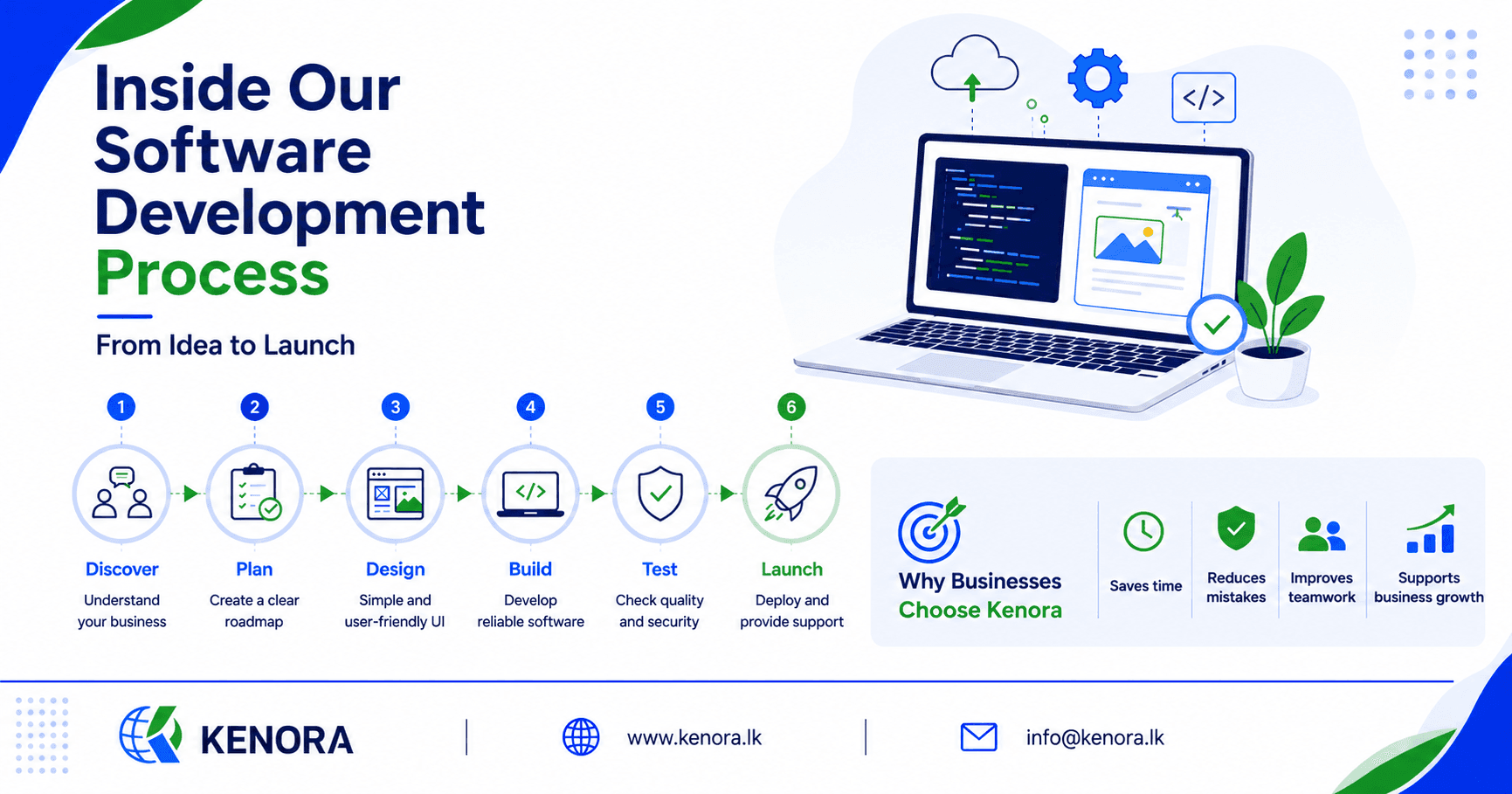
Here is how we turn an idea into software that people actually enjoy using.
It Start with a Conversation
The first meeting is never about technology. Instead, we ask simple questions:
What challenges does your team face every day?
Which tasks take up too much time?
Where do mistakes happen most often?
What would make work easier for your employees?
These questions help us understand the business before we think about features or programming.
Sometimes clients come to us asking for one solution, but after learning more about their daily work, we discover a better approach. That is why listening is one of the most important parts of our process.
Looking at the Bigger Picture
Imagine a company where the sales team records customer details in a spreadsheet, the finance team enters the same information into another system, and the support team keeps customer notes in emails. Every department works hard, but nobody has the full picture.
Employees waste time searching for information, updating multiple files, and fixing small mistakes. This is a common situation for growing businesses.
Before we build anything, we study how information moves through the company. We look for repeated work, slow approval steps, and tasks that software could easily handle instead. Finding these problems is the first step toward building a better system.
Planning Before Building
A successful project needs a clear direction. Without a plan, even the best developers can end up building something that does not fully meet the client's needs.
We create a roadmap that explains what the software will do, who will use it, how the different features work together, and how the project will move forward.
Breaking the project into smaller stages helps everyone stay focused and makes progress easier to track. Good planning saves time later.
Designing Software That Feels Simple
People use software every day. If a system is confusing, employees get frustrated. They end up spending more time learning the software than doing their actual work.
That is why we focus on simple design. Buttons should be easy to find. Important information should be clear. Tasks should take as few steps as possible.
Good software should feel natural from the very first day. When employees enjoy using a system, they work faster and make fewer mistakes.
Turning Ideas into Reality
Once everything is planned and approved, development begins. Our developers build each feature step by step. Instead of trying to finish everything at once, we focus on steady progress.
Each part of the software is carefully connected to the next, creating a stable and reliable system. Whether it is a customer portal, a business dashboard, an inventory platform, a mobile app, or a workflow automation tool, every feature is built with future growth in mind. Businesses change over time, and good software should be ready to grow with them.
Testing Before Launch
Many people think a software project ends once it goes live. We see it differently. Launch day is the beginning of a new chapter.
Employees start using the system in real situations. New ideas appear. Business needs keep changing. That is why we stay connected with our clients after launch. We help improve performance, add new features, fix issues, and keep the software running smoothly. Technology should keep improving as the business grows.
A Real Example
One business came to us because their team spent hours every day updating spreadsheets. Customer details were copied into different files. Managers had to search through emails just to find project updates. Simple tasks became slow because information was scattered across too many places.
After understanding their workflow, we built a custom system that brought everything together. Customer records, project updates, reports, and daily tasks were all available in one place. Instead of spending hours searching for information, employees could focus on serving customers and growing the business.
The result was not just faster work. The whole team felt more organised and confident, because they could finally trust the information they were using. That is the real value of custom software.
Why Our Process Works
Technology alone does not solve business problems. Understanding the people behind the business does.
Every company is different, and every team faces different challenges. That is why we never believe in a one size fits all solution. We take the time to understand each business, plan carefully, communicate openly, and build software that fits real, daily work.
This approach reduces surprises, improves project quality, and creates solutions that keep delivering value for years.
More Than Software
At Kenora, we do more than build applications. We help businesses simplify their work, connect their systems, reduce manual tasks, and prepare for future growth.
Whether you need custom software, cloud solutions, workflow automation, API integration, data management, or IT consulting, our goal stays the same: to build technology that solves real problems and creates real business value.
Final Thoughts
Behind every successful business is a process that works well. The right software strengthens that process by helping people work smarter, communicate better, and make faster decisions.
Building software is not about adding more technology. It is about removing the obstacles that slow businesses down.
When every step is planned carefully and every solution is designed around real business needs, software becomes more than a tool. It becomes a long term investment that supports growth for years to come.