
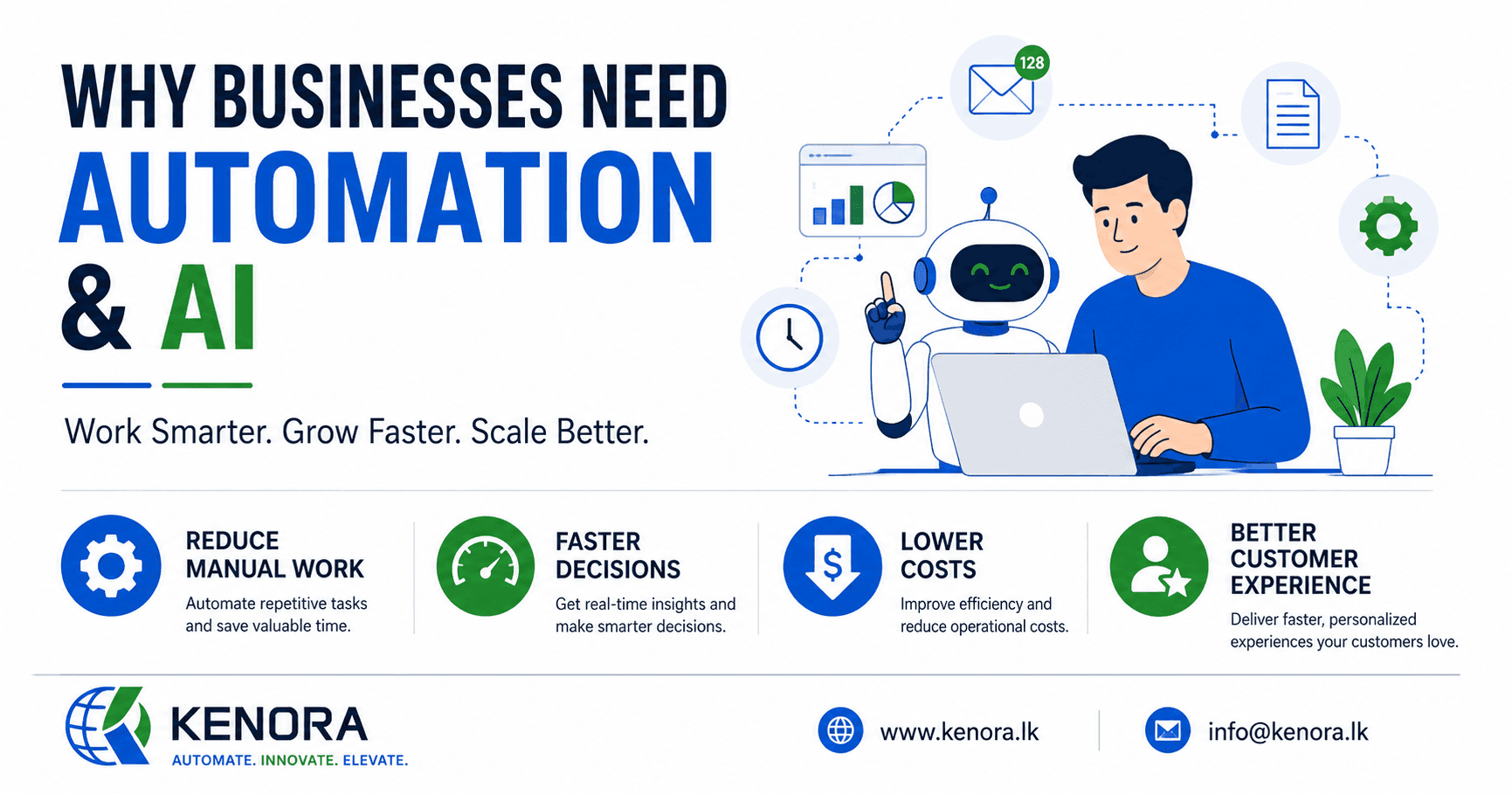
Every growing business hits a wall at some point not because the team stops working hard, but because the work itself stops making sense. Spreadsheets piling up. Data copied from one tool to another. Reports assembled by hand every Monday morning. It starts small, but it compounds fast.
This is the moment where Automation and AI stop being buzzwords and start being answers.
The Hidden Cost of Manual Work
Here's a number most businesses never actually calculate: how many hours a week do their people spend doing tasks that a machine could handle?
A sales rep keys customer details into a CRM. Someone in ops pulls numbers from three platforms to build one report. An assistant forwards emails to the right departments. Each task takes five minutes. Across twenty people, that's hours gone every single day — quietly, invisibly.
And it's not just the time. When humans handle repetitive tasks, errors creep in. A wrong digit in a spreadsheet cascades into a bad decision. A missed update creates confusion downstream. The bigger the company, the worse this gets.
Automation doesn't get tired. It doesn't mistype. And it never forgets to hit send.
Doing More With the Same Team
There's a stubborn myth that automation means layoffs. It doesn't at least not in the way people fear.
What it actually does is free people up to do the work that machines genuinely can't: building client relationships, thinking creatively, solving problems that require judgment. The admin disappears; the strategy stays.
Picture this: a customer inquiry arrives and is instantly routed to the right team. A weekly report assembles itself and lands in your inbox before you've had your coffee. New lead data flows straight into your CRM without anyone touching a keyboard.
That's not replacing people. That's giving people their time back.
How AI Takes Automation Further
Basic automation follows rules. AI follows context.
The difference matters. A rule says: if this email contains the word 'invoice', send it to accounting. AI says: here's what this customer probably needs, here's how to phrase the response, and here's a flag because their sentiment looks frustrated.
Practically speaking, modern AI tools can:
- Tear through large datasets and surface what actually matters
- Give support teams instant, relevant context before they reply to a customer
- Draft reports, summaries, and content in a fraction of the usual time
- Spot patterns and trends that wouldn't show up in a manual review
- Predict bottlenecks before they become problems
Think of it less as a replacement for human thinking, and more as the best assistant you've ever had one that never sleeps and never loses focus.
Connecting Systems That Don't Communicate
Most mid-sized businesses run on four or five different platforms. There's the accounting software, the CRM, the project tool, the inventory system, the communication stack. None of them naturally talk to each other.
So who bridges the gap? Usually a person. Someone spends their day copying data from one screen to another, keeping everything vaguely in sync. It's tedious, it's error-prone, and it scales terribly.
Automation fixes this at the infrastructure level. Data flows automatically between platforms. An order placed in your e-commerce system updates inventory, triggers a fulfillment notification, and logs against the right account without a single human in the loop.
The result isn't just time saved. It's a business that actually has a clear, real-time picture of what's happening.
The Competitive Advantage
This is where it gets interesting from a business strategy perspective.
Companies that automate intelligently don't just operate faster they operate differently. They respond to customer inquiries in minutes, not hours. They catch inventory issues before stock runs out. They scale their output without scaling their headcount proportionally.
Meanwhile, competitors who are still running things manually are slower, more error-prone, and spending money on tasks that could cost almost nothing.
Automation used to be an enterprise luxury. The cost of building it out was steep, and only big companies could afford the investment. That's changed dramatically. Today, powerful tools are accessible to businesses of almost any size and the companies that move early build compounding advantages over those that wait.
The Future Is Smarter Work
The businesses that will win in the next decade aren't necessarily the ones with the largest teams or the biggest budgets. They're the ones that figure out how to direct human energy where it actually creates value and let technology handle everything else.
That means automating the repetitive stuff. Connecting the systems that should already be talking. Using AI to make faster, smarter decisions. And continuously asking: where are my people spending time that a machine could handle better?
It's not about replacing work. It's about elevating it.
The goal isn't a smaller team. It's a team that's no longer buried in tasks beneath their ability.