
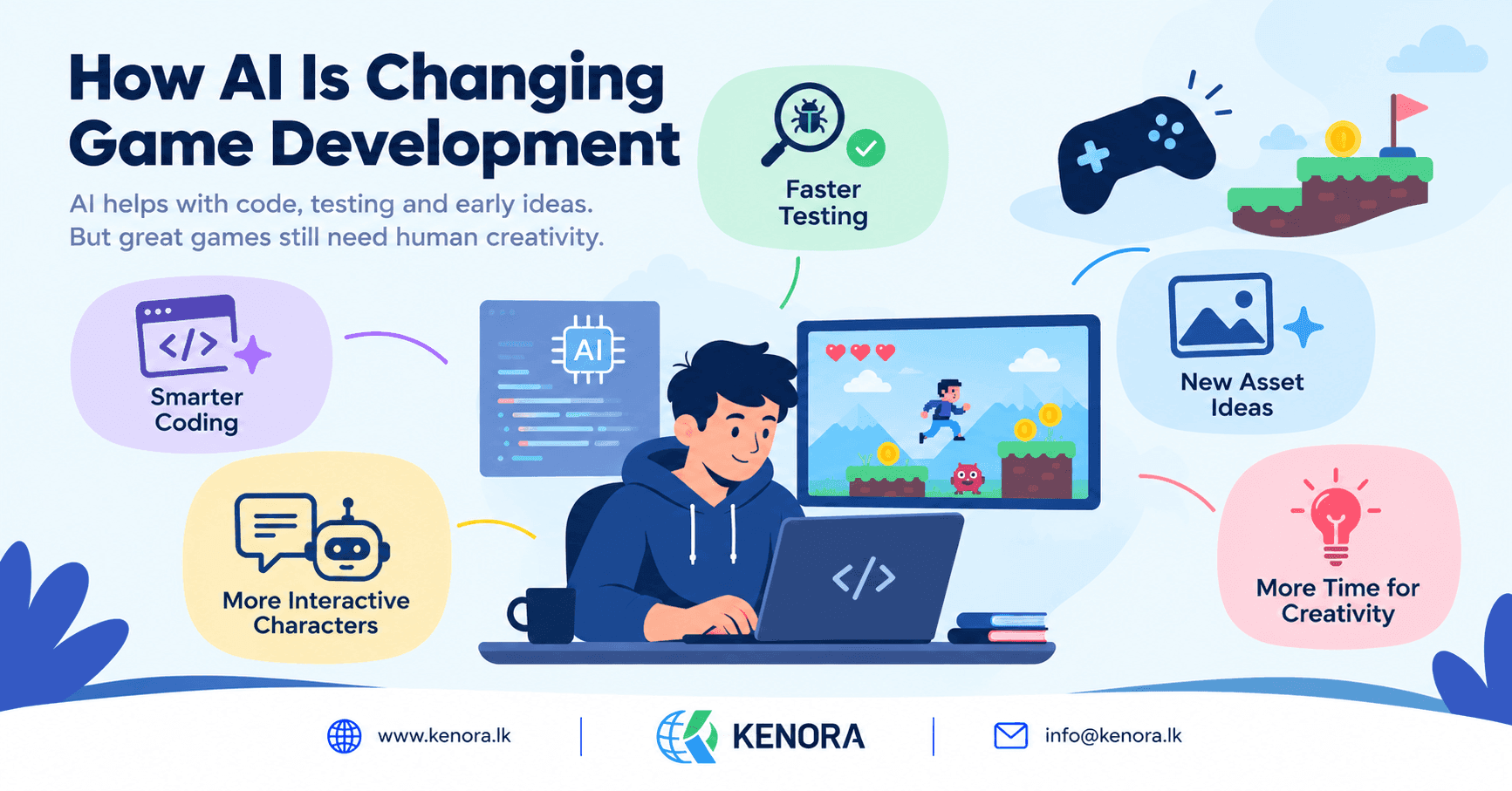
How AI Is Changing the Way Games Are Made
AI can help with code, testing, and early ideas. But great games still need human creativity.
Picture a simple game. A character jumps across platforms, grabs coins, and fights enemies. You have the idea. But turning it into something people can play takes a lot of work. You write code, design levels, make animations, fix bugs, and test everything again and again.
Now imagine getting help with some of that work, so you do not have to start every step from zero.
That is what AI is starting to do in game development. It can help with code, design ideas, testing, and boring repeat tasks. Small teams feel this the most, because their time is limited.
But AI is not a magic button that builds a perfect game. The real change is in how developers spend their time and use their skills.
1. From Idea to Playable Game, Faster
Every game starts with an idea. The hard part is making it playable.
Say you are building a 2D platform game. You need a character that runs and jumps, enemies that move around, and levels that get harder as the player goes on. An AI assistant can write a basic movement script, suggest how an enemy should behave, or explain an error message. Instead of spending hours on a first version, you get something working sooner and spend your time making it better.
This helps most during prototyping, when you are testing if an idea is even worth building.
But a prototype is only the start. A good game needs smooth controls, fair difficulty, clear goals, and a reason for players to keep playing. AI can speed up the work. You still decide what makes the game fun.
2. Coding Is Changing, Not Disappearing
Code takes up a big part of any game project. AI coding tools can suggest scripts, explain errors, and help you read code you do not know. They can also handle small tasks you would have to repeat by hand.
Say you work in Unity with C#, and your character keeps falling through a platform. You cannot see why. An AI assistant can look at the script, point out likely causes, and tell you what to check. Then you test those ideas inside Unity yourself.
That can save a lot of time. But AI code is not always right. It can add new bugs, miss small details, or break something in another part of the project. So you still need to understand the code and test it.
The real win is not writing less code. It is spending less time on routine problems and more time on the player’s experience.
3. Testing Gets Easier
One small bug can ruin a player’s day. A character gets stuck behind a box. An enemy stops moving. A level becomes impossible after one odd action. Finding these problems takes careful testing, especially in games with many levels.
AI tools can now help here. They can check game behavior, read error logs, and repeat actions again and again. Roblox, for example, has a playtesting agent in beta. It can read logs and use the player character as an automated tester to check that the game works as planned.
This takes away a lot of dull work. But a tool cannot feel a game the way a person does. It may confirm that a level works and still miss that it is confusing, boring, or far too hard. So human playtesting still matters.
Let the tools do the repeat checks. Let real players tell you if the game is fun.
4. Making Game Assets
Games are not only code. Characters, backgrounds, icons, sounds, and animations all bring a game to life. AI gives developers new ways to explore these in the early stage.
If you are making a pixel art game, you can try different color palettes, world ideas, or character looks before you pick a final direction. That saves time on designs that may not work out.
But a generated image is not a finished game asset. A character may look different from one image to the next. An animation may feel stiff. A background may not match your style. Artists and developers still need to edit and polish everything so it feels like one world.
Also check usage rights and licenses before you put AI generated content in a commercial game. A strong look still comes from clear creative direction.
5. Game Characters That Talk Back
Think about a role playing game. Usually you pick from a few dialogue options, and the character answers with a line that was written ahead of time. It works well, but it can feel limited.
AI could make this more flexible. Imagine a shopkeeper who can answer any question you ask, or a character who remembers what you said earlier in the game.
But there are risks. AI characters can say strange things, break the story, or talk in a way that does not fit the game. They can also add cost and extra technical work that small projects may not need.
Not every game needs AI conversations. Sometimes a well written character with a strong personality does the job better. Use AI when it helps the player, not just because it is new.
What Is Happening in the Game Industry?
AI is already part of real game work. Unity’s 2026 Game Development Report found that 62% of surveyed developers use AI for coding help, and 44% use it for writing and story tasks. The same report says more developers are choosing smaller projects to lower their risk.
Roblox shared a similar picture. It says 44% of its top 1,000 creators use Roblox Assistant or other AI tools to plan, build, and test their games.
Not everyone is happy about it, though. In GDC’s 2026 industry survey, about half of the developers said generative AI has had a negative effect on the industry. Many worry about jobs and quality.
So the trend is not that AI will make every game. Developers are finding practical ways to use it for specific jobs. Some use it to write code faster. Others use it to test ideas, make early assets, or cut down repeat work. Each team has to decide what really helps its project.
Will AI Replace Game Developers?
AI will change game development. But making a good game takes much more than code and assets.
Someone has to decide what the game is about, how it should feel, and what makes it different from thousands of other games. Developers connect the gameplay, art, sound, controls, and story into one experience. They also listen to feedback and change things that are not working. That takes creativity, experience, and a real understanding of players.
AI can support this work, but developers are still responsible for the final result. For small studios, it can mean testing ideas faster with fewer resources. For bigger teams, it can mean less repeat work in production.
The developers who gain the most will be the ones who know when to use AI, when to question it, and when human skill matters more.
Final Thoughts
AI is opening new doors for game development. It can help with code, testing, asset ideas, and even talking characters, so more ideas can become playable games.
But faster does not always mean better. Players remember games for the worlds they explore, the challenges they beat, and the feelings they get along the way.
AI can help build those moments. Creativity, good design, and careful testing still make them real.
The future of game development is not only about making games faster. It is about using better tools to make games worth playing.