
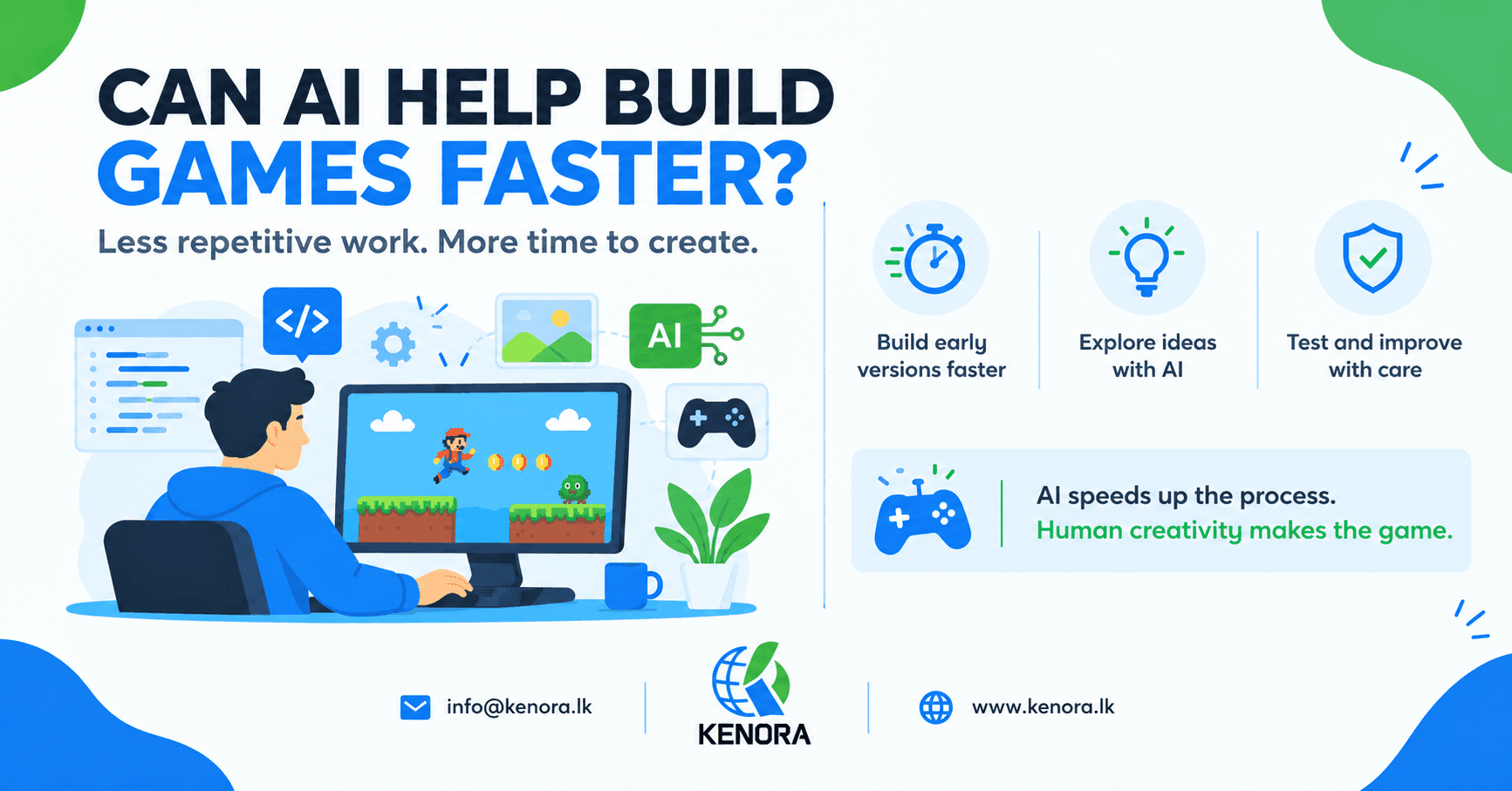
Can AI Help Developers Build Games Faster?
AI is changing how games are made. But does it really help developers build better games in less time?
Picture this. You have an idea for a mobile game. You can already see the characters, the levels, and the fun your players will have.
Then reality hits. You need to write code, design levels, make art, test everything, and fix bugs again and again. Even a small game can take weeks or months.
AI tools are starting to change that. They can help write code, spark ideas, make early art, and test features. So can anyone now build a great game in a few hours?
Not really.
AI can help developers move faster, but a game people love still needs creativity, skill, and a good plan.
1. From a Game Idea to a Playable Version
Every game starts with an idea. The hard part is turning it into something people can actually play.
In the past, developers built almost every feature by hand, one piece at a time. Now AI can take over some of that work.
Say you want to make a simple 2D platform game. The player jumps across platforms, collects coins, and avoids enemies. You can ask an AI tool to write the basic movement code, set up a score system, or explain why your character will not jump the right way.
Instead of spending hours searching for answers, you may get a useful starting point in a few minutes.
That does not mean the game is done. You still have to test the controls, improve the levels, and make sure all the parts work together. But a quick starting point lets you try ideas sooner. And that leaves more time to improve the game itself.
2. AI Can Help With More Than Code
Code is only one part of making a game. Developers also plan levels, design characters, test gameplay, and fix small problems. AI can help with many of these jobs.
Here are four areas where it can help:
- Game design: Ideas for levels, missions, characters, and game rules.
- Art and visuals: Early concepts for backgrounds, objects, and characters.
- Testing: Test lists, and help to understand bug reports.
- Writing: Story ideas, dialogue, character notes, and in game tips.
For a small team, this can make a real difference. Imagine you want a new enemy for your mobile game. AI can suggest a few enemy ideas and some basic behavior. You pick the best one and shape it to fit your game's style.
The real win is not just saved time. It is getting to explore more ideas before you decide what goes into the final game.
But you still need to check the results. A character may look great on its own and still feel wrong inside your game.
3. Game Tools Are Getting Smarter
AI is not just a chat box anymore. It is moving into the tools developers use to make games.
On October 7, 2026, Google Labs launched Playground, an experimental platform that turns text prompts into games you can play in your browser. You describe the game, then keep chatting to change the rules, the characters, or the look. For now it is open only to adults in the US, and each person gets a weekly limit for making games.
On the same day, Google and Unity announced a partnership. Unity plans to bring a new tool called Unity Spark into Playground later in 2026, so simple prompt games can grow into bigger ones.
This shows how much easier it is becoming to start making a game. You can describe what you want, get an early version, and change it with simple instructions instead of doing every step by hand. Beginners can try ideas more easily, and experienced developers may spend less time on routine work.
But a quick demo is not a finished game. A demo may have one level and a few basic features. A real game needs controls that feel good, fair difficulty, smooth performance, and enough content to keep players coming back. Early reports say the games Playground makes are still fairly simple.
AI can help with parts of that journey. Developers still have to steer.
4. A Faster Game Is Not Always a Better Game
Say AI helps you finish a game in half the usual time. That sounds great. But what if the game is boring? What if the controls feel awkward? What if every level looks almost the same?
Players do not care how fast a game was made. They care about fun challenges, smooth play, characters they remember, and a reason to keep playing.
Code and images alone cannot give you that. You need to know what makes your game different. You decide how hard each level should be, how the player should feel, and why they will come back tomorrow.
AI can offer many ideas. Someone still has to decide which ones are good.
The goal is not to make more games faster. It is to use the time you save to make better games.
5. The Hidden Work Behind AI Made Games
AI can save time, but it can also bring new problems. Generated code can have bugs. A feature may work in one case and break in another. Art may not match the rest of your game. You also need to think about performance, licenses, and whether you have the right to use what the tool made.
Imagine AI creates a new enemy for your game. It looks great and moves well. Then it gets stuck the moment it reaches a wall. You still have to find the cause, fix it, and test it again.
If AI features cause too many problems, the time you saved at the start can disappear during testing. So treat AI output as a first draft, not a finished product.
Good testing and a human review still matter, especially before you release a game to the public.
6. Why Small Teams Could Benefit
Big studios often have separate teams for code, art, animation, sound, and testing. A small team may have just a few people doing all of it. AI can help them explore ideas, build early versions of features, and cut down on repeated work.
Unity's 2026 Game Development Report gives some numbers. It surveyed about 300 developers, and 73% of the studios polled said AI tools improved their efficiency. Most studios used AI for behind the scenes work: 62% for coding help and 44% for writing and story tasks. Only 5% said they do not use AI at all.
So AI can support real work, but the results depend on how each team uses it. For a small team, saving a few hours on a boring task can mean more time to polish the gameplay or get ready for launch.
Still, AI cannot replace a clear game idea or good skills. Someone has to understand the project, make the decisions, and check the results.
7. How Should Developers Start Using AI?
You do not need to change your whole process. Start with one task that takes too much of your time. Maybe it is explaining an error, writing a basic script, brainstorming level ideas, or making a test list for a new feature.
Then check the results. Did the tool save time? Was the answer useful? How much did you have to fix? If it helps, keep it in your workflow. If it creates more trouble than it solves, try a different way.
Also protect your creative direction. Your characters, art style, gameplay, and story should feel connected, not like a pile of random AI ideas. Use AI where it helps, and keep the big decisions about the player's experience for yourself.
Final Thoughts
AI is opening new doors for game developers. It can turn ideas into early prototypes, speed up routine jobs, and make it easier to try different approaches. New tools like Playground are bringing AI closer to the heart of game making.
But a great game needs more than speed. It needs imagination, good design, careful testing, and an understanding of what players enjoy.
The developers who gain the most will not be the ones who use AI for everything. They will be the ones who know where it helps and where human judgment matters most.
AI can help you build a game faster. What you do with the extra time is what makes your game stand out.