
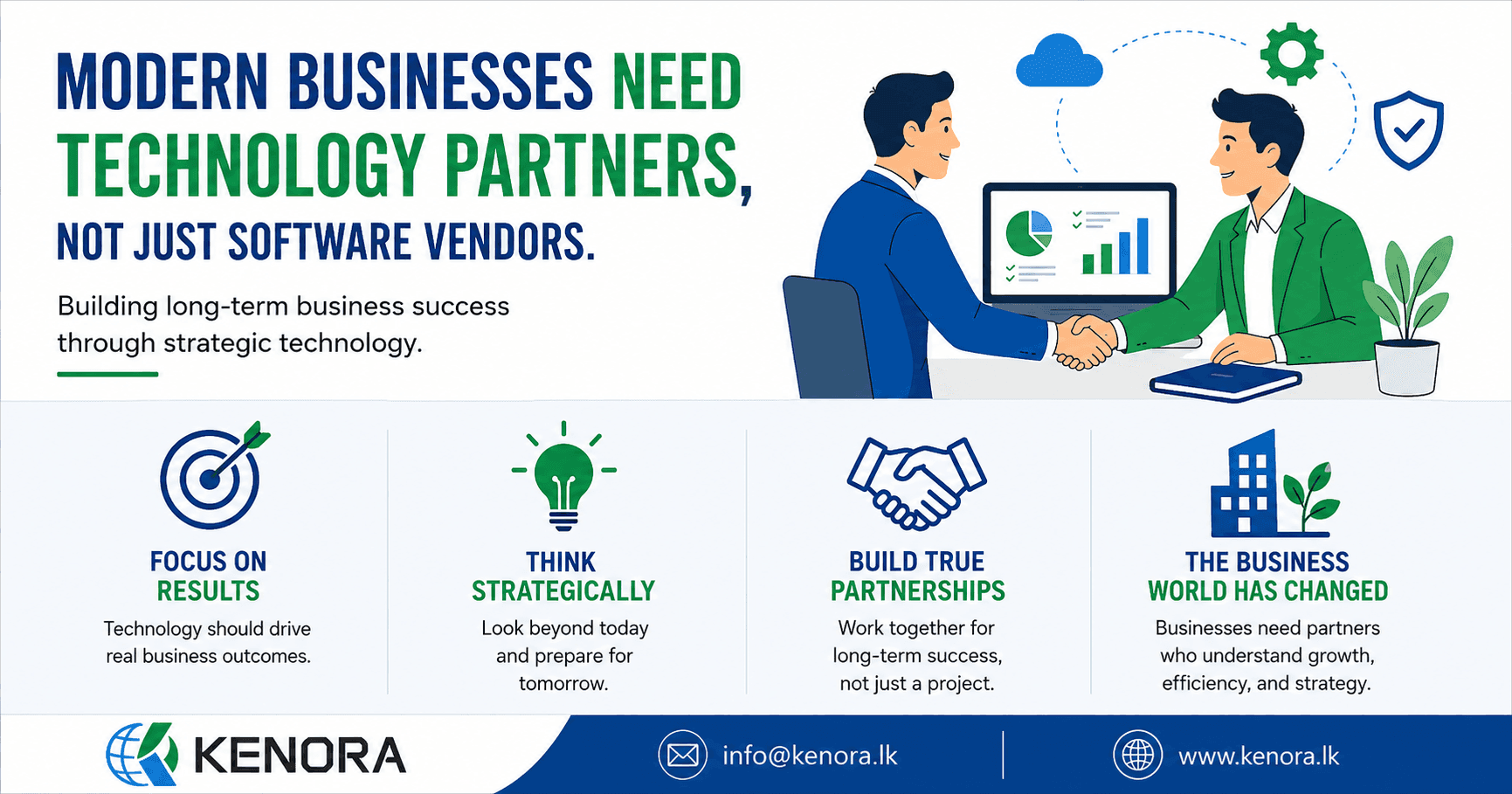
There was a time when hiring a technology company was straightforward. A business needed a website, a mobile app, or a custom system. A vendor built it, delivered the final product, and moved on to the next client. That model worked fine when technology played a supporting role in a business.
That is not how things work anymore. Technology now shapes how businesses compete, communicate, serve customers, and grow, and the expectations placed on technology partners have shifted just as dramatically. Businesses are no longer looking for companies that simply write code. They are looking for partners who understand real business challenges, think strategically, communicate openly, and help create long-term value.
The difference might sound subtle. In practice, it has transformed the entire technology industry. A quick snapshot of how the relationship has changed:
- Relationship - old vendor model: a transaction that ends at delivery; modern partner: an ongoing collaboration
- How technology is viewed - old: a cost to be minimized; modern: an investment that drives growth
- Starting point - old: a list of features; modern: a conversation about business goals
- When priorities shift - old: change is resisted; modern: change is planned for
- Security - old: added near the end; modern: built in from the first day
- After launch - old: the project is considered closed; modern: the partnership continues
Technology Is No Longer Just an Expense
Years ago, technology spending usually sat in the operational cost column of a budget. Today it belongs in the growth column instead.
A customer portal can improve retention. An automated workflow can cut operating costs. A mobile app can open up a new revenue stream. A secure cloud platform can support expansion into new markets. Technology has become tightly woven into business performance, and because of that, decision-makers now expect their technology partners to understand more than programming languages and frameworks. They expect them to understand business outcomes.
The conversation has shifted from Can you build this? to How will this help our business grow?
Understanding the Business Comes First
Every successful project starts with questions, and not the kind about features, programming languages, or budgets. Experienced technology partners begin by trying to understand the business itself. Who are the customers? Where are employees getting stuck? Which processes are slowing everything down? What does success actually look like a year from now?
Skip these conversations, and even technically excellent software can miss the point entirely. A beautifully built system that solves the wrong problem is still the wrong solution. That is why businesses increasingly value partners who are willing to challenge assumptions and ask thoughtful questions before a single line of code gets written.
Communication Matters More Than Ever
One of the biggest reasons technology projects struggle is not technical complexity. It is poor communication: unclear expectations, updates that arrive too late, confusing timelines, and changes that show up out of nowhere. These issues create frustration long before the software is even finished.
Modern businesses expect transparency from start to finish. They want regular updates, realistic timelines, and honest conversations when challenges come up, instead of silence until it is too late. Most of all, they want to know they are working with people who genuinely care about the project succeeding, not just completing a contract. Good technology work is collaborative by nature, and the best outcomes tend to come from teams that communicate openly with each other.
Flexibility Has Become Essential
Business priorities change. Markets shift. Customer expectations evolve. New regulations appear seemingly overnight. A plan that looked perfect six months ago may need real adjustments before it ever launches.
The best technology partners plan for this reality instead of resisting it. Agile development, continuous feedback, and regular planning sessions help keep a project aligned with business goals even as those goals continue to evolve. Flexibility is not a sign of poor planning. It is usually a sign of the opposite.
Security Is Expected, Not Optional
Businesses trust their technology partners with things that matter: customer records, financial data, internal operations, intellectual property. Protecting that information is not an optional add-on. It is a fundamental responsibility.
Security now needs to be considered from the very beginning of a project, not bolted on right before launch. Secure coding practices, access controls, regular testing, and real data protection strategies used to be treated as premium features. They are simply the baseline today. Technology partners who treat security as part of every decision, rather than a final checklist item, tend to build far more confidence with their clients.
Long-Term Support Builds Stronger Relationships
Launching a solution is only the beginning. Businesses keep growing after the software goes live. New employees join. Customer needs shift. Systems need updates. Integrations need to evolve.
The most valuable technology partners stay involved well after launch. They monitor performance, recommend improvements, resolve issues quickly, and help the business prepare for whatever comes next. Instead of asking, Is the project finished? they ask, What is the next opportunity to improve? That mindset is what turns a one-time project into a genuine long-term partnership.
Innovation Should Be Practical
Businesses appreciate innovation, but they value practical innovation even more. Every year brings a new wave of exciting technology: artificial intelligence, machine learning, the Internet of Things, cloud-native platforms, automation. The temptation is to chase all of it at once.
Experienced technology partners understand that the newest technology is not automatically the best solution. Sometimes a simpler approach creates more business value, and modern businesses have come to expect honest recommendations, even when that means hearing, you probably do not need this yet. Real innovation is not about following trends. It is about solving problems in smarter, more deliberate ways.
Reliability Creates Confidence
Technology failures are expensive. A delayed launch can affect revenue. System downtime can damage customer trust. Poor performance can slow down productivity across an entire organization.
Because of this, businesses place enormous value on reliability. Dependable technology partners deliver when they say they will, communicate early when challenges appear, test thoroughly before deployment, and document their work clearly. Consistency often matters more than raw speed. Trust, in the end, is built through dependable execution, project after project.
A Partnership Built on Shared Success
The strongest technology partnerships do not feel like traditional vendor relationships. They feel more like shared journeys. Both organizations celebrate the wins together, work through the setbacks together, and stay focused on delivering real value to the end customer.
When a technology partner genuinely cares about a client's long-term success, the conversations naturally become more strategic. Instead of discussing individual features, both sides start discussing future opportunities. Instead of only solving today's problem, they begin preparing for tomorrow's growth. That shift in perspective tends to make both organizations stronger.
Final Thoughts
Choosing a technology partner has become one of the most consequential decisions a growing business can make. The right partner brings far more than technical expertise to the table. They bring strategic thinking, transparent communication, dependable delivery, real security awareness, and a genuine commitment to continuous improvement.
Technology keeps changing. Business challenges keep evolving. Customer expectations keep climbing. In that kind of environment, businesses do not just need developers. They need partners who understand where the business stands today, where it wants to go tomorrow, and how technology can actually help close that gap.
Because in the end, the best technology partnerships are not measured by the software they deliver. They are measured by the businesses they help build.