
Toshiba’s New Quantum-Safe Networking Platform
What Businesses Need to Know
Picture a thief who steals a locked safe. He cannot open it today. So he hides it away and waits for someone to invent a better tool.
That is the idea behind a threat called “harvest now, decrypt later.” Attackers copy encrypted data today, store it, and hope that powerful quantum computers will be able to unlock it in the future.
Security experts take this risk seriously, and it is one reason Toshiba’s latest announcement is getting attention. On October 21, 2026, Toshiba launched its new Quantum-Safe Networking (QSN) Platform. It is built to protect important data connections and make that protection easier to grow across many locations.
So what does it actually do, and should your business care? Let’s break it down.
What Is Toshiba’s QSN Platform?
Every day, banks move financial data, hospitals share patient records, and companies send private files between offices and data centers. Those connections need strong protection.
Toshiba’s QSN Platform is a package of hardware and software made to protect data as it travels between sites. It brings several quantum-safe technologies together in one system. The package includes optical equipment, key management software, and a central controller that lets teams run the whole network from one place.
Toshiba also says you do not have to rebuild your network to get started. The platform is designed to fit into existing network setups, so you can protect your most important links first and add more later.
One thing to keep in mind: this platform is aimed mainly at telecom companies, data center operators, and other critical infrastructure providers. Most businesses will probably use this kind of protection through a provider, not buy the equipment themselves.
Why Quantum-Safe Security Matters Now
Most companies already use encryption. It scrambles readable data so that only someone with the right key can understand it. Online banking, business email, and private records all depend on it.
The problem is that a powerful quantum computer could one day break some of the encryption methods we use today. That does not mean your data is unsafe right now. Computers that strong do not exist yet. The worry is about timing.
Think about data that must stay private for ten or twenty years, like medical records, legal files, research, or government documents. If someone steals that data today, they may only need to wait. Experts warn that this kind of data collection may already be happening, which is why planning early makes sense.
Even Toshiba’s own leaders call this move the largest transformation in the history of cryptography.
How Does the Platform Work?
The platform mixes three technologies. Each one protects data in a different way.
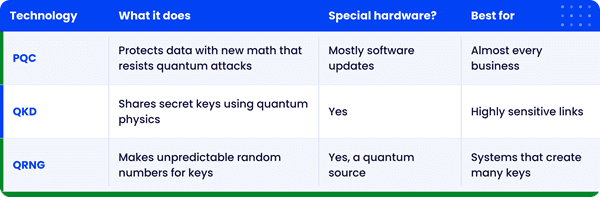
Post-Quantum Cryptography (PQC)
Post-quantum cryptography, or PQC, is a new kind of encryption. It uses math problems that are hard to solve for both normal computers and future quantum computers.
The big advantage is that PQC works mostly through software updates, so it can run on the networks you already have. For most businesses, this is the best place to start. Check which systems use encryption and plan how to update them.
Quantum Key Distribution (QKD)
Quantum key distribution, or QKD, uses the rules of quantum physics to share secret encryption keys between two places. If someone tries to spy on the exchange, the quantum signal changes, and the system can notice it.
The catch is cost and setup. QKD needs special equipment and suitable network connections. It is not needed for every business or every link. Its value depends on how sensitive your data is.
Quantum Random Number Generation (QRNG)
Quantum random number generation, or QRNG, uses quantum processes to create random numbers. This matters because every encryption key starts with randomness. If attackers can guess how a key was made, they can break in more easily.
Toshiba includes QRNG alongside PQC and QKD as part of one wider approach. Here is a quick summary of the three:
What Makes This Announcement Different?
Quantum-safe networking is not a new idea. Researchers and companies have worked on it for years. The hard part has been growing it.
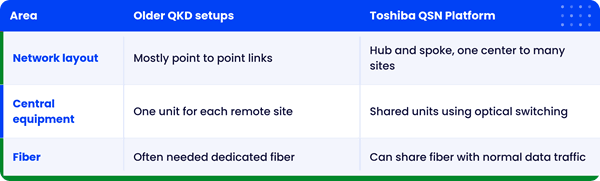
Older QKD setups mostly connected two points, with a device at each end of every link. Lee Johnson, who leads Toshiba’s QSN Platform, gave a simple example. Connecting one data center to 100 customers the old way takes 100 boxes at the data center and another 100 in the field.
The new platform uses a hub instead. With optical switching, one shared set of equipment at the center can connect to many remote sites. Toshiba says a single hub can serve hundreds of them. It can also send quantum signals over the same fiber as normal data traffic, so you may not need dedicated fiber. A central controller lets teams see and manage the network from one screen. Here is how the two approaches compare:
This is not just a lab idea either. Toshiba already works with Orange, a telecom company that has used Toshiba’s QKD technology to run a quantum-safe network for commercial customers. Toshiba also says all parts of the new platform are available now.
Of course, real costs and results will depend on each network. Toshiba’s figures show what the design can do, not what every customer will get.
What Should Businesses Do Now?
Most companies do not need to rush out and buy a quantum-safe network today. But there are a few smart steps to take now.
- 1Find your most important data. Ask which information must stay private for many years. Customer records, financial data, research, and confidential plans are common examples.
- 2Review your security systems. List the apps, websites, cloud services, and network links that rely on encryption. Some of them may need to change later.
- 3Plan for upgrades. Older systems can be hard or costly to update. If you spot them early, you have more time and fewer rushed decisions.
- 4Talk to your providers. Ask your technology and network providers how they plan to support post-quantum cryptography. A clear answer is a good sign.
None of this means replacing every system this year. It means knowing your risks and deciding what to fix first.
Is It Right for Every Business?
No, and that is fine.
Large banks, telecom companies, data centers, government bodies, and critical infrastructure operators have strong reasons to look at specialized quantum-safe networking. For them, a platform like Toshiba’s may be worth a serious look.
Smaller businesses probably do not need their own QKD network. They can still get ready by checking their encryption, updating old systems, and choosing software and cloud providers who take quantum risks seriously.
The right choice depends on three things: what data you handle, how long it must stay private, and how much protection you need. The goal is not to buy every new technology. It is to pick what makes sense for you.
Final Thoughts
Toshiba’s launch shows how security thinking is changing. Businesses used to worry only about today’s attacks. Now they also have to prepare for tomorrow’s technology.
Quantum computers will not make today’s encryption useless overnight. But if your data needs to stay private for a long time, it is smart to start planning now. Know your data, review your systems, and talk to your providers.
Because good security is not only about stopping the attacks of today. It is also about making sure your information is still safe years from now.