
What Is Continuous Security Testing?
Why one security test is never enough
Most companies treat cybersecurity like a yearly health checkup. They run a security test, fix a few problems, get a report, and move on.
There is one issue with that plan. Your technology does not stay still.
New software gets added. Developers push updates. Cloud settings change. New people get access. New weaknesses are found in tools you already use. A system that was safe three months ago may not be safe today.
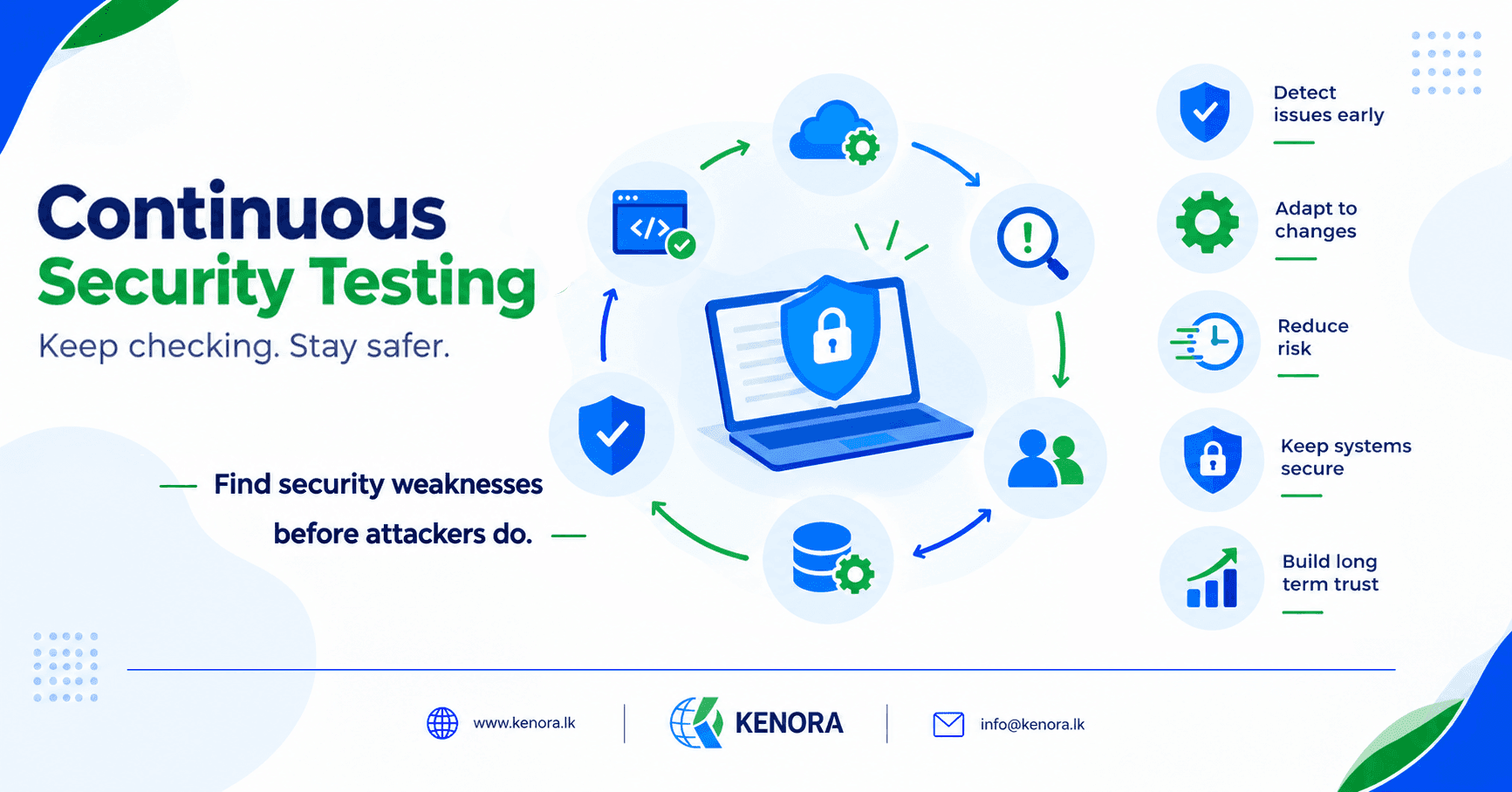
That is why more businesses are moving to continuous security testing. In simple words, they keep checking their systems as those systems change, instead of checking once in a while.
Security Is Not a One-Time Job
Think about locking up an office. On opening day, you check every door and window. All good.
Then things change. You add a new door. You install another window. Someone makes a spare key. One lock gets damaged. If you never check again, you will never know about any of it.
Technology works the same way. A website gets new code. A cloud server gets a new setting. A new software library brings in a hidden weakness. Security testing has to keep up with all of this.
NIST, the US National Institute of Standards and Technology, describes continuous monitoring as keeping ongoing awareness of security, vulnerabilities and threats, so organizations can make better risk decisions.
Does this mean testing everything every second? No. The goal is to test and watch often enough to catch important changes before they turn into big problems.
So, What Is Continuous Security Testing?
It means security checks happen regularly during the whole life of a system, not just at launch.
The old way looks like this: Build, test, launch, forget.
The better way looks like this: Build, test, fix, monitor, change, test again.
These checks can include automated security checks, vulnerability scans, configuration checks, code testing and regular security assessments. Some run automatically when developers make a change. Others run on a schedule, or when something important changes.
Here is an example. A company releases a new version of its web application. Before customers see it, a security check looks for known weaknesses. If it finds one, the developers fix it and test again. Simple, and much safer.
Why One Test Is Not Enough
Traditional testing still matters. A penetration test, for example, shows how a real attacker might try to break into your systems. That is very useful.
But one test only shows what was true on that day. NIST also notes that a security assessment is a snapshot, which is why some organizations need to assess more often, depending on their risks and environment.
A photo shows how something looked when you took it. Your systems keep moving after that. Continuous testing fills the gap between the photos.
What Does It Look Like in Practice?
No, it does not mean a team sitting in front of screens all day. It mixes automation, monitoring, scheduled tests and human review. Here is a simple example of how it works:
- 1Code changes. A developer updates an application, and security checks run as part of the normal build process.
- 2New weakness found. A new vulnerability shows up in a tool the company uses. The team checks if their systems are affected.
- 3Cloud changes. A cloud setting changes, and a check flags anything that adds unnecessary risk.
- 4Scheduled tests. Vulnerability scans and other tests run on a regular plan.
- 5Human review. Security professionals look at the important findings and decide what needs attention first.
- 6Fix and test again. The issue is fixed, then tested again to make sure it is really gone.
See the pattern? It is a cycle, not a one-time event.
Automation Helps, But People Still Matter
A company can have thousands of systems, accounts, apps, cloud resources and devices. Checking all of them by hand every day is not realistic. Automated tools can spot common problems and changes much faster. NIST has also worked on ways to assess security controls with automated tests.
But tools do not understand your business. A tool might say, “This system has a high-risk finding.” A person still needs to ask:
- What caused it?
- Is the system really exposed?
- How serious is it for the business?
- What should we fix first?
- Could the fix break something else?
Tools find the problem. People decide what it means.
Finding a Problem Is Only the Start
A finding is not the finish line. A good process also helps you know what to do next. Let’s look at an example.
Finding: An outdated software component is being used.
Ask: Is it open to the internet? Is there a known attack for it? Which systems could be hit?
Action: Update or replace the component.
Final step: Test again.
That last step matters. Do not mark an issue as “fixed” just because someone changed something. Check that the risk has really gone down.
What About AI?
AI is changing security testing too. It can help teams go through huge amounts of information, spot unusual activity and find possible weaknesses.
But attackers are using AI as well, to make their attacks faster and stronger.
So the testing habits you had last year may not be enough now. Software is released faster, systems change more often, and security has to keep pace.
Who Needs Continuous Testing?
It is easy to think this is only for big companies. It is not. Any business that relies on technology can benefit.
That includes businesses that run web or mobile apps, use cloud platforms, sell online, offer SaaS products, work in finance or healthcare, handle customer information, or have remote teams.
The right setup depends on your systems, your risks, your budget and your business needs. There is no single plan that fits everyone.
Security Assessment vs Continuous Testing
These two ideas are connected, but they are not the same. A security assessment gives you a deep look at one point in time. Continuous testing keeps watching for changes and new risks after that.
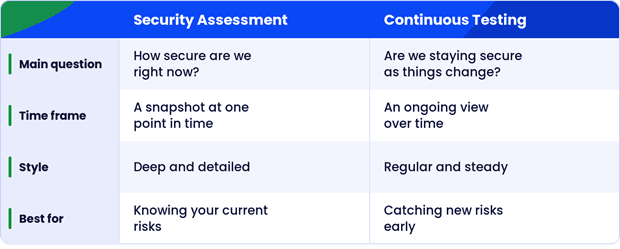
A strong security program uses both. Start with a detailed assessment, then follow it with ongoing testing and monitoring. NIST guidance also supports ongoing assessment and monitoring as part of managing security risk.
Final Thought
The biggest benefit of continuous security testing is not more reports. It is finding important problems before attackers do.
A small weakness is easy to fix today. Left alone for months, it can turn into a big mess. That is why security should not be something you check only before an audit or after an incident. It should be part of the normal life of your technology.
Your applications change. Your cloud environment changes. Your team changes. The threats change. So your security process needs to change too.
Continuous security testing does not mean testing everything, all the time. It means building a process that can keep up with change.
Because the best time to find a security weakness is not after an attack. It is while you still have time to fix it.