
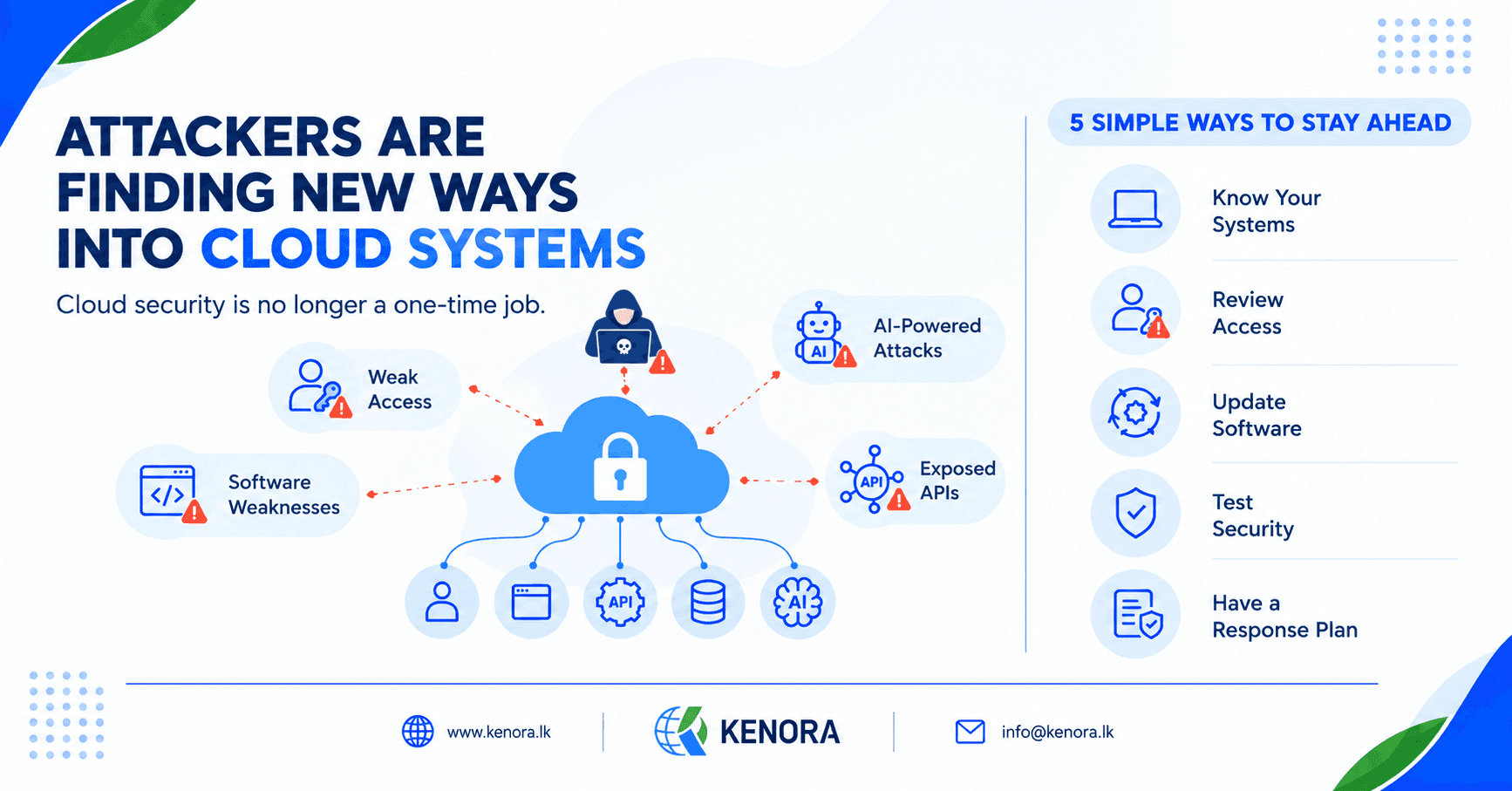
Attackers Are Finding New Ways Into Cloud Systems
Your cloud account may look secure today. But what happens when a new weakness is found tomorrow?
That is the problem many businesses face right now. Cloud technology changes fast, and attackers change with it.
Cloud services help businesses run apps, store data, manage teams, and support customers without a big physical IT setup. That is a great thing. But the more a business moves to the cloud, the more there is to protect. And attackers keep finding new ways in.
In this article, we look at the main ways attackers get in, and what your business can do about it. We keep it simple, so you can share it with your whole team.
The Cloud Is Not the Problem
It is easy to think that moving to the cloud makes a business safe by default. It does not.
Cloud platforms come with strong security tools, but the business still has to set them up and manage them the right way. Think of it like a house with a great lock. The lock only helps if someone actually turns the key.
A modern cloud setup can include users, apps, APIs, databases, storage, automated systems, and third-party services. That is a lot of moving parts. One small mistake in any of them can open a path for an attacker.
So cloud security is no longer just about protecting one server. Businesses also need to know who has access, what is connected, and where sensitive information is going.
Attackers Look for Weak Access
User access is still one of the biggest targets. An attacker does not always need to break into a server. Sometimes a valid account is all they need.
Imagine an employee who can open a cloud dashboard. If someone steals that account, the attacker looks like a normal user. Depending on the permissions, they may reach apps, data, or other connected services, and nobody notices right away.
This is why businesses should not give people more access than they need. A simple rule works well:
Give people and systems only the access they need.
Access should also be checked often. Old accounts, unused permissions, and forgotten service accounts can quietly turn into security risks. A person who left the company last year should not still have a working login today.
Turning on multi-factor authentication is also one of the easiest ways to make a stolen password far less useful.
Old Software Can Become a New Problem
Software weaknesses are another big worry. Businesses run many apps and services in the cloud. Some are built in-house, and others come from third-party providers.
When a weakness is found, attackers move fast. They start looking for businesses that have not fixed it yet. It becomes a race.
Security teams need to know which systems are affected, how serious the problem is, and how quickly it must be fixed.
A cloud setup can be safe today and risky tomorrow because of one newly found weakness. That is why regular updates and security checks matter so much.
Think about the apps on your phone that keep asking you to update. Business systems work the same way, except the risk is much bigger when an update is skipped.
AI Is Changing the Game
Something else is changing too. Attackers have started using AI to speed up parts of their work. AI can help them study information, search for weak spots, and automate some tasks.
At the same time, security teams use AI to find weaknesses and spot unusual activity. So AI can help both sides.
This does not mean AI can magically break into every cloud system. The real issue is speed. Attackers can look at more information and try more things in less time. That means security teams need better visibility and faster ways to respond.
This matters even more for small and mid-size businesses. You may not have a large security team, so knowing your own systems well is your best starting point.
APIs Are Another Door
Modern businesses depend on APIs. They connect websites to apps. They connect mobile apps to business systems. They connect one cloud service to another. They even help AI tools talk to other systems.
But every API needs protection. If login checks, permissions, or data controls are set the wrong way, an API can become another door into your business.
Every business should be able to answer these four questions:
- What APIs do we have?
- Who can use them?
- What can they reach?
- Are any old APIs still running?
If you do not know something exists, you cannot protect it. Many API problems are not clever hacks. They are simply doors that were left open by mistake, or forgotten after a project ended.
Cloud Security Keeps Changing
One of the hardest parts of cloud security is that nothing stays the same. A company may add a new app today. Tomorrow, it may connect a new API. Next month, it may add an AI service. Every change can raise a new security question.
This means cloud security cannot be a one-time job. A security check from six months ago may not show what is happening today.
Businesses need regular monitoring, access reviews, updates, weakness checks, and security testing.
A good habit is to ask one simple question every time something new is added: who can reach this, and what can it reach?
What Can Businesses Do?
No single tool can solve every cloud security problem. But businesses can start with five simple steps.
Know What You Have
Keep a list of your cloud accounts, apps, APIs, databases, and connected services. Even a simple spreadsheet is a good start. You cannot protect systems you do not know about.
Review Access
Check who can reach your important systems. Remove old accounts and extra permissions. Protect your administrator accounts with extra care.
Keep Software Updated
When a serious weakness is found, do not wait. Find out if your systems are affected and fix the problem as soon as you can.
Test Your Security
Monitoring is useful, but testing matters too. A security assessment can find weak spots before attackers do.
Have a Response Plan
Even strong security cannot promise that an attack will never happen. Your team should know what to do if an account is hacked or sensitive data is exposed. A clear plan can save valuable time during an incident. Write down who to call, who can shut off access, and how you will inform your customers.
The Cloud Is Moving. Security Needs to Move Too.
Cloud technology is not standing still, and neither are attackers. New software is released. New weaknesses appear. Businesses add new services. AI is becoming part of more systems, and attackers are finding new ways to automate their work.
That makes cloud security an ongoing job.
The goal is not to build a system that nobody can ever attack. The goal is to make it harder for attackers to get in, limit the damage if something goes wrong, and find weak spots before they turn into serious problems.
For any business using the cloud, that starts with good access control, regular updates, monitoring, and proper security testing.
The cloud gives businesses freedom and flexibility. Now they need to make sure that same flexibility does not give attackers an easy way in.