
.png&w=3840&q=75)
A Strong Password Is Not Enough Anymore
You have heard this advice many times. Make your password long. Add numbers and symbols. Never use the same one twice.
It is good advice, and it still matters. But today, a strong password is only one small piece of staying safe.
Businesses now run on cloud platforms, online apps, mobile devices, remote access, and APIs. Staff can work from almost anywhere, and company data moves between many different tools. That gives attackers more doors to try.
And sometimes, they never need to guess your password at all.
The Password Might Not Be the Problem
Say your business has an account with a long, unique password. Nobody is going to guess that.
Now say an employee gets an email that looks like it came from a service they trust. They click the link. The login page looks real, so they type in their username and password.
Just like that, the attacker has the login details.
The password was strong. The way it was stolen was the problem. This is why businesses need to look beyond passwords.
Attackers Have More Ways In
Modern attacks are not only about trying random passwords over and over. Attackers use phishing, stolen login sessions, malware, software bugs, exposed systems, and poorly protected cloud services.
Many of them also go after people instead of technology. A fake message is often easier than breaking into a well-protected system.
That is why security needs more than one layer.
MFA Adds Another Layer
One of the easiest ways to protect an account is multi-factor authentication, or MFA. Instead of asking only for a password, it asks for a second proof that it is really you. That could be:
- An authenticator app
- A security key
- A phone confirmation
- A fingerprint or face check
So even if someone steals the password, they may still not get in. MFA is not perfect, but it makes an attack much harder. For a business, that extra step can make a big difference.
But MFA Is Not the Finish Line
It is easy to think, "We have strong passwords and MFA, so we are safe." Sadly, security is not that simple.
A business can still run an old application with a known weakness. A cloud service can have the wrong settings. A former employee's account might still be active. Someone might have more permissions than their job needs. A server might be open to the internet when it should not be.
All of this can happen even when everyone uses strong passwords. That is why security needs regular checks.
Your Cloud Setup Matters Too
The cloud has changed how companies work. Applications, databases, file storage, backups, and websites often live there now.
But every account, permission, connection, and setting needs someone to manage it. An employee may see data they do not need. A cloud resource may be set up the wrong way. One small mistake can turn into a much bigger problem.
Strong passwords cannot fix poor access settings.
Give People Only the Access They Need
Here is a simple rule: people should only have access to what they need.
A customer support agent does not need to open financial systems. A developer does not need every production database. A temporary worker may only need access for a few weeks.
When too many people can reach sensitive systems, one stolen account can do much more damage. Limiting access lowers that risk. It sounds basic, but many businesses overlook it.
Your Software Can Be a Weak Point
You can have strong passwords, MFA, and careful staff, and still be at risk because of one outdated application. Software flaws give attackers another way into your system.
Waiting for an attacker to find the weakness first is a bad plan. It is better to look for weaknesses yourself. Regular vulnerability scanning and penetration testing can help you find problems before they turn into serious incidents.
Security Testing Finds What You Cannot See
A security assessment looks at your systems from a security point of view. It can help you find things like:
- Vulnerable software
- Weak configurations
- Exposed services
- Poor access controls
- Application security issues
- Cloud security risks
But finding a problem is only the beginning. What matters more is knowing what the problem means, how serious it is, and what to fix first. That is where clear security reporting and remediation guidance become important.
People Are Part of Security Too
Technology is only one side of cybersecurity. People matter too.
Someone might click a dangerous link. Someone might approve a fake login request. Private information could go to the wrong person, or an unsafe file could be downloaded by mistake.
This does not mean employees are the problem. It means businesses need security that helps people make safer choices. Simple training, clear rules, MFA, good access control, and regular security checks work well together to lower risk.
So, Is a Strong Password Still Important?
Yes, it is. Strong and unique passwords still matter. Try not to use the same password on different accounts, and a password manager can make that much easier.
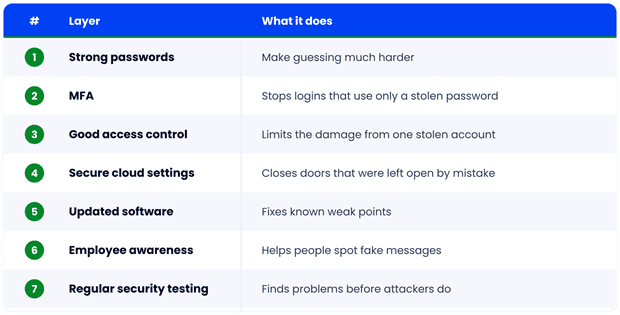
But a password should never be your whole security plan. Modern businesses need several layers of protection, and each layer helps when another one fails:
Where to Start
You do not need to fix everything in one week. A good first round looks like this:
- 1Turn on MFA for every account that supports it. Begin with email and admin accounts.
- 2Check who has access to what, and remove accounts that are no longer needed.
- 3Update your software and review your cloud settings.
- 4Book a security assessment to find the gaps you cannot see on your own.
The Way We Think About Security Must Change
The old idea was simple: make the password hard to guess. The modern idea is different: make the whole system harder to break.
Businesses are more connected than ever. Cloud platforms connect to applications. Applications connect to APIs. Employees log in from different places. Customers come in through websites and mobile apps. AI tools are becoming part of daily work. Every connection is one more area that needs protection.
So if your business still thinks of cybersecurity as just having a strong password, it may be time to take another look.
A strong password protects the door. Modern security protects everything behind it.