
The Modern IT Team Looks Very Different Today
Five years ago the job was simple. Not anymore.
Five years ago, most IT teams had one clear job: keep the systems running. If the network worked and the laptops started, everyone was happy.
That job has grown a lot. AI is changing how software gets built. Cloud platforms now run a big part of daily business. Cyber attacks are faster than before, and companies still need to try new technology without creating new problems.
AI agents are also moving beyond simple chat. They can now do real tasks and work across different business systems. That opens new doors, but it also brings new security and management worries.
So the IT team has to change too. Fixing computers, managing servers, and writing code still matter, but they are no longer enough. Businesses now need teams that can build, secure, manage, and improve technology together.
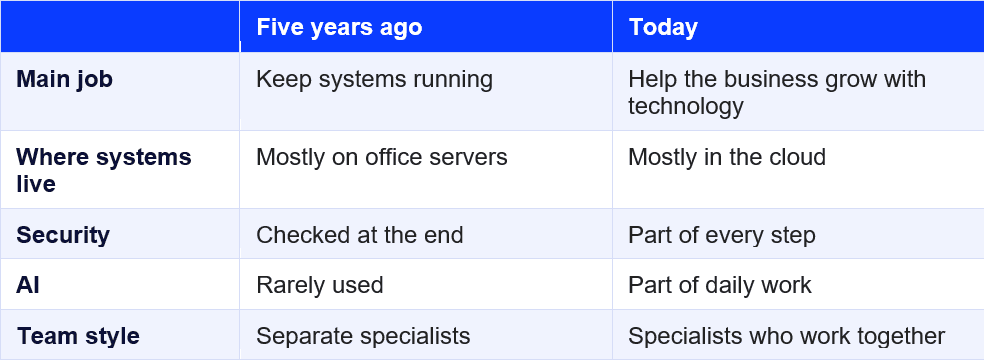
IT Is Not Just a Support Team Anymore
For a long time, IT was the team you called when something broke. The website was down. A laptop would not start. Someone forgot a password. A server needed attention.
Now technology sits much closer to the center of the business. Sales runs on software. Operations depend on cloud systems. Customer service uses digital tools all day. Managers make decisions from data. Even a simple process can rely on several systems working together.
When technology changes, the business changes with it. That is why IT teams now take part in business decisions, not only technical ones.
The Cloud Changed the Work
Cloud platforms let businesses run applications, store data, manage infrastructure, and grow their systems when needed. But moving to the cloud did not remove IT work. It changed it.
Teams now have to think about cloud design, security, monitoring, backups, access, speed, and cost. A modern team may spend less time looking after physical hardware and more time looking after cloud setups. That asks for different skills and a lot more teamwork.
AI Adds Another Layer
Then AI arrived. It is changing how software is built, how data is handled, and how teams work. Developers use AI tools to help write code. Support teams automate common requests. Businesses use AI to go through large amounts of information. Security teams use it to spot threats and weak points.
AI agents go one step further. Instead of only answering questions, they can connect to tools and systems and complete parts of a workflow.
That raises some fair questions. Who checks the result? What data can the AI see? What happens if it gets something wrong? How do we keep company information safe? And how does it fit with the systems we already use?
No single AI team can answer all of this alone. Developers, cloud engineers, security specialists, data teams, and business leaders often need to sit at the same table.
Security Cannot Wait Until the End
Security is now part of everyday IT work. A company can have a great website and still have a weak spot. It can use strong passwords and still get attacked. It can move to the cloud and still manage access badly. It can start using AI and accidentally expose private information.
The threats are changing too. Recent security research shows that attackers are starting to use AI and automated workflows to move faster, and AI systems themselves are becoming valuable targets.
So security cannot be a last check before launch. Developers need to write secure code. Cloud teams need to protect access and infrastructure. IT teams need to watch their systems. Businesses need to test for weaknesses. Security should be part of the whole process, from the first idea to long after launch.
Teams With Mixed Skills Work Better
Modern IT teams are also more connected. A developer may need to understand cloud deployment. A cloud engineer may need to know security basics. A security specialist may need to understand how applications work. An AI team needs to understand data and business processes.
Nobody has to know everything. That would be unrealistic. The goal is to remove the walls between technical areas so specialists can work together.
This is why communication matters just as much as technical skill. A team that talks well often beats a team of brilliant people who work alone.
Flexible Teams for a Fast Changing World
Technology needs can change quickly. A business might need extra developers for a new product. A company moving to the cloud might need expert help. A security team might need support with testing. Another business might want steady IT support without building a big team.
Because of this, more businesses are looking at flexible team models. They keep their own employees and bring in outside specialists when needed. This gives them the right skills without the cost of a large permanent team.
For a growing business, that flexibility can make a big difference.
A Team That Understands the Business
Maybe the biggest change is not technical at all. Modern IT teams need to understand the business they work for.
Developers should know what the software needs to achieve. A cloud team should know why the system has to scale. A security team should know which data matters most. An AI team should understand the problem before choosing a solution.
Technology should not exist just because it is new. It should solve a real problem. So besides asking, "What technology can we use?", teams should also ask, "What problem are we trying to solve?"
That small shift in thinking changes a lot.
What Comes Next?
There is no perfect IT team for every business. A small company may have a few people covering many areas. A larger one may have separate teams for cloud, security, software, data, and AI. Some keep most work inside the company. Others work with outside specialists or offshore technology teams.
The structure can be different, but the direction is clear. Modern IT teams need to be more flexible, more connected, more aware of security, and more comfortable with AI and cloud technology.
They also need to keep learning. Technology moves too fast for any team to rely only on the skills it had five years ago.
The Real Change
Technology has changed. Business has changed. So the way companies build their technology teams has to change too.
The modern IT team is not just developers, support staff, or system administrators. It is about bringing the right skills together to build better systems, run modern infrastructure, protect important data, and help the business move forward.
The best IT team today is not the one that only keeps technology running. It is the one that helps the business grow with technology.