
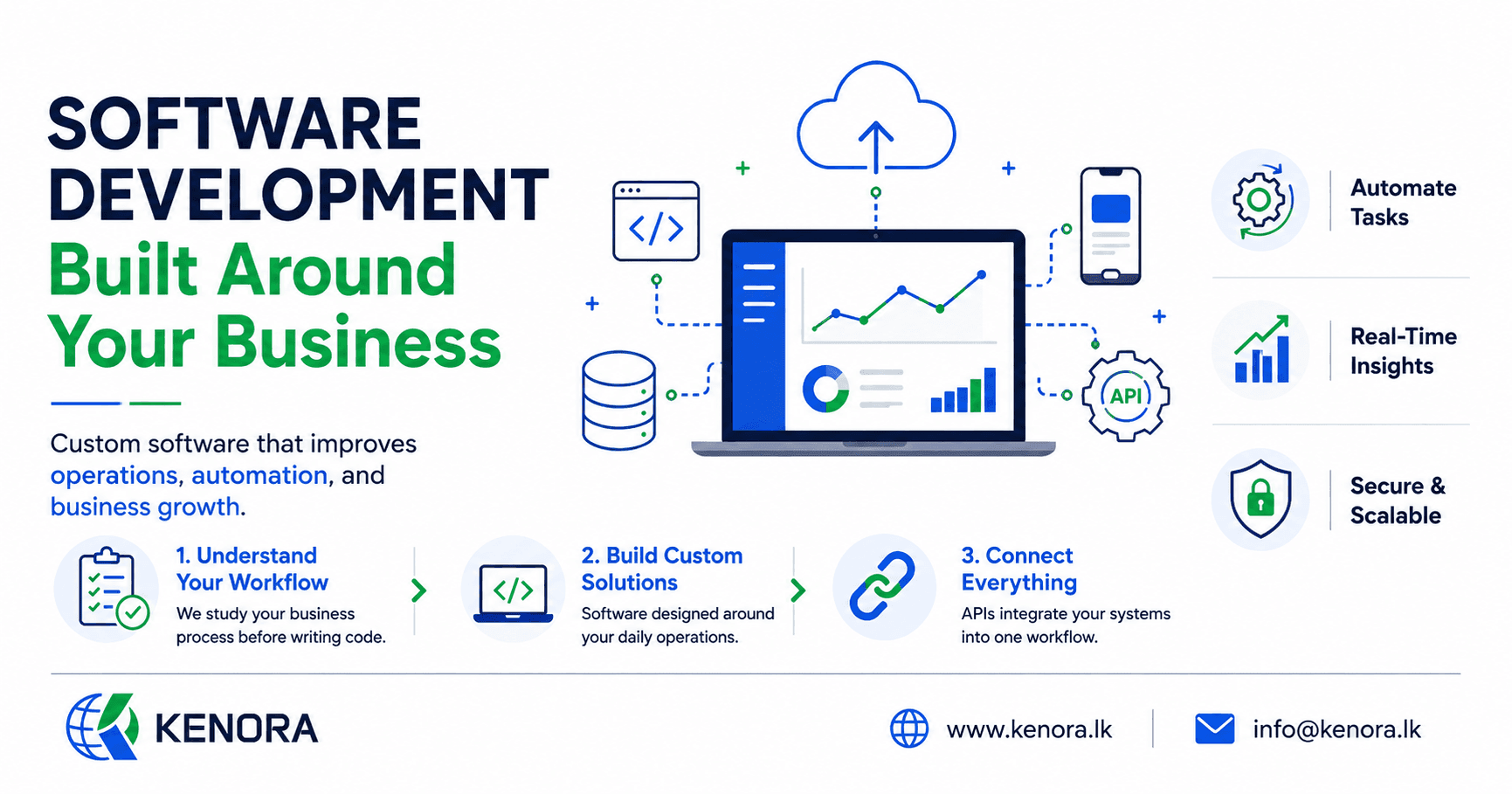
Every business runs on a process that makes it unique.
Some companies field hundreds of customer requests a day. Others coordinate supply chains across several locations. Healthcare providers manage sensitive patient records, manufacturers track products from raw material to delivery, and finance teams depend on accurate reporting to make decisions that matter. Yet many of these businesses are still trying to force their day-to-day work into software that was designed for everyone in general and no one in particular.
That approach can hold up for a while. Then it doesn't. As a company grows, spreadsheets multiply, departments drift apart, and employees end up spending more time working around their software than actually working with it.
This is the point where custom software starts to make a real difference.
The Difference Between Buying Software and Building Software
Off-the-shelf applications are built to solve common problems for the average business, packed with features meant to satisfy thousands of different customers at once. The catch is that no business is really average. A logistics company doesn't operate like a hospital. A retail business doesn't run like a manufacturing plant. Even two companies in the same industry often have completely different approval chains, reporting needs, and customer journeys.
Custom development flips the usual order of things. Instead of forcing a team to adapt to whatever a piece of software allows, it starts by understanding how the business already works, then builds the technology to support that, not replace it. The result is software that feels familiar from day one, because it was shaped around how people actually do their jobs.
- Design approach - off-the-shelf: built for the average customer; custom: built around your specific workflow
- Onboarding - off-the-shelf: your team adapts to the software; custom: the software adapts to your team
- Data flow - off-the-shelf: often siloed across separate tools; custom: connected across departments
- Reporting - off-the-shelf: manual, spreadsheet-based; custom: live dashboards, real-time data
- Growth - off-the-shelf: new needs mean new tools; custom: new features added as you scale
Every Click Should Have a Purpose
Most companies lose hundreds of working hours every month to tasks that shouldn't need a human at all: employees copying information from one system to another, sales teams updating the same customer record twice, finance staff stitching reports together from a handful of spreadsheets, operations managers digging through email threads to find a project update.
None of that creates value. It's just the cost of running on disconnected systems. Custom software removes that cost by pulling information into a single platform where data moves between departments on its own, freeing people up to solve problems and make decisions instead of re-entering data all day.
Building Around Operations Instead of Features
Good software projects don't start with a list of features. They start with questions: How does information actually move through the business? Where do things slow down? Which processes rely too heavily on manual work? What do decision-makers need to see that they can't get to easily today?
Once those questions have real answers, the software stops being just an app and becomes an operational tool that changes how the whole organization runs. Every screen, workflow, and automation earns its place by tying back to a specific business outcome, rather than being added because it seemed useful in general.
Web Applications That Grow With Your Business
Modern teams need to work from wherever they are, whether that's the office, home, or a client site, and web applications are what make that possible. Unlike traditional desktop software, a modern web platform gives people secure access from almost any device while keeping data centralized and maintenance simple.
It also makes it much easier to grow later. New features, new departments, and new user roles can be added without tearing out and replacing the whole system, which means a business can invest once in its software and keep evolving it for years.
Dashboards That Replace Guesswork
Plenty of leadership decisions are still made on reports that are already out of date by the time they land on someone's desk. A monthly spreadsheet can be describing a situation that's already changed by the time anyone reads it.
Custom dashboards solve that by pulling live operational data, sales performance, project progress, inventory levels, productivity, financials, and customer activity into one place. Instead of waiting on a report to be compiled, decision-makers can see what's actually happening right now. When information is current, decisions get faster and more accurate almost automatically.
APIs That Connect Everything
Very few businesses run on a single piece of software. Customer information tends to live in a CRM, accounting in its own finance tool, inventory somewhere else again, and e-commerce on its own separate platform. Without integration, employees end up being the connection between all of these, manually moving data from one system into the next.
APIs remove that manual bridge. They let systems talk to each other automatically, so information stays in sync across the business without anyone having to babysit it. A single customer order can update inventory, trigger an invoice, notify operations, and feed into a management report, all without a person touching any of it. Fewer manual steps means fewer mistakes and faster operations overall.
Customer Portals That Improve Service
Customers today expect to help themselves. Instead of emailing to ask where's my order, they'd rather just check. A well-built customer portal gives them secure, direct access to orders, invoices, project updates, support requests, appointments, and documents whenever they want them.
That doesn't just make customers happier. It also takes real pressure off internal support teams, since fewer people need to reach out just to get a status update. Everyone comes out ahead when there's more transparency built in from the start.
Security Should Never Be an Afterthought
Every piece of software touches valuable information, whether that's customer data, financial records, healthcare details, or intellectual property, and protecting it has to be part of the plan from day one, not something bolted on later.
Role-based access, encrypted communication, secure authentication, audit logs, regular updates, and compliance requirements should all be built in as the software is developed, not treated as optional extras. Software that's genuinely reliable isn't just functional. It's trustworthy.
Future-Proof Software Is Built to Evolve
Business requirements never sit still. Companies expand, product lines change, regulations shift, and customer expectations move with them. Software has to be able to grow alongside all of that instead of becoming outdated a couple of years after launch.
That means designing with flexible architecture, modular components, databases that can scale, and code that's maintainable enough to support new functionality without disrupting what's already running. Building for the future starts with the very first decisions made on day one, not as an afterthought once the system feels dated.
More Than Developers, A Technology Partner
Writing code is only one part of building software that actually works. The real value comes from understanding the business challenge behind it. The best projects come out of close collaboration between technical teams and business stakeholders, where every feature is tied to a measurable improvement in efficiency, productivity, customer experience, or profit.
Technology is at its best when it simplifies operations and takes complexity off people's plates instead of adding to it. Software built around real workflows, instead of generic assumptions, becomes something more than another app running in the background. It becomes the engine that helps a business move faster, serve customers better, and grow with confidence.
How Kenora Builds Software That Delivers Results
At Kenora, software development starts with understanding the business, not picking a programming language. We work closely with organizations to map out their operational processes, find where the bottlenecks are, and design solutions that improve efficiency across every department, whether that's a customer-facing web app, an internal operations portal, secure API integrations, real-time dashboards, or workflow automation.
The goal is simple: build software that's reliable, secure, and scalable enough that your team can do more without adding complexity. As the business grows, the software should grow with it, opening up new opportunities instead of getting in the way of them.
The best technology works quietly in the background, so your people can stay focused on what they do best.