
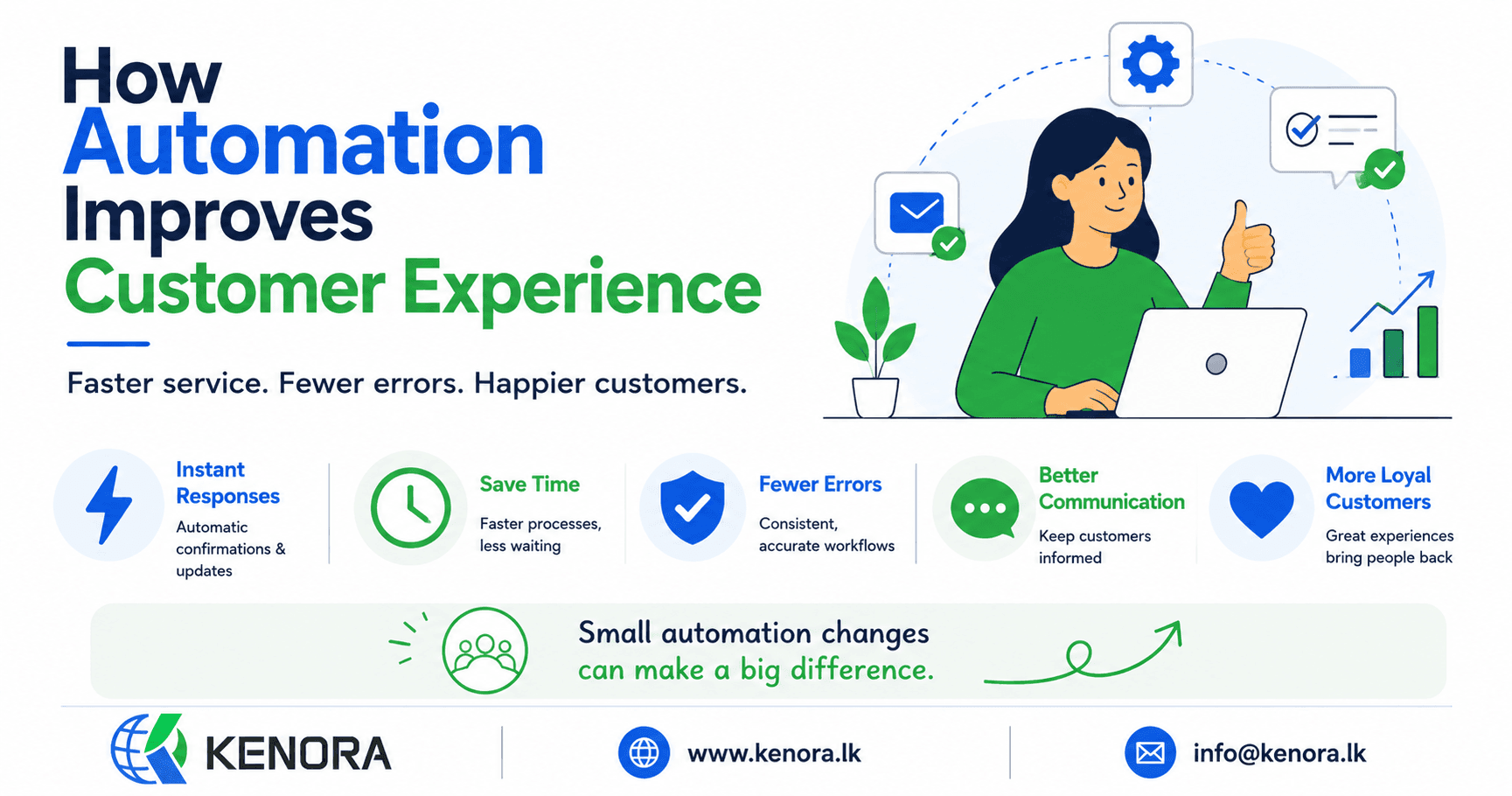
Customers don't see your processes. They feel the results.
Picture yourself ordering something online. Within seconds, a confirmation lands in your inbox. A few minutes later, another message lets you know your order is being prepared. The next day, a tracking link shows up. When the package finally arrives, a short follow-up asks whether everything met your expectations.
The whole thing feels effortless, and most customers never stop to think about what made it work. They just remember that it was quick, accurate, and never left them guessing.
Behind that kind of experience is something most businesses rarely talk about out loud: automation. Not the kind that replaces people, but the kind that clears away repetitive work so people can actually focus on serving customers well. That's the real point of automation. It isn't just about running a tighter operation. It's about making every interaction with your business feel easier.
Every Customer Values One Thing
Customers care about different things. Some are watching the price. Others care most about quality. Some want speed above everything else, while others just want to know they can rely on you. But almost everyone shares one expectation underneath all of that: they want things to be easy.
Nobody enjoys typing the same information into a form for the third time. Nobody wants to wait days just to get a simple confirmation. And nobody wants to explain the same problem to three different people in three different departments. Customers remember the businesses that respect their time, and automation is one of the clearest ways to show that respect.
Faster Responses Build Confidence
Think about what happens the moment someone submits a question through your website. Without automation, an employee has to notice the message, figure out who should handle it, send a confirmation, and pass it along to the right team. If that person is busy, which happens often, the whole thing can sit for hours, sometimes longer.
With automation in place, that changes immediately. The customer gets confirmation the second their message goes through. The request routes itself to the right team. Notifications go out instantly, and nothing slips through the cracks. The customer never has to sit there wondering if anyone actually saw what they sent. Confidence starts with communication, and automation is what makes that communication instant.
Small Delays Create Big Impressions
Businesses tend to focus their attention on the big projects and overlook the small delays that quietly shape how customers feel. Waiting on an invoice. Waiting for a delivery update. Waiting for someone to respond to a support ticket. Waiting for an appointment to be confirmed.
On their own, none of these delays seem like a big deal. But added together, they define a customer's entire impression of your business. Automation closes many of these gaps at once. Invoices can go out the moment they're needed. Reminders can land before an appointment instead of after it's too late. Shipping updates can appear in real time, without the customer having to ask. What you end up with isn't just a faster process. It's a smoother experience from start to finish.
Consistency Creates Trust
Imagine calling the same company twice. The first time, someone solves your problem in minutes. The second time, you're asked to explain the whole thing again from scratch. That kind of inconsistency sticks with people.
Customers don't actually expect perfection. What they expect is consistency. Automation helps standardize how things get handled: every inquiry follows the same basic workflow, every order gets confirmed, every customer receives an update, every request gets tracked somewhere visible. Service quality becomes more predictable simply because the important steps are never left to memory. Consistency builds confidence, and confidence is what eventually turns into trust.
Employees Can Focus on Customers
Automation gets misunderstood a lot. People assume it's there to replace human interaction, but in most businesses the opposite ends up being true. When employees spend less time entering data, copying details between systems, or handling repetitive admin work, they get more time back for the conversations that actually matter.
They can answer harder questions, work through complicated problems, offer recommendations that feel personal, and give customers real attention instead of rushing through a checklist. Technology handles the repetitive parts. People handle the relationships. Put those two together, and you get something far stronger than either one on its own.
Mistakes Become Less Common
Manual work naturally opens the door to small errors. An address gets typed in wrong. An invoice goes out with outdated numbers. A reminder never gets sent. A payment confirmation just never arrives. These slip-ups usually aren't about anyone being careless. They happen because the same task gets repeated hundreds of times, and eventually something gets missed.
Automation cuts down on that risk significantly. Information moves directly between systems instead of being retyped. Notifications fire off on their own. Routine tasks follow the same rules every time, without depending on someone remembering every step. Fewer mistakes, in the end, simply means happier customers.
Customers Appreciate Transparency
One of the biggest frustrations for customers is not knowing what's going on. Did my payment go through? When is my order actually going to show up? Did anyone even see the message I sent? Without updates, customers end up contacting support just to ask questions that should already have answers.
Automation solves that by keeping people informed at every stage: order confirmed, payment received, shipment on its way, appointment scheduled, issue resolved. Instead of guessing, customers stay in the loop the whole way through, and that transparency is a big part of what builds their confidence in you.
Better Experiences Create Loyalty
Winning a customer matters, but keeping one matters even more. People tend to come back to businesses that make their lives simpler: fast replies, dependable service, accurate information, and processes that don't require extra effort on their part.
Automation doesn't take the place of great customer service. It reinforces it. Every smooth interaction becomes one more reason a customer chooses you again the next time around.
Automation Supports Every Department
Customer experience isn't shaped by a single team. It's influenced by sales, marketing, finance, operations, and support all at once, each playing a part in the overall journey. When those departments are connected through shared systems and automated workflows, customers can actually feel the difference.
They get consistent information no matter who they talk to. Processes move faster. Problems get resolved without being passed around. Automation improves how departments work together behind the scenes, and customers end up experiencing the payoff out front.
- Order confirmation - manual: sent whenever staff get to it; automated: sent within seconds
- Support requests - manual: logged and routed by hand; automated: assigned automatically
- Shipping updates -manual: customer has to ask; automated: shared in real time
- Invoices - manual: created one at a time; automated: generated instantly
- Follow-up - manual: easy to forget; automated: triggered automatically
Start Small and Grow
A lot of businesses assume automation means a complete overhaul of how they operate. It doesn't. Some of the most meaningful improvements start with small, simple changes: sending welcome emails automatically, generating invoices instantly, scheduling appointment reminders, updating inventory in real time, or routing inquiries to the right team without anyone having to sort through an inbox.
Each small change saves a bit of time on its own. Put them together, and they add up to a noticeably better experience for the customer. Automation doesn't have to happen all at once. It just needs to keep moving in the right direction.
Final Thoughts
Customers will probably never know which software your business runs on. They won't ask about your workflows or notice which systems talk to each other behind the scenes. What they will notice is how your business makes them feel: Was it easy to work with you? Did you communicate clearly? Did you respond quickly? Did things happen when you said they would?
Automation helps answer all of those questions with confidence, not by replacing the people on your team, but by giving them better tools to do their best work. The businesses that stand out aren't always the ones spending the most on marketing. They're the ones creating experiences customers actually remember for the right reasons. In the end, automation was never really about the technology itself. It's about making every interaction with your customers a little simpler, a little faster, and a little better.