
Picture this: it's 11 PM. Your dev team just pushed a release. Everyone's holding their breath, watching metrics, praying nothing explodes before morning. Servers need babysitting. A single config change can knock out a service that thousands of customers depend on. The post-mortem emails practically write themselves.
Sound familiar? For a lot of companies, that's not a horror story - it's a Tuesday.
Cloud computing and DevOps didn't get popular because they're trendy. They got popular because they solve a very real, very expensive problem that most businesses are still quietly suffering through.
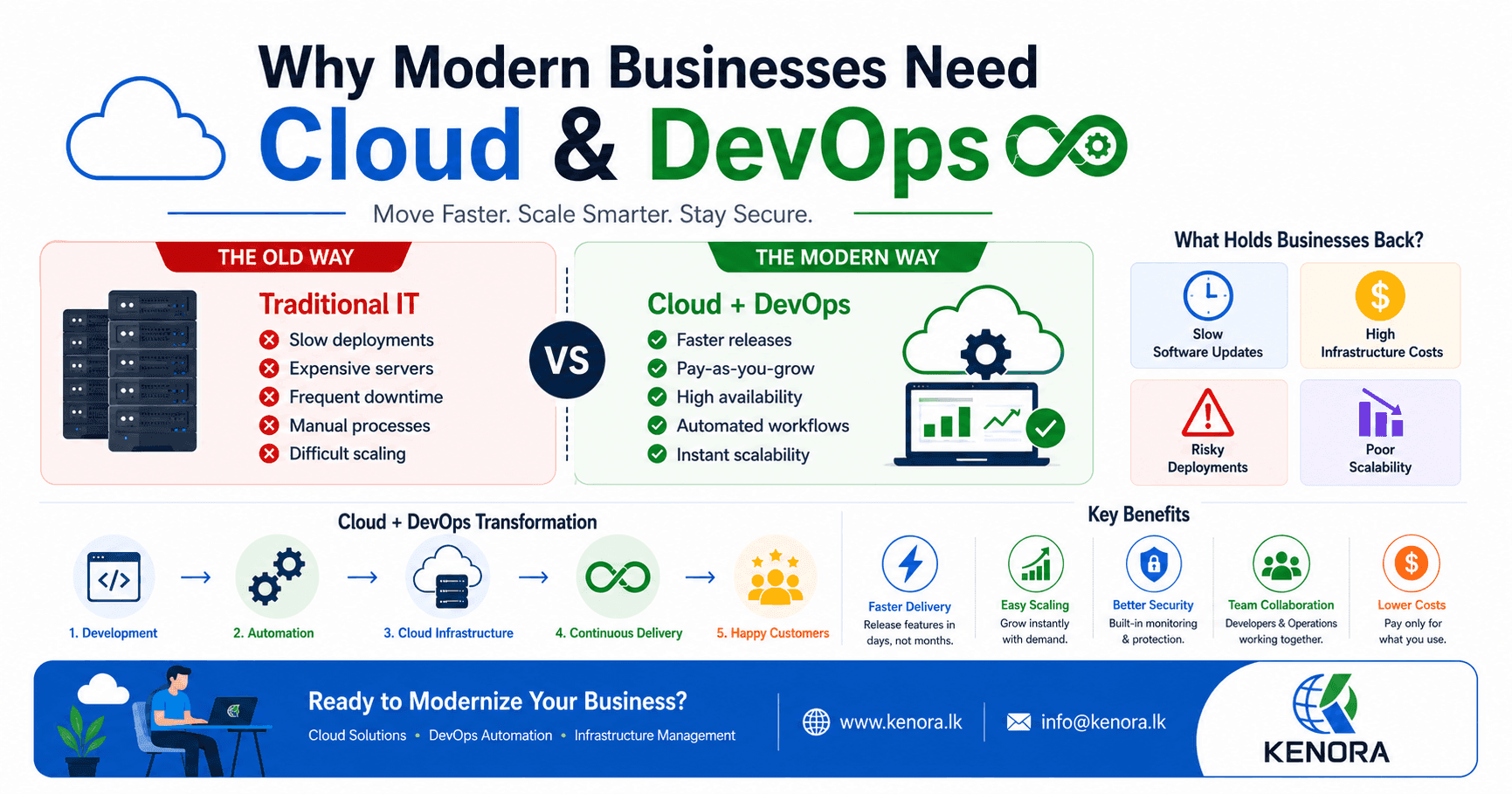
The Problem with Traditional IT
Let's be honest about what legacy IT actually feels like from the inside.
You want to launch a new feature. Someone has to submit a ticket. Then another team reviews it. Provisioning a server takes two weeks. Testing happens at the end, when it's most expensive to fix anything. Deployments are big, scary events that nobody looks forward to.
The cost of that slowness adds up fast:
- Infrastructure that needs constant, expensive babysitting
- Deployment cycles so long they're measured in months, not days
- Downtime that hits revenue, reputation, and team morale all at once
- Zero flexibility when the market shifts and you need to pivot fast
Customer expectations didn't slow down while IT was figuring things out. They accelerated. Businesses that couldn't keep up didn't just fall behind - some of them disappeared.
Enter the Cloud
Cloud computing didn't just change where software runs. It changed how businesses think about infrastructure entirely.
The best analogy is electricity. Nobody builds their own power plant anymore. You flip a switch, electricity comes out, and you pay for what you use. The cloud does the same thing for computing power, storage, and global reach.
What that actually means in practice:
- Scale up instantly when traffic spikes - no hardware purchase required
- Deploy globally in minutes, not months
- Pay for what you use, not what you might someday need
- Built-in redundancy means one failed server doesn't end your night
- Disaster recovery that used to cost millions now costs almost nothing
A startup can now access the same infrastructure as a Fortune 500 company. That's not just a technical shift - it's a competitive landscape shift.
But here's the thing that catches a lot of businesses off guard:
We moved everything to the cloud and... nothing really changed.
The cloud gives you the capability. It doesn't give you the discipline to use it well. That's where most cloud migrations quietly fail - not in the technology, but in the workflow that surrounds it.
DevOps: Breaking Down the Walls
DevOps is one of those terms that sounds like marketing until you see it working.
At its core, DevOps is about collapsing the wall between the people who write software (developers) and the people who run it (operations). When those two groups work in separate silos, you get software that gets written fast, then deployed slowly, then monitored by people who didn't build it and don't fully understand it.
DevOps breaks that pattern. Shared ownership. Shared responsibility. Automated pipelines that carry code from a developer's laptop to production without a dozen manual handoffs along the way.
The business impact is real and measurable:
- Release cycles shrink from months to days or even hours
- Deployment failures drop because automation catches what humans miss
- When something does go wrong, the team that broke it is already fixing it
- Better collaboration means less organizational friction, faster decisions
- Customers get improvements continuously, not in big lumpy releases
Speed matters. But in a DevOps culture, speed doesn't come at the cost of stability - it comes from building stability into the process itself.
The Power of Cloud + DevOps Together
Cloud and DevOps individually solve real problems. Together, they become something different: a genuine competitive advantage that compounds over time.
- Weeks of preparation becomes automated testing and deployment
- Manual, error-prone deployments become scalable infrastructure on demand
- High risk of breaking things becomes faster recovery when issues happen
- Long, painful rollback becomes one-click rollback in minutes
- Siloed teams and blame culture become shared goals and shared ownership
The gap in that comparison isn't just about speed. It's about risk, resilience, and the confidence to move decisively when an opportunity opens up. Businesses with Cloud + DevOps can experiment, iterate, and recover from mistakes faster than their competitors can finish a requirements document.
What This Means for Your Business
Customers in 2025 don't grade on a curve. They expect your app to work at 2 AM on a Sunday. They expect you to fix bugs before they have to report them. They expect security that doesn't require them to think about security.
That's a high bar. And it's only getting higher.
Organizations that get Cloud + DevOps right gain something more valuable than speed:
- The ability to respond to market shifts in days instead of quarters
- Engineering teams that ship with confidence instead of dread
- Infrastructure costs that scale with revenue, not in spite of it
- Security built into every step, not bolted on at the end
- More time solving real problems, less time fighting your own tools
That last point is worth sitting with. Every hour an engineer spends on manual deployments, infrastructure fires, or it works on my machine debugging is an hour not spent building something customers will actually love.
The Future Belongs to Agile Businesses
Technology has always shaped how businesses operate. But something shifted. It's not just supporting operations anymore - for most industries, technology is the product, the distribution channel, and the competitive moat all at once.
Cloud provides the foundation. DevOps provides the engine. Together, they let organizations move at the speed that modern markets demand - not in spite of safety and quality, but because of it.
The question for most businesses has quietly shifted. It's no longer should we adopt Cloud and DevOps? - that debate is over. The question now is: how long can we afford to wait?
Every month spent on legacy infrastructure is a month of compounding technical debt, slower releases, and a widening gap between you and competitors who already made the move.
The good news: the path forward is well-traveled. The tools, the practices, the people who know how to make this work - they're all available.
The only variable is when you decide to start.