
Here's a moment almost every growing company eventually hits: sales are climbing, customer requests keep piling up, and somewhere between preparing reports, answering emails, and chasing down admin work, the team quietly runs out of hours in the day.
It's rarely a lack of ambition that slows a business down. It's that the people you hired to build the business end up spending most of their time keeping it running instead.
This is exactly the gap that Business Process Outsourcing, or BPO, was built to close. And the way companies use it has changed a lot in the last few years.
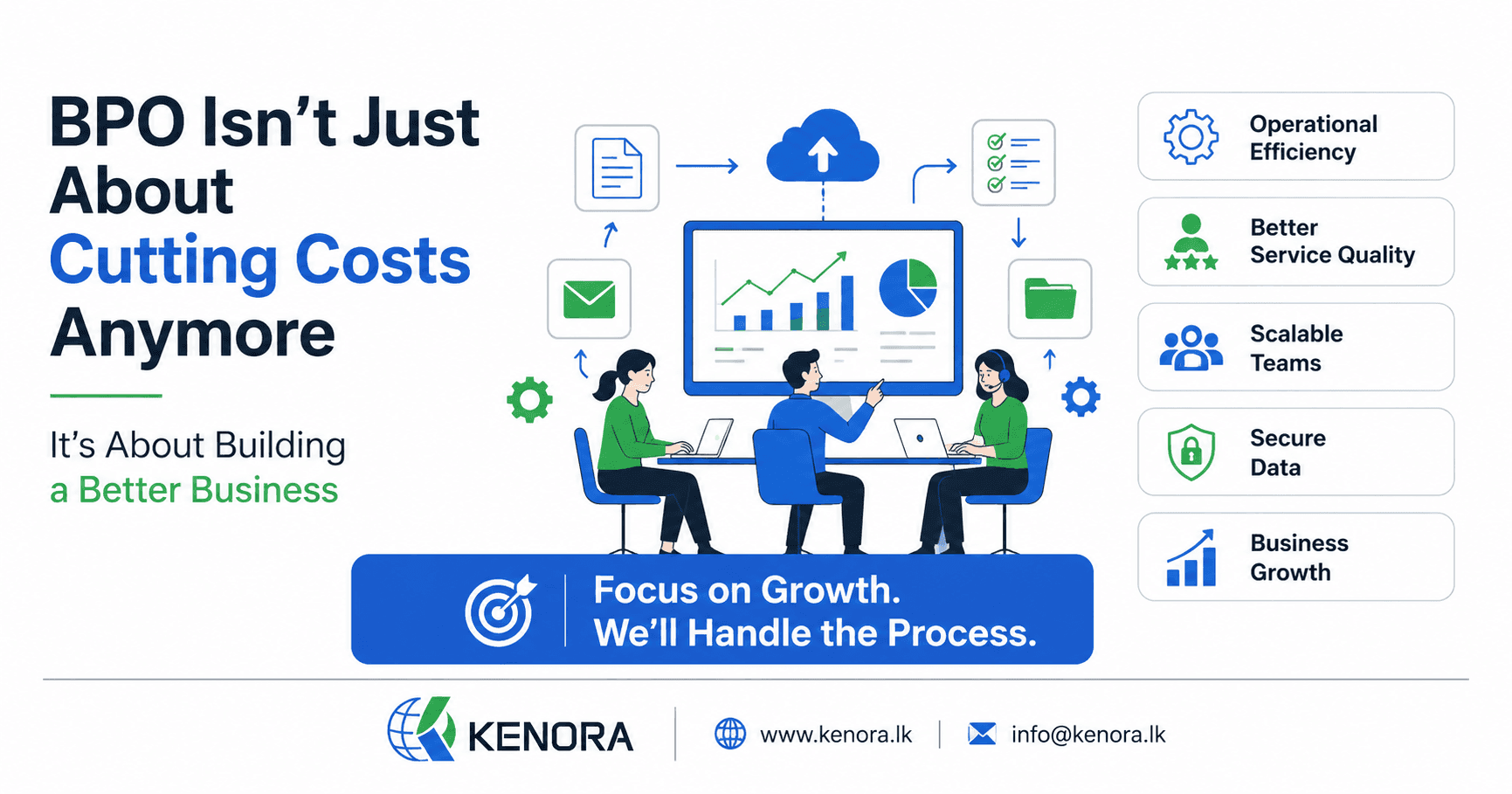
Modern BPO isn't really about trimming a budget line anymore. Done well, it's about operational efficiency, better service quality, room to scale, and giving your best people back the time to focus on what actually grows the business.
At Kenora, we think of BPO as an extension of your own team, not a replacement for it. The point isn't to hand off responsibility. It's to make sure the essential, everyday processes run smoothly in the background so your people can focus on the work only they can do.
The Hidden Cost of Doing It All In-House
Plenty of businesses assume that keeping every process in-house gives them more control. In practice, it usually just adds more complexity than anyone signed up for.
Admin workloads grow faster than teams can absorb them. Managers end up buried in spreadsheets instead of planning the next quarter. Developers field support tickets instead of shipping product. Healthcare staff fill out paperwork instead of spending time with patients. Finance teams reconcile records by hand instead of actually analyzing how the business is performing.
None of these are one-off problems. They're small, everyday bottlenecks, and they add up. Businesses rarely slow down because of one big failure. They slow down because dozens of small inefficiencies quietly pile up over months and years.
What Modern BPO Actually Covers
Outsourcing has a bit of an outdated reputation. Most people still picture simple data entry, but that's not really what's on offer anymore.
Companies today outsource entire operational functions and still keep full visibility, quality control, and security. Here's a quick look at where BPO teams tend to add the most value:
- Customer Experience - customer support, email and chat support, CRM maintenance
- Back-Office and Data - data processing, validation, document management, reporting
- Finance and Healthcare - finance and accounting support, revenue cycle, healthcare admin
- Operations - order processing, supply chain management, quality assurance, digital workflows
Instead of hiring and training a new specialist for every function, businesses get a team that's already experienced in exactly that process. The result tends to be the same: work gets done faster, and the quality stays consistent.
Why Businesses Choose a Strategic Partner
Business moves fast, and most companies can't afford to hire a full-time employee for every operational need that pops up. A good BPO partner gives you scalability without the weeks of recruiting, onboarding, training, and infrastructure setup that hiring usually requires.
When workload spikes, you scale the operation up. When things quiet down, you're not stuck paying for capacity you no longer need. That kind of flexibility lets a company respond to the market in real time, without quality slipping.
Data Processing Needs More Than Speed
Data is one of the most valuable things a business owns, but only if it's accurate and organized enough to actually use. Messy data leads to reporting errors, frustrated customers, operational delays, and decisions made on bad information.
Real data processing goes well beyond typing information into a spreadsheet. It covers validation, standardization, verification, cleansing, formatting, indexing, and categorization, with quality control running through all of it. Get that right, and accurate data becomes the foundation everything else is built on.
Healthcare BPO and Better Patient Care
When administrative processes improve, patient experiences improve right along with them.
Healthcare organizations are drowning in administrative work: patient registration, insurance verification, medical documentation, billing, claims, compliance. All of it takes real time away from patient care.
Healthcare BPO exists to take that weight off clinical staff so they can focus on patients, while dedicated specialists keep the paperwork moving accurately and on time.
Why Revenue Cycle Management Matters
For any healthcare organization, the revenue cycle is where financial stability is won or lost. A small mistake in documentation can turn into a delayed reimbursement or a rejected claim, and those add up fast.
A well-run revenue cycle keeps every stage tight, from the first patient registration all the way to final payment. Better documentation, faster processing, and ongoing monitoring all add up to healthier finances, without patients noticing any of the friction.
Supply Chains Run on Accurate Information
Supply chains run on precision: purchase orders, inventory records, vendor communication, shipment tracking, and documentation, all of it needs to be accurate and up to date. Even a small delay can throw off production schedules, delivery timelines, and financial planning.
BPO teams working in supply chain support help keep that information accurate while taking the manual workload off procurement and logistics staff.
Technology Has Changed How BPO Works
The old image of outsourcing, a big room full of people manually processing paperwork, doesn't really describe modern BPO anymore. Today's operations pair skilled professionals with genuinely useful technology: automation handles the repetitive parts, AI assists with classification and validation, digital workflows cut out unnecessary delays, cloud platforms enable real-time collaboration, and dashboards give everyone visibility into how things are running.
People are still the ones making the judgment calls. Technology just lets them do it faster, more accurately, and more consistently.
Security Cannot Be an Afterthought
Outsourcing usually means sharing sensitive information: customer records, financial documents, medical data, employee details, business intelligence. None of that works unless security is treated as a core part of the process, not an add-on.
Strong access controls, encryption, secure infrastructure, compliance frameworks, staff training, and ongoing monitoring all need to work together. Efficiency should never come at the cost of security. The two have to move in lockstep.
Choosing the Right BPO Partner
Not every outsourcing provider brings the same value to the table. The right partner actually understands your goals, communicates clearly, adapts as your needs change, and keeps improving how they operate. A few things worth checking for:
Real industry expertise, strong quality assurance, operations that can scale with you, clear and honest communication, reliable reporting, full process transparency, a security-first mindset, technology-driven workflows, and a genuine habit of continuous improvement.
Most of all, the right partner should feel like part of your team, not an outside vendor you check in on once a quarter. That's the kind of relationship that actually lasts.
The Kenora Approach
At Kenora, we build BPO around outcomes, not just tasks. That means combining experienced people, structured workflows, modern technology, and genuinely rigorous quality standards to deliver operational support you can count on, across industries.
Whether it's back-office administration, healthcare process management, data processing, revenue cycle management, or supply chain support, everything we do comes back to one goal: helping your organization run more efficiently, so your internal team can focus on innovation, customer relationships, and long-term growth.
Every workflow is built for your business specifically. Every process gets measured. Every improvement is intentional, not an afterthought.
Looking Ahead
As more of business becomes digital, operational excellence is turning into one of the biggest competitive advantages a company can have. The businesses that streamline their internal processes are the ones that respond to customers faster, make sharper decisions, keep costs under control, and scale with confidence.
BPO isn't just a support function anymore. It's become a real strategic capability, and the companies embracing it aren't giving up control. They're gaining the freedom to focus on what actually matters.
Sustainable growth was never about asking your team to do everything themselves. It comes from building the systems, partnerships, and processes that let everyone do their best work. That's the future of Business Process Outsourcing, and it's the standard Kenora shows up for every day.