
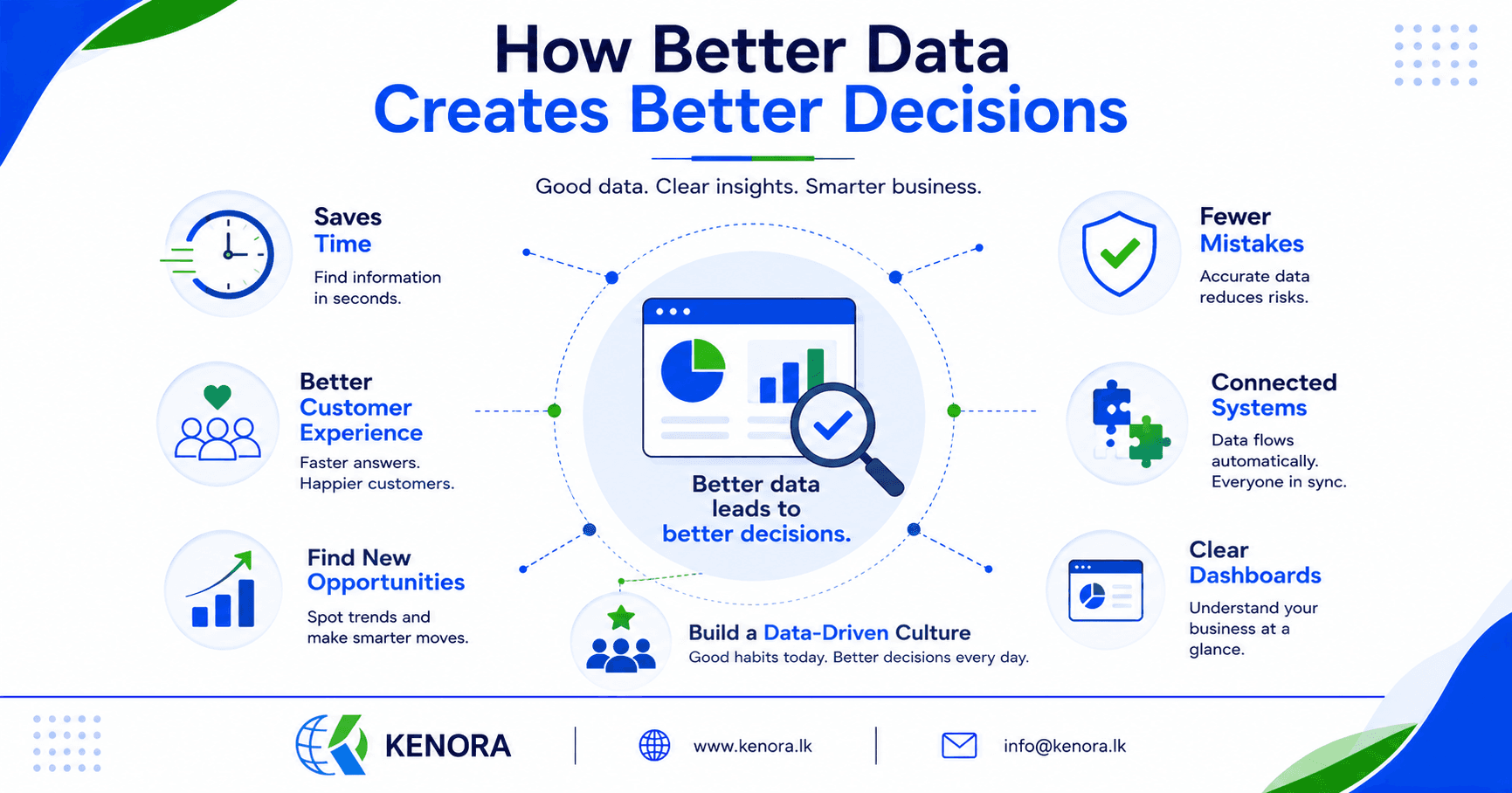
How Better Data Creates Better Decisions
Every business wants to make the right call. Whether you're hiring new people, buying equipment, launching a marketing campaign, or releasing a new product, every decision matters. Some choices help a business grow. Others cost time and money when they are based on the wrong information.
So how do you know you are making the right choice? The answer is better data.
Most businesses already have plenty of data. They collect sales reports, customer details, invoices, website visits, support tickets, and more. The real problem is not a lack of information. It is that this information is often scattered across different systems, buried in spreadsheets, or out of date by the time anyone looks at it.
When data is hard to find or hard to trust, good decisions become much harder to make.
More Data Does Not Always Mean Better Descisions
Some business owners think they need more reports. Others think they need more software. In reality, they usually need neither.
Picture opening five different spreadsheets just to understand last month's sales. One file shows one number, another shows something different, and nobody is quite sure which one is right.
Now picture opening a single dashboard that shows the latest numbers in seconds.
The difference is not the amount of data. It is having data that is accurate, organized, and easy to understand.
A Small Problem That Becomes a Big One
Here is a simple example. A growing company takes orders through its website. Customer details live in one system. Payments are recorded in another. Inventory gets updated in a spreadsheet, while the support team keeps notes somewhere else entirely.
At first, everything works fine. But as the business grows, employees spend more time hunting for information than actually using it.
A customer calls about an order. Support checks one system. Finance checks another. The warehouse checks a spreadsheet. By the time anyone has an answer, the customer has waited far longer than they should have.
This happens every day in businesses of all sizes, not because employees are doing a bad job, but because the information is not connected.
Better Data Saves Valuable Time
Think about how many hours your team spends every week just looking for information: searching emails, opening spreadsheets, comparing reports, fixing mistakes, and calling another department to confirm a number.
These tasks seem small on their own, but together they eat up a surprising amount of time.
Now imagine all of that information sitting in one place. A two hour report becomes a five minute one. Checking three systems becomes checking one dashboard. Instead of asking questions, your team already has the answers.
Those saved hours can go toward helping customers, improving services, or growing the business.
Better Data Builds Better Customer Relationships
Customers expect fast, accurate service. They do not want to explain the same problem twice.
When your team has complete, up to date customer information, conversations get easier. They can see past orders, support history, payments, and recent activity in one glance.
The customer feels understood. The employee feels confident. Problems get solved faster.
A better customer experience usually starts with better information.
Better Data Helps You See Opportunities
Every business has opportunities hiding inside its data. Maybe one product sells far better than expected. Maybe most new customers come from a single marketing channel. Maybe a certain service is growing in popularity month after month.
Without clear data, these patterns are easy to miss. Once your information is organized, trends become much easier to spot, and you can make decisions based on facts instead of guesswork.
Better Data Reduces Expensive Mistake
Mistakes usually happen when people work with the wrong information. Maybe inventory numbers are outdated. Maybe a sales report is missing key details. Maybe two departments are working from different versions of the same spreadsheet.
Small errors like these can get expensive fast. Products get ordered unnecessarily. Projects go over budget. Important customers receive the wrong information.
Accurate data lowers these risks and gives everyone more confidence in the decisions they make.
Why Connected Systems Metter
Many businesses run different software for different jobs: one system for customers, another for accounting, another for projects, another for inventory. Each one works fine on its own.
The trouble starts when they cannot share information. Employees end up copying data from one place to another, which creates duplicate records, typos, and outdated numbers.
Connecting these systems changes everything. Instead of moving information by hand, data flows automatically between applications. Everyone works from the same numbers and stays on the same page.
Dashboards Turn Numbers Into Clear Answers
Dashboards Turn Numbers Into Clear Answers
Most business owners do not enjoy digging through long spreadsheets. They just want answers: How are sales performing? Which projects are on schedule? Which customers need attention? Where are costs going up?
A good dashboard answers these questions in seconds. Charts and reports turn complicated numbers into something simple, so managers spend less time preparing reports and more time making decisions. That is the real value of a good dashboard.
Build Good Habits Around Data
Technology is only part of the answer. People and processes matter just as much.
Encourage your team to update information regularly, remove duplicate records, and follow the same process across departments. Review reports often instead of waiting for problems to show up.
Small habits like these keep your data clean and reliable, and over time they build a culture where decisions are based on facts instead of assumptions.
Every Small Improvement Counts
Many businesses think they need a full digital overhaul before they will see any results. That is not true.
Start small. Connect two systems. Build one dashboard. Automate one manual report. Clean up one customer database.
Each small improvement saves time, cuts down on mistakes, and makes the next improvement easier. Step by step, your business becomes faster, smarter, and more organized.
How Kenora Helps Business Work Smarter
At Kenora, we believe technology should make work easier, not more complicated. We help businesses connect their systems, organize their data, build custom dashboards, automate everyday tasks, and develop software that actually fits how they work.
Our solutions give business owners a clear view of their operations, so they can make faster decisions with confidence. Instead of spending time hunting for information, your team can focus on serving customers, improving performance, and finding new opportunities.
Final Thoughts
Every successful business collects data. The ones that grow the fastest are the ones that know how to use it.
Good data helps you understand your customers, improve your operations, reduce mistakes, and plan for the future with confidence.
You do not need hundreds of reports. You do not need more spreadsheets. You need information that is clear, accurate, and available when you need it.
Better data leads to better decisions. Better decisions lead to stronger businesses. And stronger businesses are built one smart decision at a time.