
AI Is Moving From Chatbots to Real Business Workflows
For a while, business AI was mostly about asking questions.
Write an email. Summarize a report. Find some information. Create an idea.
AI helped people work a little faster.
But now something bigger is happening. AI is moving from just answering questions to actually doing the work.
This is where AI agents come in.
From Chatbots to Action
A chatbot usually waits for you to ask something. You ask a question, it gives you an answer, and you decide what happens next.
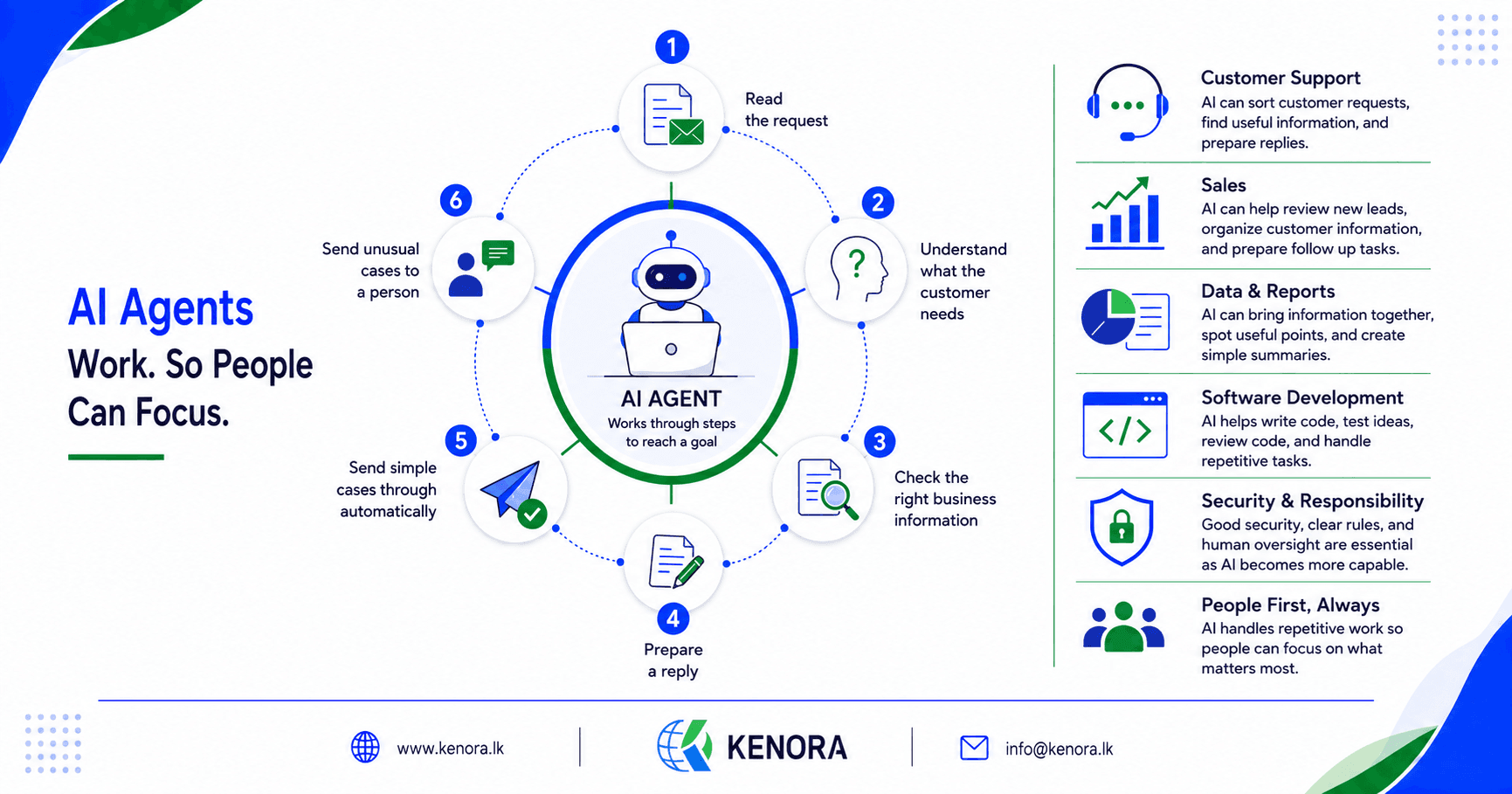
An AI agent works differently. You give it a goal, and it works through several steps to reach that goal.
For example, imagine a company gets hundreds of customer requests every week. Instead of an employee reading each one by hand, an AI agent could:
- 1Read the request
- 2Understand what the customer needs
- 3Check the right business information
- 4Prepare a reply
- 5Send simple cases through automatically
- 6end unusual cases to a person
The key point is that the AI is not just answering a question. It is helping move the whole process forward.
Why Businesses Care About This
Most businesses handle hundreds of small tasks every day.
Someone checks emails. Someone moves data between systems. Someone prepares reports. Someone updates customer records. Someone sorts requests.
None of these tasks are hard on their own. But they take time. When the same task happens hundreds or thousands of times, that time adds up fast.
This is where AI powered workflows help. Instead of asking employees to spend their day on repetitive work, businesses can let AI handle the basic steps. Employees can then spend more time on work that needs human judgment.
AI Agents Can Help in Many Areas
Customer Support
AI can sort customer requests, find useful information, and prepare replies. Simple questions move faster, while complex cases go to the support team.
Sales
AI can help review new leads, organize customer information, and prepare follow up tasks. This gives sales teams more time to focus on customers instead of updating systems.
Data and Reports
Businesses often collect information from many different systems. AI can help bring that information together, spot useful points, and create simple summaries.
Software Development
AI is also becoming part of the software development process. Developers can use AI to help write code, test ideas, review code, and handle repetitive tasks. The developer still makes the important decisions. AI simply helps speed up the work.
But There Is a Catch
Giving AI more control also means more responsibility.
If an AI system can access company data or business systems, businesses need to think about security.
What can the AI access? What actions can it take? Who checks its work? What happens when it makes a mistake?
These questions cannot be ignored. The more capable AI becomes, the more important good security and clear rules become.
Recent developments in AI already show why this matters. More capable agents can interact with systems and carry out real tasks, but experts are also paying closer attention to security, access, and human oversight.
Don't Try to Automate Everything
One mistake businesses make is trying to use AI everywhere at once. That is not necessary.
Start with one problem.
Maybe your team spends too much time sorting customer requests. Maybe employees prepare the same report by hand every week. Maybe information has to be copied between several systems.
Find one process that takes too much time. Then ask: can AI safely handle part of this work?
If the answer is yes, start small. Test it. Measure the results. Improve the workflow. Then expand.
This approach is also a common recommendation for businesses moving toward agentic AI: focus on clear business problems first, instead of trying to add AI everywhere at once.
AI Won't Replace Every Person
There is always one question when people talk about AI: "Will AI replace humans?"
I think there is a better question: "What could people do if AI handled more of the repetitive work?"
A support employee could spend more time helping customers. A developer could spend more time solving hard problems. A manager could spend less time preparing reports and more time making decisions.
The goal should not be to remove people from every process. The goal should be to give people better tools.
The Real Change Is the Workflow
The biggest change may not be the AI model itself. It is how businesses use it.
AI can connect with software. It can work with business data. It can interact with other tools. It can support cloud systems.
It can become part of a workflow, instead of being a separate tool that employees open only when they need help.
That means businesses need to think about more than just AI. They also need good software, clean data, reliable cloud systems, and strong security.
Where Should Your Business Start?
You don't need a huge AI project.
Start with a simple question: what repetitive task is taking my team too much time?
Find that task. Understand the process. Look at where AI can help. Keep people involved where decisions matter. And make security part of the plan from the beginning.
AI is moving beyond the chatbot. The next stage is about AI working inside the business, not just talking to the business.
And for companies that use it the right way, that could mean less repetitive work, faster processes, and more time for people to focus on what really matters.