
.png&w=3840&q=75)
5 Cybersecurity Mistakes Businesses Should Avoid
Your business can have good software, a strong website, and a modern cloud setup. But one small security mistake can still cause a big problem.
It usually does not start with something complicated. Someone clicks a fake email. An old employee account is still active. A software update gets ignored. A password gets reused. A backup exists, but no one has tested it.
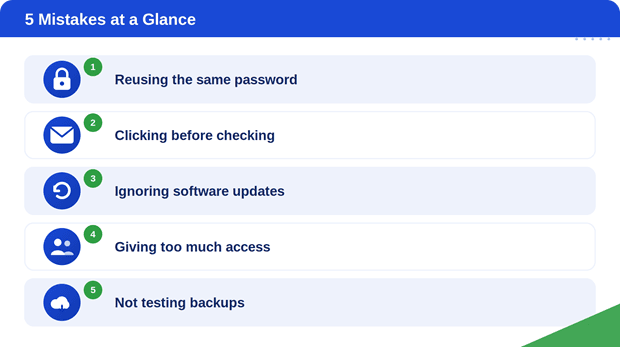
Most security problems come from everyday habits, not clever hackers. Here are five common mistakes businesses should watch for, and what to do instead.
Using the Same Password Everywhere
We all know someone who does this. One password for email. The same password for a work account. The same password again for another website.
It feels easy, but it is risky. If one account gets exposed, attackers will try that same password on your other accounts too.
A better approach:
- Use a different password for every important account.
- Turn on multi factor authentication (MFA) wherever you can.
MFA adds a second step to the login process, so a stolen password alone is not enough to get in. CISA recommends MFA for business systems whenever it is available.
It is a small change, but it makes a real difference.
Clicking First and Checking Later
Imagine an employee gets an email like this:
"Your company payment account needs verification. Click here now."
The logo looks real. The message sounds urgent. It is tempting to click right away, and that is exactly what the sender is hoping for.
Phishing emails work by creating urgency, pushing people to act before they stop and think.
Before you click a strange link or open an unexpected file:
- Check who the email is really from.
- Hover over the link before clicking it.
- Ask yourself if you were expecting this message.
- If it involves money or passwords, confirm it a different way, such as a phone call.
One minute of checking can save you days of cleanup.
Ignoring Software Updates
"Remind me tomorrow." We have all clicked that button. Then tomorrow turns into next week, and the update gets forgotten completely.
Software updates are not just about new features. Many of them fix security holes that attackers already know how to use. Old software gives attackers an easy way in.
Keep an eye on updates for:
- Operating systems
- Business applications
- Websites and plugins
- Cloud systems
- Network devices
- Mobile devices
Keeping software up to date is one of the simplest habits a business can build. CISA lists regular updates as one of the most effective ways to close known security gaps.
Giving People More Access That They Need
Here is a simple question: does every employee really need access to everything? Usually, the answer is no.
A customer support employee needs customer information. They probably do not need access to financial systems or server settings.
When people have more access than their job requires, one stolen account can cause a much bigger problem than it should.
What to do instead:
- Give employees only the access their role actually needs.
- Remove access as soon as it is no longer needed.
- Review accounts regularly, especially after someone changes roles or leaves.
This is called the principle of least privilege, and CISA recommends reviewing accounts regularly to remove access that is no longer needed.
Thinking Backups Are Only an IT Problem
Picture this: you come in on Monday and none of your files will open. Customer records, invoices, project files, all locked. Now imagine there is no working backup.
That is the moment a security problem turns into a business problem.
Good backups give your business a way to recover when something goes wrong. But there is one step many companies skip: testing the backup.
A backup you have never tested is not something you can fully trust. You need to know what data is backed up, where it is stored, and how fast it can be restored.
CISA recommends keeping backup copies separate from your main network and testing them on a regular schedule.
Cybersecurity Is Not Just an IT Job
This is one of the most important things for a business to understand: cybersecurity is not only an IT job.
Your IT team can install security tools, watch systems, and manage access. But they cannot catch every mistake made by every person, every day.
- A finance employee who double checks an unusual payment request can stop fraud.
- A manager who reports a strange email can help prevent an attack.
- An employee who turns on MFA makes their account harder to break into.
- A team member who flags a strange system change helps IT react faster.
Security gets stronger when everyone plays a part, not just the IT department.
Start With the Basics
You do not need to fix everything in one day. Start by asking your team five simple questions:
- Are our important accounts protected with MFA?
- Are our systems and software up to date?
- Do employees know how to spot a suspicious email?
- Does everyone have only the access they actually need?
- Can we actually restore our backups if we need to?
If you are not sure about the answer to any of these, that is exactly where to start.
The Real Goal of Cybersecurity
No business can promise it will never face a cyberattack, and that is not really the goal.
The real goal is to make attacks harder, keep the damage small when something does go wrong, and recover as quickly as possible.
Good cybersecurity is built from small decisions, made again and again: a stronger password, a second login step, an update installed on time, an old account removed, a backup that has actually been tested.
None of these things sound exciting. But together, they are often the difference between a bad day and a disaster.
Final Thoughts
Cybersecurity does not have to be complicated. Often, the biggest improvement comes from fixing the simple things that have been put off for too long.
- Check your accounts.
- Update your systems.
- Train your team.
- Review who has access.
- Test your backups.
Then keep checking. Security is not a task you finish once. As your business grows, your systems change, your team changes, and your risks change with them.
Good cybersecurity is not about being perfect. It is about being prepared.