
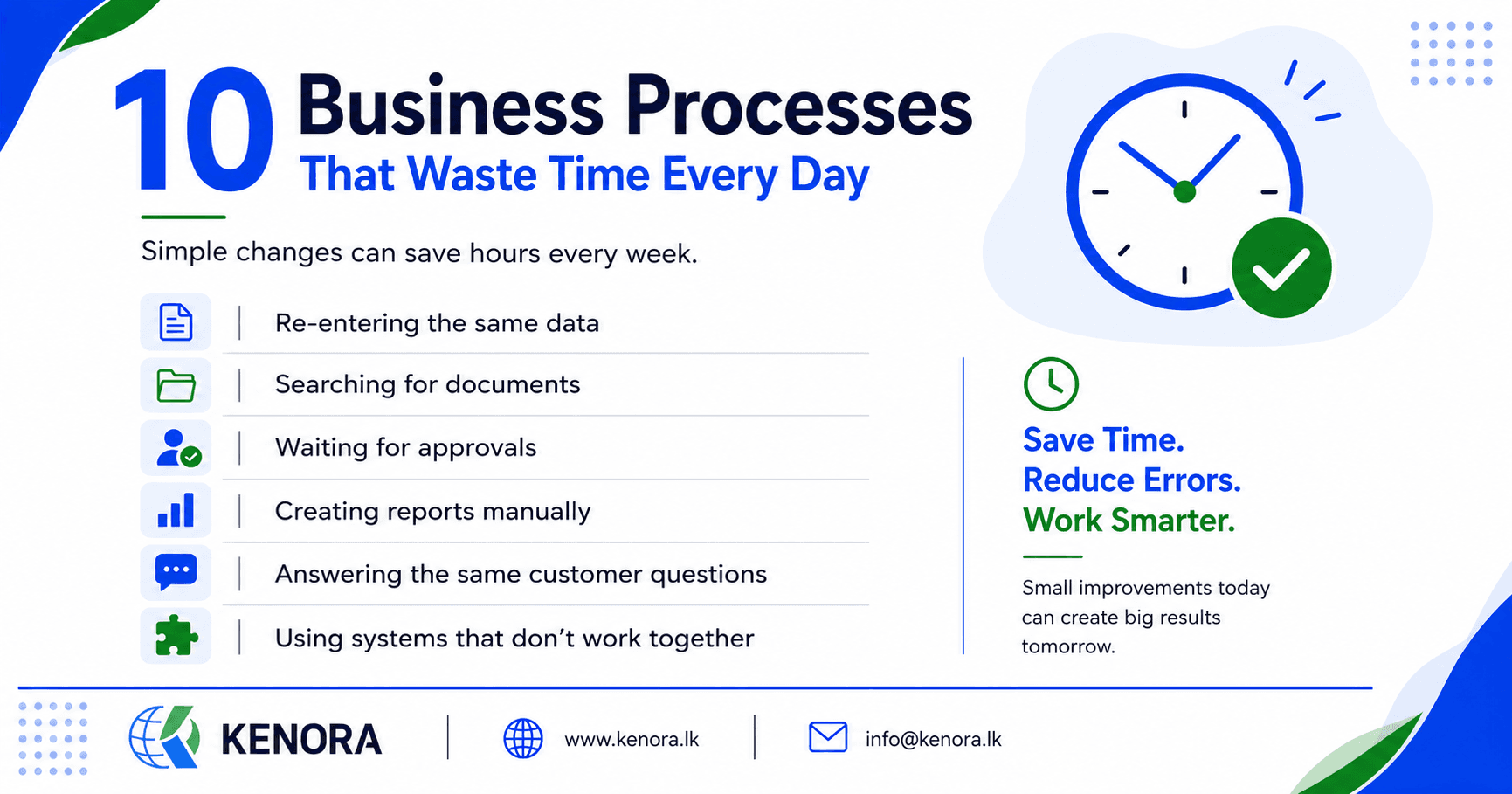
10 Time-Wasting Business Habits That Hold Companies Back (And How to Fix Them)
Ever get to the end of a long workday and wonder where the time actually went?
Your team was busy all day. Emails got answered. Meetings happened. Reports went out.
But somehow, the work that really matters didn't move forward much.
This happens in more companies than you'd expect. It's rarely because people are lazy or bad at their jobs. It's usually because so much of the day gets eaten up by small tasks that don't add much value on their own. One by one, they pile up until there's barely any time left for planning, improving, or growing the business.
The good news is that this is fixable. A few smart changes can save your team hours every week, cut down on stress, and free people up to focus on work that actually matters.
Here are ten everyday habits that quietly drain time, and simple ways to fix each one.
Retyping the Same Data
Picture this: a customer places an order online. Someone copies their details into a spreadsheet. Later, another person types the same details into the accounting system. Then someone else updates the CRM.
That's the same information typed three separate times.
It's slow, tedious, and an easy place for mistakes to creep in.
When your systems talk to each other, information only needs to be entered once. Every connected system updates on its own, so your team spends less time typing and more time helping customers.
Hunting for Documents
Every office has this moment. Someone needs a contract, an invoice, or a project file, and suddenly everyone is digging through folders, inboxes, and shared drives. Five minutes turns into fifteen. Sometimes the file never turns up at all.
It doesn't feel like a big deal in the moment, but multiply it by every day of the year and you're looking at hundreds of lost hours.
Keeping files in one organized place, with clear folders and good search tools, fixes this almost overnight.
Stuck waiting on Approvals
A purchase request sits untouched in an inbox. A discount for a customer waits on a manager's sign-off. A project stalls because one person hasn't replied to an email yet.
Meanwhile, everything else waits too.
Digital approval tools solve this by sending instant alerts and letting managers approve requests from anywhere, even from their phone.
Building Reports by Hand
Every Friday, or every month, someone pulls numbers from a handful of spreadsheets, checks them, fixes the errors, and finally pieces together a report.
Then a few hours later, the numbers change again.
Live dashboards solve this problem. They update automatically, so managers always see current numbers without waiting on someone else to build a new report.
Answering the Same Questions
How often do customers ask things like: What's the price? When will my order arrive? How do I reach support?
These are fair questions, but answering them one at a time, over and over, eats up hours.
A clear website, a solid FAQ page, or a simple chatbot can handle the common ones instantly, freeing your team to focus on the harder questions that actually need a human.
Teams Out of Sync
Sales tells the customer one delivery date. Operations is working off a different schedule. Support doesn't know either one.
The customer ends up confused, and every department gives them a different answer.
When departments work off separate systems and separate information, mistakes like this become routine. Sharing information across teams keeps everyone on the same page, and that means fewer headaches for employees and customers alike.
Projects Lost in Spreadsheets
Spreadsheets are great for a lot of things, but they fall apart once a project grows past a certain size. Tasks get forgotten. Deadlines slip. Nobody's quite sure who's supposed to do what next.
Project management tools fix that by giving everyone a clear view of the work: what needs doing, who's doing it, and when it's due.
Invoicing One by One
Creating invoices one at a time is fine when you're small. But as the business grows, the workload grows with it. Payments get harder to track, and late invoices start to hurt cash flow.
Modern accounting software can generate invoices automatically, track payments, and even send reminders when something's overdue. It saves time and keeps your finances in better shape.
Small Tasks That Add Up
Welcome emails. Updated customer records. Assigned tasks. Weekly reports. Scheduled appointments.
Each one only takes a few minutes on its own. Add them all up across a week, though, and they quietly eat several hours.
Automation handles this kind of repetitive work quickly and accurately, so your team can spend that time on things that actually need a human touch, like solving problems and building relationships.
Tools That Don't Talk to Each Other
This might be the biggest hidden problem in a lot of businesses. Sales uses one system. Finance uses another. Support runs on something else entirely. Inventory lives somewhere different again.
Since none of these systems can communicate, someone has to manually move information between them.
Connecting your software into one smooth workflow fixes this. Information flows automatically, mistakes drop, and every department works off the same up-to-date data.
The Real Cost of Lost Time
This might be the biggest hidden problem in a lot of businesses. Sales uses one system. Finance uses another. Support runs on something else entirely. Inventory lives somewhere different again.
Since none of these systems can communicate, someone has to manually move information between them.
Connecting your software into one smooth workflow fixes this. Information flows automatically, mistakes drop, and every department works off the same up-to-date data.
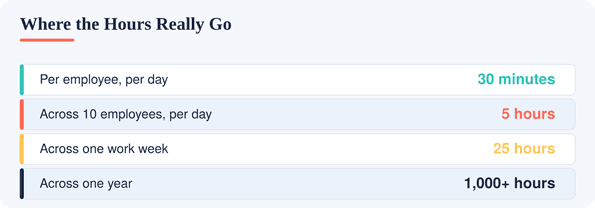
If ten employees each lose just 30 minutes a day, that's five hours gone before lunch. Over a week, that's 25 hours. Over a year, it adds up to more than a thousand working hours.
Think about what your team could do with that time back: better customer service, new products, more clients, or simply getting home on time.
Small Fixes, Big Results
A lot of people assume fixing this means buying expensive software or overhauling everything at once. That's rarely true, and it's rarely the best place to start.
The best starting point is usually one simple question: what task does my team repeat every single day?
Find that task. Then ask whether technology could make it faster, easier, or automatic. Once one process improves, the next one gets easier to spot and fix. Over time, the business runs smoother, the team gets more done, and customers notice the difference.
Success rarely comes from working longer hours. It comes from spending time wisely.
Take a look at how work actually moves through your business day to day. Ask your employees what slows them down, since they usually know exactly where the time goes. Every unnecessary step you cut gives your team more room to do work that actually matters.
Technology isn't about replacing people. It's about giving people better tools to do their best work.
At Kenora, we believe every business deserves systems that make work simpler, faster, and easier. When your tools support your team instead of getting in the way, growth gets a lot easier to reach.
Small changes today can lead to big results tomorrow.