
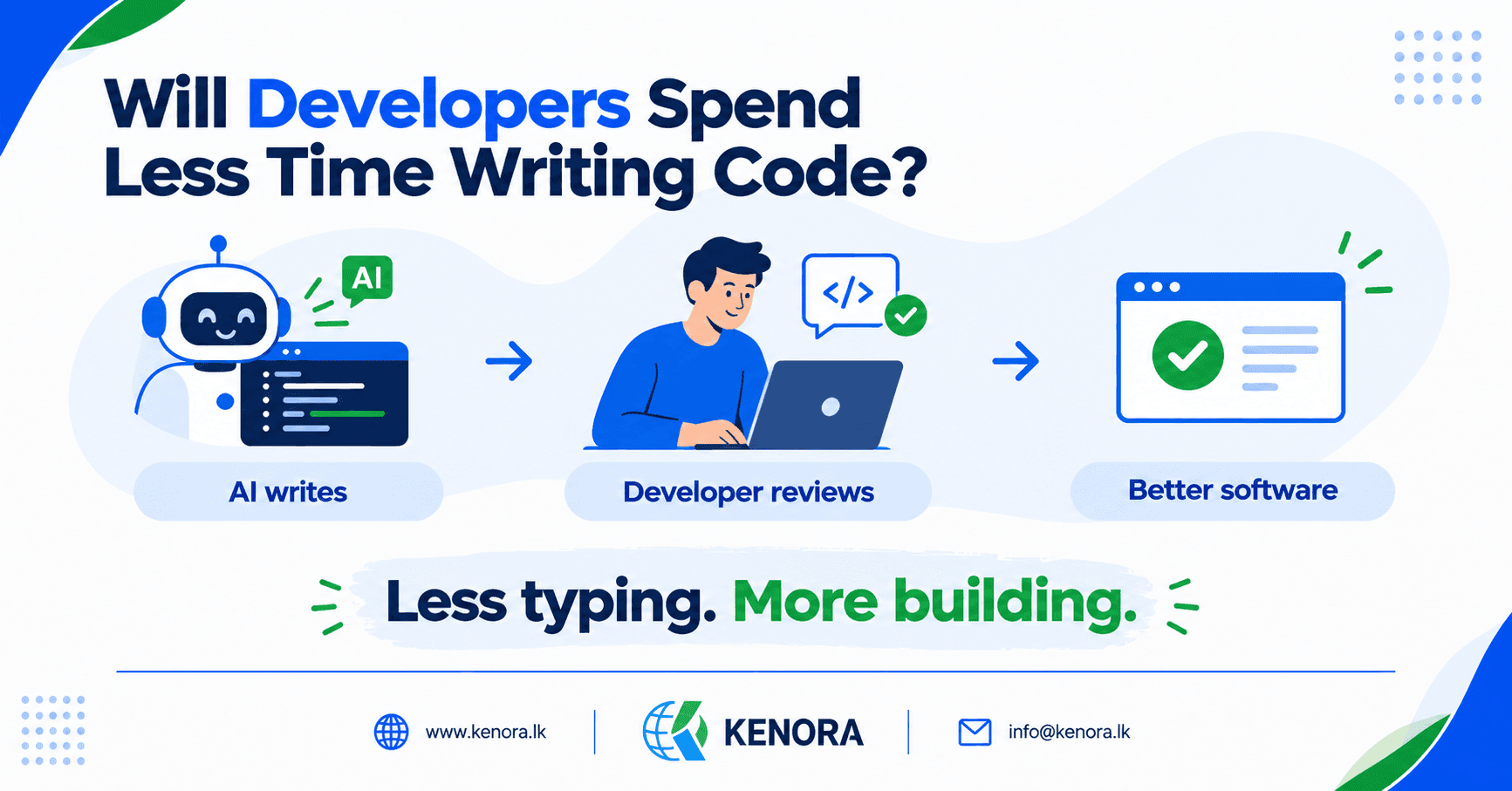
Will Developers Spend Less Time Writing Code?
A few years ago, a developer could spend hours writing a single feature. Today, an AI tool can write a first version in seconds.
So what happens to the developer?
It is a fair question, and more people are asking it as AI coding tools become part of everyday software work. These tools can write functions, fix errors, create tests, explain code, and even build parts of an app.
So, will developers spend less time writing code? Yes, they will. But that does not make them less important. Their work is simply changing.
AI Is Writing More Code
Not long ago, AI coding tools only gave small suggestions, like finishing a line of code. Today, they can do much more. A developer can describe a task in plain language and ask the tool to build a first version.
For example:
"Create a login page with email verification and password reset."
Instead of starting with an empty file, the developer gets a working starting point in a short time. That saves hours of repeated work.
AI can also help with tasks like these:
- Writing basic functions
- Creating tests
- Finding simple errors
- Explaining code
- Updating existing code
- Writing documentation
So developers may type fewer lines by hand. But typing code was never the whole job.
Developers Still Have to Think
Imagine you ask AI to build an online shopping website. It can create the pages and features very quickly.
But who decides what the website should really do? Who decides how payments should work? Who protects customer information? Who checks that the system is secure? And who decides what happens when something goes wrong?
These are not only coding questions. They need human thinking and real experience. A developer has to understand the business, the users, the technology, and the risks.
Even the simple login page from the example raises questions. What if a user types the wrong email? How long should a password reset link stay active? What should the system do after five wrong passwords? AI can suggest answers, but a person has to decide which answer is right for the product and its users.
That is why AI does not simply replace the developer. It helps the developer move from writing everything by hand to guiding and checking the work.
Less Typing, More Reviewing
This could be one of the biggest changes in software development.
A developer might once have spent two hours writing a feature. With AI, the first version can appear much faster. But someone still has to check it.
AI can misunderstand a requirement. It can pick the wrong solution. It can write code that works in one situation and fails in another. It can also bring in security problems without anyone noticing.
Think of AI like a very fast new team member. It works quickly and it never gets tired, but it does not know your business well. You would not publish a new team member's work without checking it first. The same rule should apply to AI code.
So the question is no longer only, "Can I write this code?" It is also, "Is this the right code?"
That is a different skill.
More Code Does Not Mean Better Software
There is an easy mistake that businesses can make. They think that if AI can produce code faster, software development will automatically become much faster too.
Not always.
Software development is much more than writing code. There is testing, security checking, code review, deployment, monitoring, fixing bugs, and looking after the system over time. AI can help with many of these tasks, but people still need to make sure everything works together.
A fast first version is useful. A reliable final product is what really matters.
Imagine a team that writes a feature in one day instead of three. That sounds great. But if the code needs the same amount of testing, or if hidden bugs show up a month later, the team has not saved as much time as it thought. Speed only helps when quality comes with it.
The goal is not more code. The goal is better software.
AI Gives Developers More Time
There is good news too. Developers spend a lot of their day on repeated tasks, like writing simple functions, fixing small errors, creating basic tests, updating similar pieces of code, and writing documentation.
None of this work is hard, but it takes time and energy. After doing it again and again, even good developers get tired. AI can take over a big part of that work. That leaves developers more time for the bigger things. They can understand users better. They can improve the product. They can think about system design. They can work on speed and security. And they can solve problems that need real experience.
In simple words, AI can help developers spend less time typing and more time building.
But There Is a New Challenge
More AI code also brings new problems. Companies need to know what code is being created, how it works, and whether it is safe. AI can write code quickly, but developers still need to review and test it.
Security is another concern. Modern AI coding tools can work with code repositories, files, APIs, and other development tools. If these tools are given too much access, they can create new risks.
A few simple questions can help any team. Who checked this code? Was it tested? What can the AI tool open, read, or change? If nobody can answer these, the team is moving fast without looking at the road.
So companies should not think, "AI can write the code, so we don't need developers."
A better way to think is, "AI can write more code, so we need better ways to review and control that code."
The Developer's Role Is Changing
The developer of the future may not spend the whole day typing code. They might give a task to an AI tool. The AI creates a first version. The developer reviews it, tests it, and fixes what is wrong. Then they move on to the next problem.
This is a new way of working. Here is how it looks in daily work:
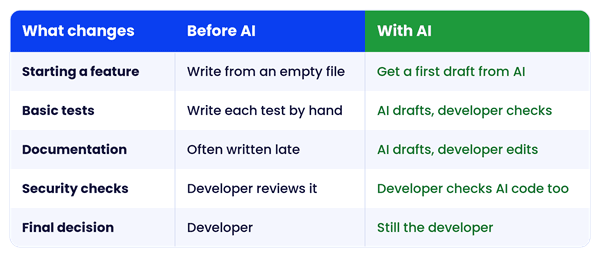
The developer becomes more of a builder, a reviewer, and a problem solver. And that does not make developers less valuable. In fact, good developers may become even more important, because:
- You need to understand software to know when AI is wrong.
- You need experience to spot a poor solution.
- You need security knowledge to find risky code.
- You need business understanding to know if the software solves the right problem.
So, Will Developers Write Less Code?
Yes.
AI is already changing how developers work. They can hand over more of the repeated coding tasks and spend more time planning, reviewing, testing, and solving hard problems.
But the future is not humans against AI. It is humans working with AI.
The best development teams will not be the ones that produce the most code. They will be the ones that know when to use AI, when to question it, and when a person needs to take control.
Because software is not valuable just because it has a lot of code. It is valuable because it works, it is secure, and it solves a real problem.