
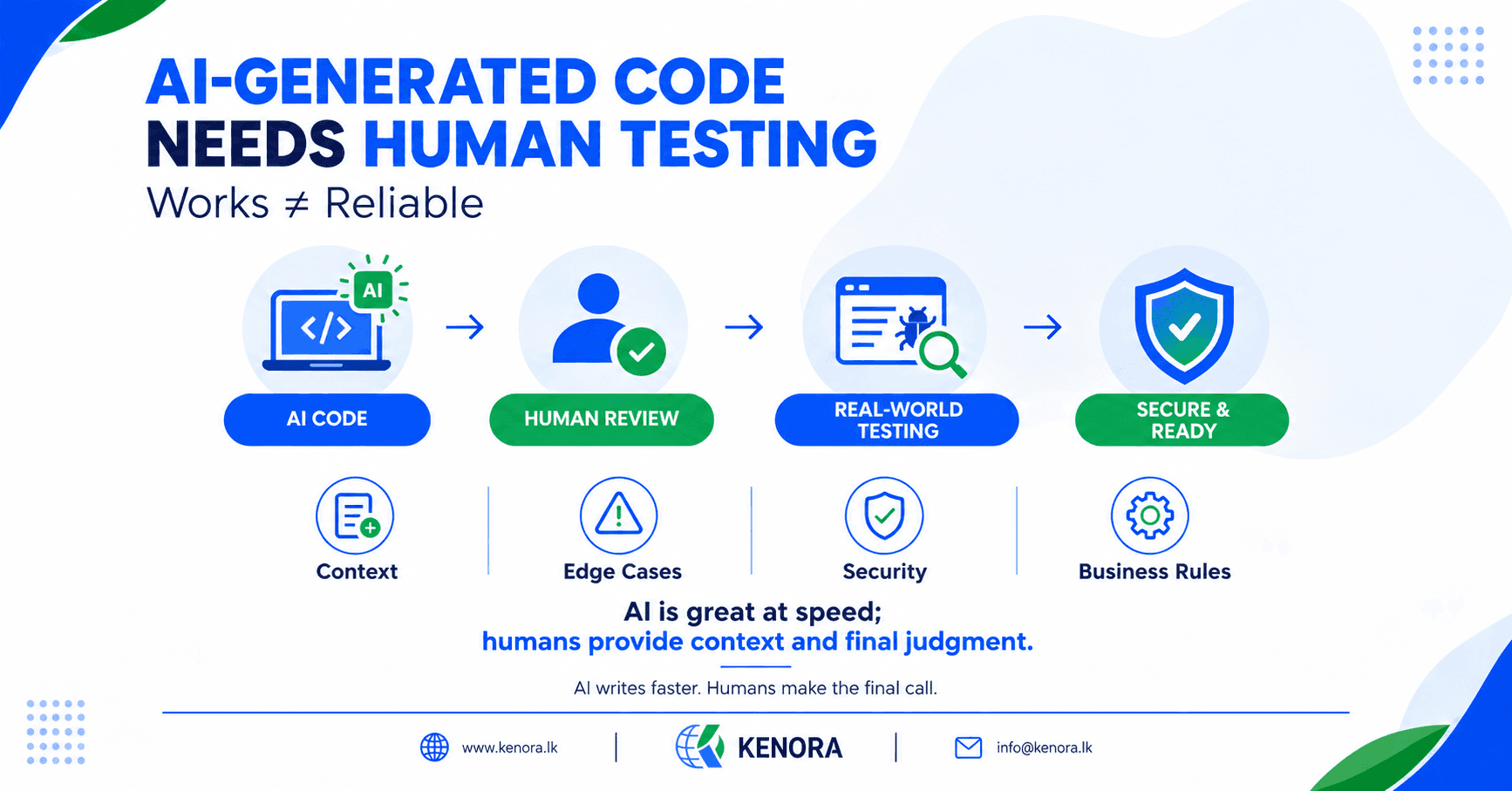
Why AI-Generated Code Still Needs Human Testing
Your AI just wrote 500 lines of code. It looks clean. It even runs. So, would you ship it?
Most developers would stop and think for a moment. That is a good habit.
It is not because AI cannot write good code. It often can. The real problem is that code that works and software that is reliable are two different things.
AI has changed how we build software. You can ask a tool to create a feature, fix an error, write a function, make tests, or even work across many files at once. It can save you hours.
But one thing has not changed: testing. No matter how fast the code shows up, a person still needs to check that it works properly, stays secure, and does what the business really needs.
Think of it like a new car. It looks great and the engine starts. But you would still want to drive it in the rain, on a bumpy road, and with a full load before you trust it. Software is the same.
AI Can Write Code, But Does It Understand Your Business?
Say you ask an AI to build a login system. In a few seconds, you get working code.
Now think about your business. Maybe you have different types of users. Maybe some people have special permissions. Maybe there are extra security rules, or some accounts need approval before they can log in.
If nobody told the AI about these things, it will not know about them. So the code can look completely fine and still miss something important.
This is where people matter. A developer knows the project, the users, the business rules, and the problems that can happen in real life. AI can help build the solution, but it does not automatically understand everything behind the project.
A good habit is to share as much context as you can. Tell the AI who the users are, what the rules are, and what must never happen. Even then, a person should check the result, because nobody can explain every rule in one short request.
Code That Works Is Not Always Good Code
It is easy to fall into this trap: "It works, so it must be good."
Not always. Code can pass a simple test and still have problems.
- It might become slow when many users come in at the same time.
- It might break when it gets unexpected information.
- It might use too many resources.
- It might create a security problem.
- It might work well in one part of the app and cause trouble in another part.
That is why testing has to go further than checking if the software opens or a button works. Good testing asks a bigger question: what happens when things do not go as planned?
Many bugs hide in the gaps between features. One small change can quietly break something that was working last week. A tool that only checks the new feature will never notice it. A tester who knows the whole product often will.
Real Users Don't Use Software Perfectly
Picture an online shop. The AI builds the checkout system. You test it once. You add a product, enter your details, make the payment, and everything works. It feels ready, right?
Now ask a few more questions. What if a customer clicks the payment button twice? What if the payment fails? What if the internet drops halfway? What if someone types something unexpected into a form? What if hundreds of people try to buy the same product at the same time?
A quick test may never show these problems. Real users are not like developers. They make mistakes. They click things in strange ways. They use different phones, browsers, and devices. And sometimes they find problems nobody thought about.
That is why real world testing matters.
Try this next time: before you call a feature done, spend ten minutes trying to break it. Click fast. Type strange things. Turn off the Wi-Fi. If you can break it in ten minutes, a real user will break it in ten seconds.
Security Needs Even More Attention
Security is another big reason to review AI-generated code with human eyes. An AI tool can create a login system, an API, a file upload feature, or a database connection very fast. But one small mistake can turn into a serious problem.
For example, a system might let one user see information that belongs to another user. A file upload feature might accept a file it should block. An API might share data that should stay private.
Here is the scary part. The code can still pass a basic test. Something can work exactly as expected and still be unsafe. Security testing helps you find these hidden problems before they turn into real incidents.
The tricky thing is that AI only sees what you show it. It does not know how your servers are set up, who should be allowed to see what, or which data is private. So it may pick a simple option that works, but is not safe for your case. A person who knows the setup can spot this quickly.
AI Can Help With Testing Too
So, should we stop using AI? No. AI can actually make testing better. Developers can use it to:
- Create test cases
- Find possible edge cases
- Explain code they do not know
- Suggest security checks
- Find areas that may need more testing
- Create tests for different user actions
This saves time and helps you think about situations you may have missed.
But there is one important rule: do not let AI approve its own work. If AI writes the code and then writes the tests using the same assumptions, it can miss the same problems twice. A human needs to look at it and ask the questions the first request never covered.
- Does this make sense for our users?
- Does it follow our business rules?
- Could someone misuse this feature?
- What happens if something fails?
These questions are just as important as the code itself.
The Best Approach Is AI + Humans
The future of software does not have to be humans against AI. It can be humans working with AI.
AI is great at speed. It can create code, suggest solutions, write tests, explain errors, and handle repeated work. Humans are great at context. They understand business needs, question decisions, think about users, review risks, and make the final call.
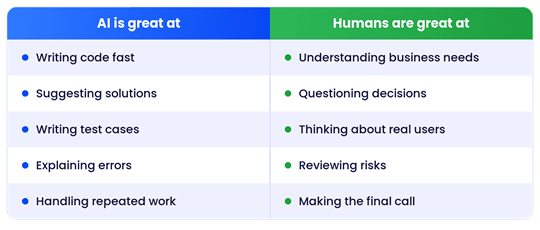
Think of AI as a very fast teammate who never gets tired but also does not know your company. You would not let a new teammate release code with no review, no matter how fast they type. The same rule applies here.
When you put the two together, you get a much stronger process. Here is a simple workflow:

The important part is that the process does not stop when AI finishes writing the code. That is only the beginning.
Faster Coding Makes Testing More Important
There is an interesting side effect of AI-assisted development. The faster we can build software, the easier it becomes to build software with problems.
When a developer spends hours on a feature, there is natural time to think about how it works. When AI builds the same feature in a few minutes, a team may be tempted to move on just as quickly.
But faster development should not mean faster approval. Use the time AI saves to focus on quality, security, user experience, and the bigger picture.
A simple rule helps here. If AI saves you three hours of writing, spend at least some of that time on testing and review. You still finish faster, and you ship with much more confidence.
Final Thought
AI-generated code is not the problem. Blindly trusting it is.
AI is now a powerful part of modern software development, and businesses can gain a lot from it. But good software still needs testing. It still needs security checks. It still needs human review. And most of all, it needs to work for real people in the real world.
The goal is not to stop AI from writing code. The goal is to make sure the code it writes is tested, trusted, and ready for real users.
Because when software reaches production, saying "AI wrote it" is not enough.
The software still has to work. It still has to be secure. And it still has to be tested.