
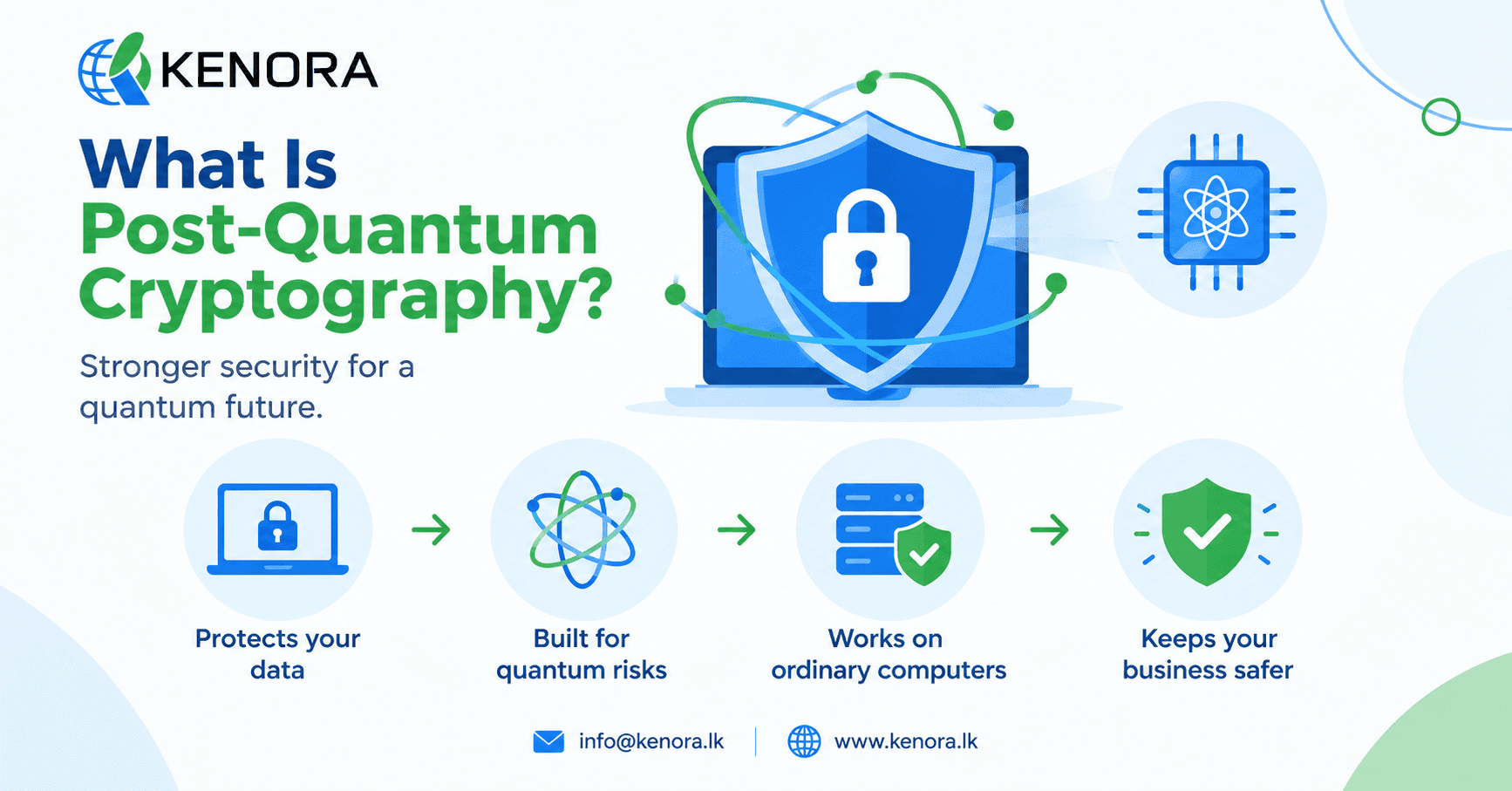
What Is Post-Quantum Cryptography?
Imagine someone steals a locked box full of your private information. They can’t open it today, so they hide it somewhere safe and wait.
Years later, a new tool comes along that can break the lock. Suddenly, the secrets you thought were safe are out in the open.
This is the kind of risk that post-quantum cryptography was built to solve. Quantum computers are still being developed, but security experts are already getting ready for a future where some of today’s encryption may no longer be safe.
So what is post-quantum cryptography, and why should your business care? Let’s break it down in plain English.
What Is Post-Quantum Cryptography?
Post-quantum cryptography, also called PQC, is a way to protect digital information from attacks by both normal computers and the powerful quantum computers of the future.
You use encryption every day, even if you never notice it. It protects online payments, private messages, business files, and medical records. Think of it as a digital lock that only the right key can open.
Most of today’s locks are built on math problems that are very hard for normal computers to solve. A strong enough quantum computer could solve some of those problems much faster, which would put certain methods at risk.
PQC uses different kinds of math, designed to hold up against those attacks. And here is a point people often miss: PQC does not need a quantum computer. It runs on ordinary computers and existing systems, although some of them may need updates.
Why Are Quantum Computers a Concern?
Quantum computers work in a different way from the computers we use today. For some very specific problems, they could be much faster. They are not better at everything, and today’s quantum computers cannot break modern encryption.
The worry is about what comes next. If the technology becomes strong enough, some of the encryption that protects websites, apps, and digital identities could become weak. That could affect banking, healthcare, software, and cloud services.
Nobody knows exactly when this could happen, and estimates vary. But changing security systems takes years. That is why experts are acting now instead of waiting for the problem to arrive.
The Hidden Risk: Your Data Can Be Stolen Today
Here is the part that surprises many people. An attacker can copy your encrypted data today, even though they cannot read it. They simply store it and wait for better tools.
Experts call this “harvest now, decrypt later.”
It matters most for information that must stay private for many years, like medical records, financial data, business plans, and customer details. Even if the data is safe now, it could become a problem later.
So ask yourself two questions. How secure is our information today? And how long does it need to stay secure?
How Does Post-Quantum Cryptography Work?
You do not need advanced math to get the basic idea. Today’s encryption depends on certain hard math problems. PQC brings in new methods that are designed to stay secure against known quantum attacks. Some use math structures called lattices. Others use hash functions, which are already common in digital security.
Different methods do different jobs. Some help two systems agree on a secret key so they can talk safely. Others create digital signatures, which show who sent a message and prove it was not changed along the way.
This is already real, practical work. In August 2024, the US National Institute of Standards and Technology (NIST) published its first three finalized PQC standards. Then, on October 27, 2026, NIST published the final version of its transition report, a guide that helps organizations plan their move away from older methods. Here is a quick look at the key dates.
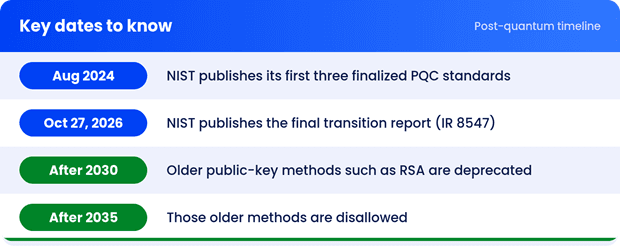
The 2030 and 2035 dates are part of NIST’s plan for retiring older public-key methods. Businesses can use them as a helpful guide for their own planning.
What Does This Mean for Businesses?
You might think quantum computing only matters to big tech companies. But many businesses rely on the same encryption, even if they never touch quantum technology. Online stores protect payments. Clinics store private patient records. Software companies protect their products. Teams share files with suppliers over secure connections.
If the lock changes, the systems that use it may need to change too. Here are three areas to think about.
Protecting Customer Information
Customers expect their personal and financial details to stay private. Know how that data is protected and how long it needs to stay safe. Planning early means fewer surprises later.
Updating Existing Systems
Encryption hides in many places, including websites, apps, network connections, and digital certificates. Updating it is rarely as easy as installing one new tool. You need to find where older methods are used, then plan the updates so your daily work does not stop.
Working With Technology Providers
Most companies rely on outside providers for cloud services, software, and security tools. Ask them about their post-quantum plans, available updates, and timelines. The earlier you start these chats, the smoother things will go.
What Can Businesses Do Now?
Good news: you do not need to panic or replace everything tomorrow. Start by understanding what you have. Here are five simple steps.
- 1Find out where encryption is used. List the important systems, apps, websites, and services that depend on it.
- 2Spot your sensitive information. Focus on data that must stay private for years, such as medical records, financial data, and confidential documents.
- 3Talk to your technology providers. Ask your software, cloud, and security partners how they are preparing.
- 4Plan for future updates. Some systems take longer to change than others. A clear plan helps you avoid rushed choices and surprise costs.
- 5Follow trusted guidance. Keep an eye on NIST and review your plan as new advice appears.
These steps will not make everything quantum-safe overnight. But they will help you prepare in a calm, organized way.
Is Post-Quantum Cryptography Ready Today?
Yes. Key post-quantum standards are available now. But that does not mean every website, app, or business system is already protected. Organizations still need to check their systems, find the weak spots, and plan the changes.
NIST’s final transition report offers more guidance. The right plan depends on the systems you use, the data you protect, and the tools you have. For most businesses, the best move is to prepare carefully instead of waiting until the last minute.
The Future of Digital Security Starts Today
Technology keeps changing, and security has to keep up. Post-quantum cryptography is a big step toward protecting information in a world where powerful quantum computers could challenge today’s encryption.
We do not know exactly when that day will come. But we do know that moving to new standards takes planning, testing, and time.
You do not need to be a quantum expert. You just need to understand how your data is protected, talk to your providers, and start planning.
The smartest time to prepare for a security risk is before it becomes an emergency.
Follow Kenora for more simple insights on cybersecurity, software, cloud services, and the technology shaping the future of business.