
.png&w=3840&q=75)
The Race for AI Computing Capacity Is Growing
AI is changing how businesses work. From customer support to software development, more companies are finding new ways to use it every day.
But behind every AI tool, there is something most people never see: computing power.
AI needs powerful computers to process information, learn from data, and give us answers. As more businesses start using AI, the demand for that power keeps growing. Cloud providers, chip makers, and data center operators are all racing to build the infrastructure to keep up.
So why should an ordinary business care? Let’s take a closer look.
Why Does AI Need So Much Computing Power?
Picture a company that builds an AI assistant for its customer support team. The assistant has to understand questions, find the right information, and write a helpful reply.
If only a few people use it, the workload is small. But what happens when thousands of customers start chatting with it at the same time?
Suddenly, the demand jumps.
AI models need computing resources to run, and bigger or more complex jobs need stronger hardware. Many AI systems use special processors called GPUs to handle this work.
There are two main jobs here. Training is when a model learns from data, and it can take a huge amount of computing power. Inference is when the trained model answers real users, and it needs capacity too.
This means businesses are not only looking for better AI tools. They also need the infrastructure that keeps those tools running. Good AI needs more than good software. It needs a strong technology base.
The Demand for AI Infrastructure Is Growing
As more people use AI, cloud providers and tech companies are investing in more computing capacity. They need powerful servers, special chips, fast networks, cooling systems, and a steady power supply.
In the AI cloud market, this high demand is putting pressure on capacity and pricing. For businesses, it means getting access to AI infrastructure can take more planning than just signing up for a service.
The good news is that most companies do not need to build their own AI data center. Many can use cloud platforms and managed AI services to get the computing power they need.
So the smart question is not “How do we buy the biggest AI system?” It is:
“What does our business actually need?”
It’s Not Just About Buying More GPUs
When people talk about AI computing, they often focus on GPUs. They matter, but they are only one piece of the puzzle. A working AI setup needs all of these:
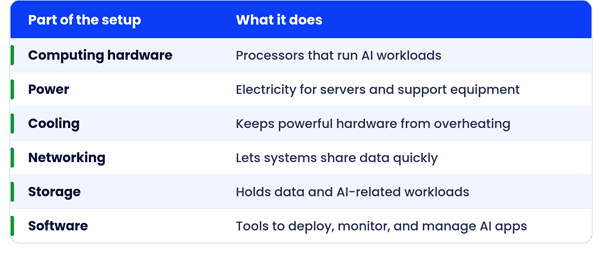
All these parts have to work together. A company might have a strong AI model but still get slow results because of limited resources or poor planning. Another company might have plenty of power but spend too much because nobody manages it well.
AI infrastructure is not only a hardware problem. It is an operations problem too.
How Cloud Services Are Helping Businesses
Cloud computing means you do not have to buy and maintain every server yourself. You use cloud services based on what you need, and you can change that later.
This works well for businesses that are testing AI ideas. A company might start with a small project. As more customers use it, the company can add more computing resources, depending on the platform and the workload.
But the cloud still needs planning. Before you choose, think about:
- How much computing power you need
- How fast your workload may grow
- How much you can spend
- How you will protect your data
- How you will track performance
Choosing a cloud service is not about picking the most powerful option. It is about finding the setup that fits your business.
What Does This Mean for Smaller Businesses?
You might be thinking, “We are not building a giant AI model. Why should we care?”
That is a fair question. Most small and mid-sized businesses will never build their own AI infrastructure. They can use existing AI platforms, cloud services, and ready-made software.
Still, knowing the basics helps you make better choices. A support team might use AI to sort customer questions. Another company might use it to process documents. A software team might use it to write and review code.
Each of these has different needs. Some will work fine with managed services. Others will need custom software, more storage, or more computing power as they grow.
The best way to start is with the business problem, and then choose the technology. AI should solve a real problem. It should not turn into an expensive project with no clear purpose.
The Cost of AI Computing Matters
AI can open new doors, but it also comes with costs. Running AI applications can involve fees for computing, storage, data processing, and other cloud services.
A small test may need very little. An app used by thousands of customers is a different story.
That is why monitoring matters. Track how your applications use computing resources, and review your costs as usage changes. You may find that an app is using more power than you expected. Once you look closer, you might find ways to make it more efficient or adjust your setup.
Good planning helps you avoid wasted money and keeps your apps useful. The goal is not to avoid AI. The goal is to use it in a way that makes business sense.
AI Infrastructure Also Needs Energy
There is one more part of this race: energy.
Data centers use a lot of electricity to run servers and cooling systems. As AI workloads grow, power supply and infrastructure capacity matter more and more. Building and running large data centers can mean big investments in energy, cooling, and networking.
This is a real challenge for companies that are expanding their AI infrastructure. It also shows something useful for every business: technology growth depends on more than software and hardware. Careful planning and smart resource management can help you get more from the systems you already have.
What Should Businesses Do Now?
You do not need to chase every AI trend or buy the most expensive setup. Start with a few simple steps.
1. Start with a clear business problem
Before you pick an AI tool, decide what you want to improve. Do you want to cut manual work, improve customer support, or process data faster? A clear goal makes it easier to choose the right solution.
2. Understand your workload
Think about how your application will be used. Will it serve a small team or many customers? Will it run now and then, or all day? These answers shape the infrastructure you need.
3. Plan for growth
An app that works well today may need more resources next year. Think about how your system can handle more users without extra cost or slow performance.
4. Monitor costs and performance
Keep an eye on your computing resources, app speed, and cloud spending. Regular checks help you spot problems early and make better decisions.
5. Choose the right infrastructure
Cloud services, managed AI platforms, and custom setups all have their place. The right choice depends on your goals, budget, security needs, and technical skills.
You do not need the biggest system. You need the one that works for you.
The Future of AI Depends on Infrastructure
People love to talk about new AI models and exciting features. But behind all of it is the infrastructure that makes it possible: computing power, cloud platforms, data centers, networks, and energy.
As demand grows, businesses will need to think harder about how they build and manage technology. Some may need better cloud operations. Others may gain from custom software, AI workflow planning, or better infrastructure monitoring. The right answer is different for every business.
What matters is understanding your needs and making technology choices that support long-term growth.
Final Thoughts
The race for AI computing capacity is changing more than the tech industry. It is also changing how businesses think about infrastructure.
Using AI takes more than picking a model or adding a new tool. You also need to think about computing resources, cost, performance, security, and the ability to grow.
At Kenora, our cloud hosting, migration, and operations services help businesses build and manage their digital infrastructure. You can learn more at www.kenora.lk or reach us at [email protected].
The future of AI will not depend only on who builds the biggest models. It will also depend on how businesses choose and use the technology behind them.
The next step in AI is not just smarter software. It’s smarter technology planning.