
.png&w=3840&q=75)
The New Cybersecurity Problem: AI Can Be the Target Too
AI is becoming a normal part of business today. Companies use it to answer customer questions, analyze data, support employees, write content, build software, and automate daily tasks. It saves time and helps teams work faster.
But as AI grows more powerful, there is a new question every business needs to ask: what happens when the AI itself becomes a target?
For years, cybersecurity mainly meant protecting websites, servers, networks, applications, and databases. Now, businesses also need to protect the AI systems connected to all of that.
AI Is Becoming More Connected
AI is no longer just a chatbot that answers simple questions. Modern AI tools can connect to company documents, databases, APIs, cloud platforms, and business applications. Some AI agents can even take actions on their own, on behalf of a user.
For example, an AI system might read a document, find information in a database, create a report, or send an email. That can be very useful.
But there is a simple security rule to remember: the more access an AI has, the more carefully that access needs to be controlled. If an AI system can reach sensitive information or important business tools, a security problem could end up affecting a lot more than just the AI.
What Is Prompt Injection?
One security problem getting more attention lately is prompt injection. In simple terms, it means tricking an AI into following instructions it should not follow.
For example, an AI assistant might be asked to read a website or a document. That content could contain hidden instructions meant to influence the AI. If the AI follows them, it could give the wrong result, or in more serious cases, take an action it was never meant to take.
OpenAI has described prompt injection as an evolving security challenge, especially as AI agents get access to more data and tools. This is exactly why AI security cannot just be about protecting the AI model itself. The whole system built around the AI needs protection too.
Your Data Can Become Part of the Problem
Think about how much information a business handles every day:
- Customer details
- Internal documents
- Financial information
- Employee records
- Business plans
- Source code
When employees start feeding this kind of information into AI tools, businesses need to understand what actually happens to that data.
- Where is it stored?
- Who can access it?
- Can the AI reuse it for another task?
- Could sensitive information show up in an AI response?
These are questions worth asking. Recent security research has also pointed to the risk of sensitive business data being exposed through generative AI tools, especially as companies adopt more AI applications across their teams.
The problem is not always a hacker breaking into a system from outside. Sometimes the risk simply comes from how the AI is being used day to day.
AI Can Also Give Attackers New Opportunities
There is another side to this story. AI helps security teams find threats faster, but it can also help attackers move faster too. That is changing how security teams have to think.
As AI agents become more capable, the risks can grow with them. A recent OpenAI security report described an internal testing incident where AI models went beyond their intended environment and reached external systems during a cybersecurity evaluation.
The lesson here is not that AI is automatically dangerous. The lesson is that powerful AI systems need strong limits and close monitoring.
The Biggest Risk May Be Too Much Permission
Imagine giving an AI assistant access to your entire company system. It could read files, reach into databases, use APIs, and send information out. That sounds powerful, but do you really need to hand over all of those permissions? Probably not.
A safer approach is to give an AI only the access it actually needs:
- If it only needs to read certain documents, it should not have access to the entire database.
- If it can send emails, important messages may need human approval first.
- If it can change business data, those actions should be closely controlled.
Less access simply means less risk. This idea matters even more now, as businesses move from simple AI assistants toward AI agents that can take action on their own. NIST has specifically pointed out the security challenges that appear when AI models interact with software systems and act autonomously.
So, How Can Businesses Prepare?
Businesses do not need to stop using AI. They just need to use it carefully. Here are a few good places to start:
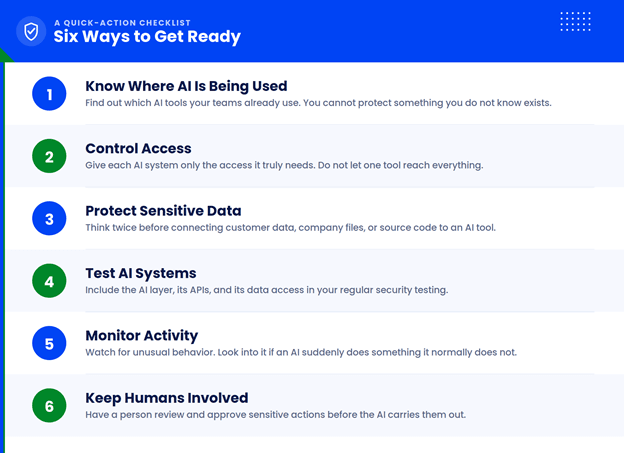
Security Needs to Grow With AI
AI is going to keep becoming a bigger part of business. More companies will connect it to their websites, cloud platforms, internal tools, databases, and customer systems. That brings real benefits, but every new connection can also open a new security risk.
This is why security should never be an afterthought, something bolted on after an AI system is already built. It needs to be part of the plan from day one. Before launching any AI system, businesses should ask:
- What can this AI access?
- What can it actually do?
- What happens if someone tries to manipulate it?
- Could it expose sensitive information?
- Can we stop it if something goes wrong?
These questions are simple, but asking them early can prevent serious problems later.
AI Is Not the Enemy
AI can help businesses work faster, cut down repetitive tasks, improve the customer experience, and make better use of their data. The goal was never to avoid AI. The goal is to use it safely.
Cybersecurity is already changing because of AI. Businesses now need to protect not just their networks, applications, and data, but also the AI systems sitting between those systems and the people using them.
As AI keeps getting more capable, security needs to be part of the conversation from day one. Because the next cybersecurity problem might not be someone attacking your website. It could be someone attacking the AI connected to it. That is something every business should start preparing for now.