
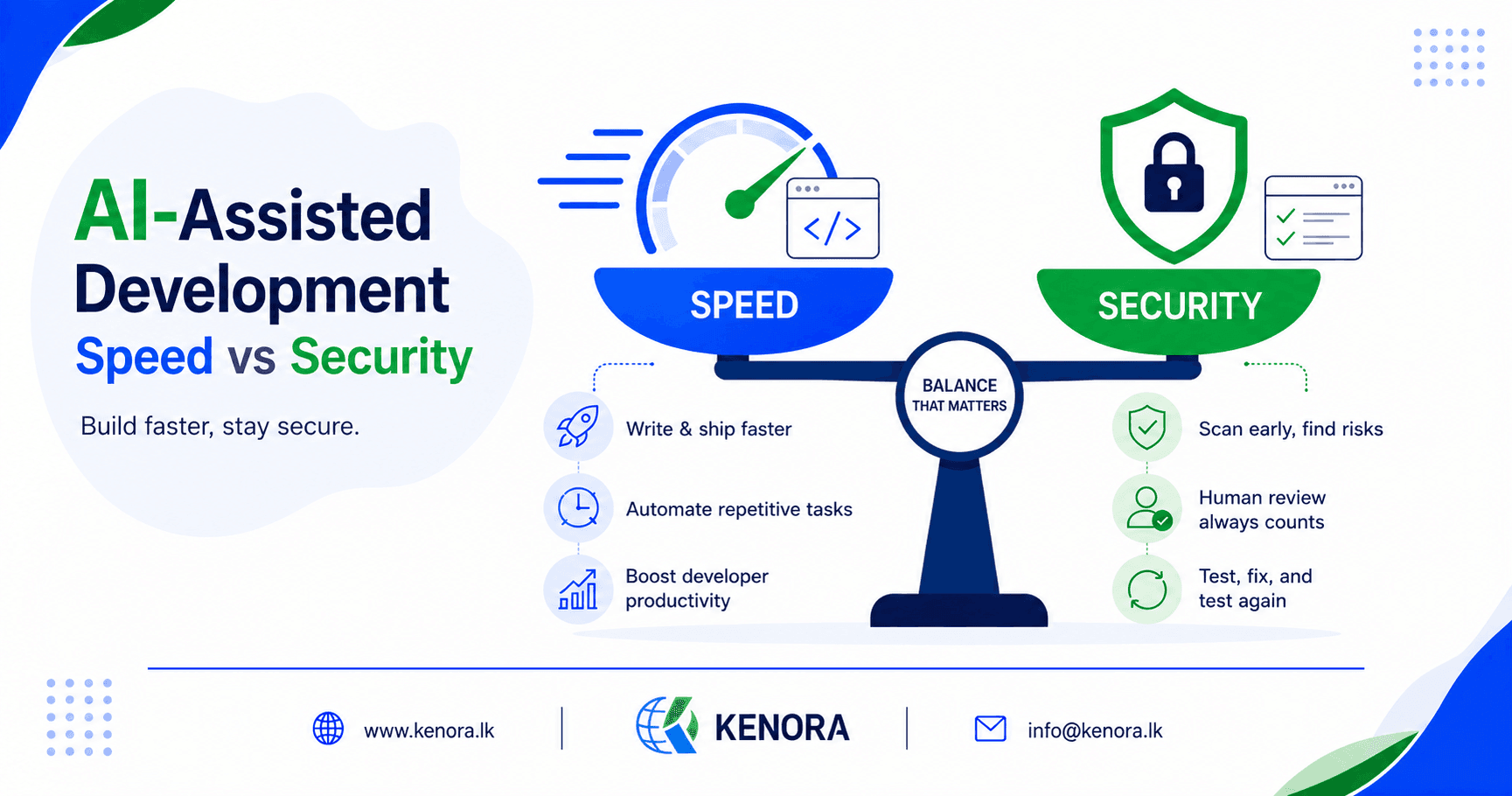
AI-Assisted Development: Speed vs Security
How fast, AI-written code changes the risk equation
Software development is changing fast.
A few years ago, developers wrote almost every line of code by hand. Today, AI tools can write code, explain errors, build tests, suggest improvements, and even take on bigger chunks of a project.
That's a real advantage for any business. Teams ship faster, and developers get to spend more time solving real problems instead of doing repetitive work.
But there's another side to this story. When development speeds up, security has to speed up with it. That's the challenge most businesses are facing right now.
AI Is Changing How Software Is Built
AI coding tools are becoming a normal part of everyday development.
A developer can describe what they need and get working code back in seconds. For example, instead of spending an hour building a basic API function, a developer can ask an AI tool to draft it and simply review the result.
AI can also help with:
- Writing code
- Finding bugs
- Creating test cases
- Explaining old code
- Improving existing code
- Writing documentation
- Spotting possible security problems
This saves a lot of time. Reports from 2026 show just how quickly AI has become part of everyday software development, and security teams keep repeating the same warning: AI generated code still needs a proper review before it goes anywhere near production.
The problem was never that AI writes code. The problem is trusting that code without checking it first.
Faster Code Does Not Always Mean Safer Code
AI learns from huge amounts of existing code and text. That's what makes it useful, but it doesn't mean every suggestion it gives is secure.
An AI tool can produce code that looks completely normal on the surface while quietly carrying a security weakness. For example, it might:
- Handle user input in an unsafe way
- Give users more access than they actually need
- Expose sensitive information
- Rely on an outdated library
- Store data incorrectly
- Set up a weak authentication process
A developer under pressure to ship might accept the suggestion, test that it works, and move on. That's exactly where the risk starts.
Some 2026 research has already found security weaknesses hiding in AI generated code, and industry reports have documented real vulnerabilities slipping into production through AI assisted development.
So the real question isn't “Can AI write the code?” It's “Can we trust this code enough to put it into production?”
The Speed Gap Is Becoming a Security Problem
Picture an ordinary development team. Before AI, a developer might write around 100 lines of code in a day. With AI helping, that same developer can produce far more in the same amount of time.
That sounds great, until you ask what happens to security. If testing still takes the same amount of time it always did, a gap starts to open up. Development speeds up. Security stays where it was.
That's not a healthy combination. A team can end up with more code, more releases, and more features, while the security team is stuck reviewing a growing backlog. This is why security can't just be something that happens at the very end of a project anymore.
Security Needs to Be Part of Development
A better approach is to build security into development from day one.
Instead of the old pattern of build, finish, then check security, teams should move toward something closer to this: build, test, check security, fix, and test again.
This doesn't mean every developer needs to become a security expert. It just means security checks should sit inside the normal development workflow, not off to the side.
For example, whenever new code is written, automated tools can scan it for common problems right away. If something looks risky, the developer can fix it before it ever reaches production. That's a lot easier than discovering the same issue after customers are already using the product.
AI Can Help Security Teams Too
Here's the more encouraging part of the story. AI isn't only helping developers write code, it can help security teams review it too.
AI can scan large amounts of code and flag the areas that need a closer look. It can explain why something looks risky and help prioritize which issues to fix first. That's especially useful for large applications, where checking everything by hand would take far too long.
Researchers are also building automated systems that combine code scanning, AI analysis, suggested fixes, and a second security check once the fix is applied. That creates a useful loop: find the issue, understand it, fix it, and check again.
The last step matters most. A suggested fix isn't automatically a good fix.
AI Should Be a Co-Pilot, Not the Final Decision Maker
This might be the most important point in the whole article.
AI can be incredibly useful, but it shouldn't replace experienced developers and security professionals.
Say an AI tool tells you, “This code is safe.” Should you just take its word for it? No. The better question is, “What proof do we actually have that this code is safe?”
Human review still matters. Developers understand what the application is actually for. Security professionals understand how attackers think and where they'll look for weaknesses. Business teams know which data and systems matter most.
AI can help all three groups move faster, but it should support their decisions, not make every important call on its own.
What About AI Agents?
The next step is even more interesting, and a bit more complicated.
AI is moving beyond simple coding assistants toward AI agents that can handle several development tasks at once. An agent might read through a project, change code, run tests, spot problems, and suggest fixes, all without much hand-holding.
That can save even more time. But it also raises a bigger security question: how much access should an AI system actually have?
If an AI tool can reach source code, databases, cloud systems, or development environments, businesses need to think carefully about permissions. An AI system shouldn't get access to everything just because it's technically capable of using it.
The more power an AI system has, the more its security controls matter. Recent developments in AI security make this clear. AI systems are getting better at finding and working with software vulnerabilities, which makes strong access controls and human oversight even more important.
5 Simple Rules for Safer AI-Assisted Development
Businesses don't need to stop using AI for software development. They just need better habits around it.
1. Review AI generated code. Don't accept everything an AI tool produces automatically. A developer should understand what the code actually does before using it.
2. Scan code regularly. Security scanning helps catch common weaknesses before they ever reach production.
3. Test before release. Code should be tested for both functionality and security, not just whether it runs.
4. Limit AI access. AI tools should only get the permissions they genuinely need, nothing more.
5. Keep humans involved. The decisions that matter most should still get a human review.
None of these steps need to slow a team down. If anything, they help teams move faster, because problems get caught early instead of after launch.
The Real Goal Is Not Slower Development
There's a common fear that security will slow AI assisted development down. But speed and security don't have to be enemies.
The goal was never “fast development or secure development.” It's “fast and secure development.”
That means using automation where it makes sense, weaving security checks into the normal workflow, and keeping experienced people involved wherever decisions actually matter.
AI is giving development teams a real chance to build faster. Now it's up to businesses to make sure their security processes can actually keep up.
Final Thoughts
AI assisted development isn't going anywhere. It's likely to become an even bigger part of how businesses build websites, apps, APIs, and internal tools.
That's a good thing. But faster development also means businesses need to rethink how they approach security.
AI can write code. It can review code. It can flag possible vulnerabilities and even suggest fixes. None of that means we get to stop asking the basic questions.
What does this code actually do? What could go wrong? Could someone misuse it? Have we actually tested it?
Those questions still matter, maybe more than ever.
The approach that works is simple: use AI to move faster, use security testing to stay safe, and use human judgment to make the final call.
The future of software development isn't about choosing between AI and security. It's about making the two work together, and businesses that build security into the process from the start will be in a much stronger position.