
There was a time when running a business meant a physical office, a few desktop computers, and maybe a server humming away in a back room that nobody touched unless something broke. As long as email worked and files could be shared, that counted as a healthy setup.
That approach now belongs in the same category as a printed road atlas: technically still functional, but nobody serious is relying on one to get anywhere.
Customers expect instant service. Teams are scattered across cities, time zones, and home offices. Applications are expected to run at 2 a.m. on a Sunday just as reliably as 2 p.m. on a Tuesday. And the amount of data flowing through a typical business has exploded far past what a server in the corner was ever built to handle.
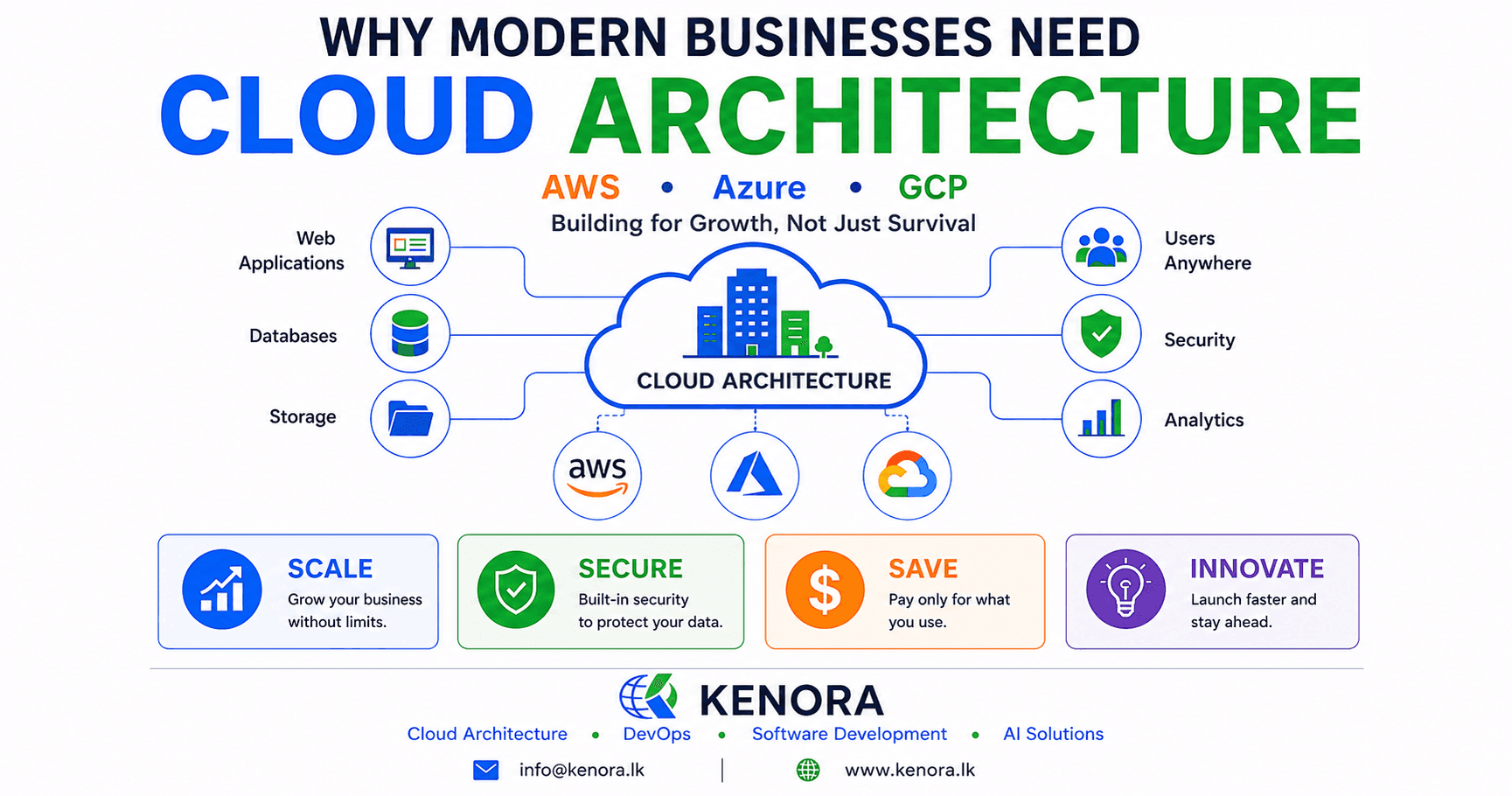
Behind every company that handles this well sits something most customers never think about: a deliberately designed cloud architecture. Whether that company runs on Amazon Web Services, Microsoft Azure, or Google Cloud Platform, the architecture underneath is what actually lets it move fast, serve people well, and grow without constantly tripping over its own technology.
The interesting part is that almost nobody is debating whether to use the cloud anymore. That argument is over. The real question, the one that actually separates resilient companies from fragile ones, is whether the cloud environment was designed with any intention at all, or whether it just sort of happened.
What Cloud Architecture Actually Means
Picture two ways to put up a building. In one, a crew shows up and starts stacking bricks, hoping the structure stays upright as they go. In the other, an architect draws blueprints first: load-bearing walls, plumbing routes, electrical systems, fire exits, and room to add a second floor later if the business needs it.
Cloud architecture is the second approach, applied to software instead of concrete. It's the underlying plan that decides how applications, databases, storage, security layers, networking, and backups all fit together and talk to each other.
Get that plan right, and the systems underneath stay secure, dependable, and reasonably priced even as the business changes shape. Get it wrong, and you end up with an expensive tangle of problems that simply haven't introduced themselves yet.
Why the Old Way Starts to Crack
Most companies didn't choose bad infrastructure on purpose. They chose infrastructure that fit the business at the time, and the business simply outgrew it.
It tends to go the same way everywhere. The systems work fine at first. Then the company adds customers. Then it hires more people. Then someone bolts on another piece of software because the team needs it right now. A few years in, every update feels risky, every outage costs real money, and starting a new project feels like renovating a house while the previous tenants are still living in it.
The pattern shows up in a familiar set of headaches:
- Systems that can't scale without a major, expensive overhaul
- Hardware costs that show up whether the capacity gets used or not
- Maintenance that eats up time the team could spend building something new
- Single points of failure that turn one bad server into a company-wide outage
- Deployment cycles measured in weeks instead of minutes
- Security gaps that nobody quite owns
- Disaster recovery plans that exist mostly on paper
None of this is a character flaw. It's just what happens when infrastructure decisions made for a twenty-person company are still running the show at two hundred.
Renting the Grid Instead of Running Your Own Generator
This is roughly what AWS, Azure, and GCP offer instead. Rather than owning every piece of hardware outright, a business taps into a shared pool of computing resources and uses exactly what it needs in a given moment.
It's the difference between owning a generator and plugging into the power grid. Nobody builds their own power plant just to turn on a light. They use what's already there, and the provider deals with the complexity behind the switch.
Applied to a business: if traffic on the website doubles overnight, the infrastructure can expand to match it automatically. If a slow season hits, costs scale back down with it. If a single server fails, another one quietly picks up the slack before most people even notice. What used to take a team weeks of planning and procurement can now happen in the time it takes to read this sentence.
Growing Without the Growing Pains
A lot of founders dream about explosive growth and don't think much about what that growth actually does to their technology. Then a marketing campaign hits, or a product gets picked up by the right influencer, or a competitor stumbles and sends a wave of new customers their way. Suddenly there are ten times the normal number of visitors hitting the site in a single afternoon.
Without the right architecture, this is exactly when things go wrong. Pages slow to a crawl. Checkout times out. The app that worked fine yesterday can't keep up today, and the customers who showed up ready to spend money quietly leave instead.
Properly designed cloud architecture flips that script. Resources scale up automatically when demand spikes and scale back down once it passes, so the business is ready for a good day before that good day even arrives. Growth should feel like an opportunity, not a four-alarm fire.
The Reliability Customers Quietly Expect
Nobody using an app cares why it went down. They don't care that a particular server in a particular data center hiccuped, or that a database connection timed out for some obscure reason an engineer will explain in a postmortem nobody reads. They just notice that the thing they were trying to use didn't work, and they remember that the next time they're deciding where to spend their money.
Well-built cloud architecture plans for this by spreading services across multiple locations, so when one piece has a bad day, another piece is already there to cover for it. That redundancy is what keeps a single hardware failure from turning into a headline.
Reliability used to be something companies bragged about in sales calls. Now it's closer to table stakes. People simply expect things to work, and architecture is the quiet reason they usually do.
Disaster Recovery, Minus the Disaster
Imagine losing a day's worth of orders, a year's worth of financial records, or every file the team has touched this quarter, all because a hard drive failed or someone fat-fingered a delete command. For a lot of businesses, that's not an inconvenience. It's the kind of event that ends the company.
Cloud architecture designs around that risk from the start: automated backups running on a schedule, copies of critical data stored across more than one geographic region, and a clear, tested plan for what happens if the worst actually occurs.
That shifts the conversation from what happens if something goes wrong to this is exactly what we do when something goes wrong, and that shift in confidence is worth more than most businesses realize until the day they actually need it.
Security That's Built In, Not Bolted On
Small and mid-sized businesses used to assume cybercriminals only went after large enterprises. That assumption hasn't aged well. If anything, smaller companies have become attractive targets precisely because attackers expect weaker defenses and less attention paid to the basics.
Cloud architecture gives a business the chance to build security into the foundation instead of duct-taping it on after a scare. That usually includes identity and access management to control who can touch what, network isolation so one compromised system can't freely roam into everything else, encryption for data at rest and in transit, and automated monitoring that flags unusual activity before it becomes a real incident.
The strongest security strategy isn't a fast reaction to a threat that already happened. It's a system designed from day one to make that threat less likely to succeed in the first place.
The Real Cost Conversation
Most companies move to the cloud expecting a smaller bill, and sometimes that happens. But the bigger financial win usually isn't the sticker price. It's what the business stops wasting money on.
Traditional infrastructure forces a business to buy for the future it expects to have, which means paying today for capacity it might not use for another year, if ever. Cloud platforms flip that around: a business largely pays for what it's actually using, and stops sinking money into hardware that sits idle most of its life.
Smart cloud architecture isn't really about chasing the lowest invoice. It's about making sure every dollar spent on technology is actually doing something useful.
Speed as a Competitive Edge
In a crowded market, shipping a new feature six months late can mean losing customers to whoever got there first. Cloud architecture is a big part of why some teams move fast and others don't.
A well-designed setup lets engineers spin up a new testing environment in minutes instead of filing a request and waiting weeks for someone in IT to provision a server. Updates can ship continuously instead of in a handful of nerve-wracking releases a year. New ideas can be tested cheaply, without committing to expensive infrastructure before anyone even knows if the idea works.
That kind of agility doesn't just make a tech team happier. It lets a business respond to the market while the opportunity is still there.
AWS, Azure, or GCP: Does the Logo Really Matter?
- AWS — broadest service catalog overall, largest global data center footprint, deepest partner and marketplace ecosystem
- Microsoft Azure — deep integration with Microsoft 365 and Windows, strong fit for established enterprise environments, familiar tooling for IT teams already on Microsoft
- Google Cloud — strength in data analytics at scale, leading machine learning and AI tooling, cloud-native roots with Kubernetes built in-house
All three platforms are genuinely capable. AWS has the broadest catalog of services and the largest global footprint, which makes it a safe default for almost any kind of workload. Azure tends to be the natural choice for companies already living inside Microsoft's world, from Office 365 to Active Directory. GCP has built a strong reputation in data analytics and machine learning, partly because Google's own internal tools for that kind of work eventually became the public product.
The right platform depends on specifics: what the team already knows, what systems already exist, and where the business expects to be in a few years. What it doesn't depend on is brand loyalty.
Here's the part that's easy to miss. None of these three platforms can rescue a business from a badly designed architecture. The cloud provider is the materials. The architecture is still the blueprint, and a beautiful set of materials poured into a bad blueprint just produces an expensive, well-built mistake.
The Advantage Nobody Sees
Customers almost never ask which cloud platform powers the app they're using. They wouldn't know AWS from Azure from GCP if you quizzed them, and they don't need to.
What they do notice is speed. Whether the site loads. Whether checkout works the first time. Whether the app is still running during the exact ten minutes they decided to use it. Those small, unglamorous details are the actual experience customers walk away with, and none of them happen by accident.
While competitors are firefighting an outage or watching their app crawl under traffic it wasn't built to handle, a business with properly designed cloud architecture gets to spend that same afternoon on something more useful: serving customers and growing.
Final Thought
Cloud architecture stopped being just an IT decision a while ago. At this point, it's a business strategy, whether a company treats it like one or not.
The organizations actually thriving right now built systems that can flex as their goals change, rather than systems they have to fight against every time something new comes up. Whether you're three people in a co-working space or a two-hundred-person company modernizing what you already built, a properly designed AWS, Azure, or GCP architecture is the foundation the rest of the growth gets to stand on.
Technology should never be the reason a business stops growing. With the right architecture underneath it, it becomes the reason growth is possible in the first place.