
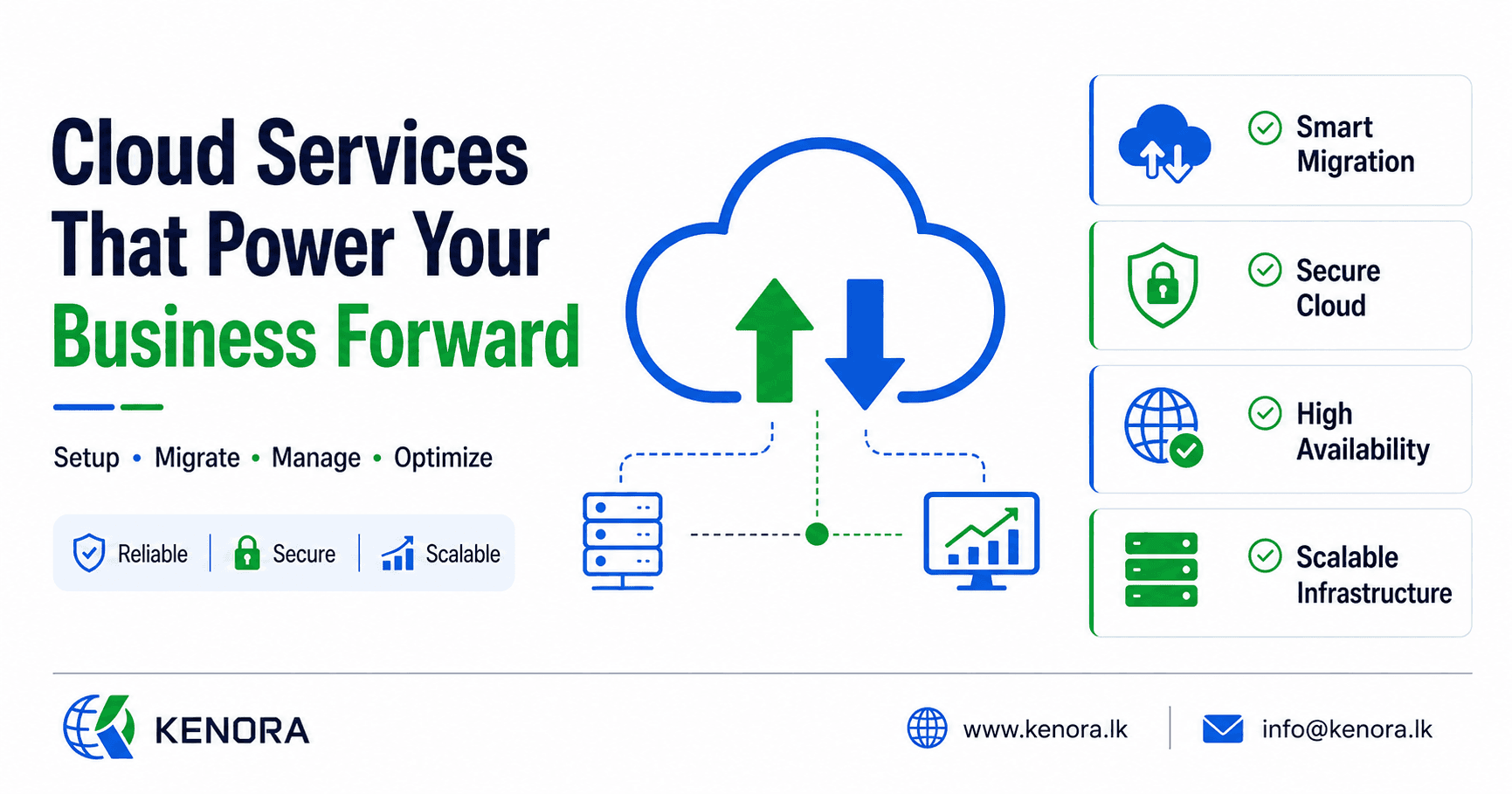
A decade ago, moving to the cloud was treated as a technology upgrade, something you handed to IT and checked off a list. That thinking is outdated now. Cloud strategy has become a business decision, one that shapes how fast a company grows, how well it protects its data, how customers experience its products, and whether it can still compete five years from now.
Yet plenty of organizations still treat cloud services as little more than renting server space online. That narrow view is expensive. It leads to infrastructure nobody is really using, bills that creep up without explanation, and systems that buckle the moment demand spikes.
The cloud isn't just where your applications happen to live. It's the foundation your business runs on every single day, whether anyone in the boardroom thinks of it that way or not.
At Kenora, we treat cloud services as a chance to build something sturdier: businesses that move faster, recover quicker, and are actually ready for what's next.
The Digital Economy Runs on Flexibility
Business doesn't wait anymore.
Customers expect an instant response. Teams are spread across cities, sometimes continents. Applications are expected to stay up around the clock, and new products need to reach the market long before eventually.
Traditional IT infrastructure was never built for that pace. Buying physical servers means guessing, years in advance, how much capacity you'll need. Guess low, and performance suffers the moment traffic picks up. Guess high, and you're paying for hardware that sits there doing nothing.
Cloud infrastructure changes the math entirely. Instead of building for a future you can't predict, you get the flexibility to scale up or down as it actually unfolds. Traffic doubles overnight, a seasonal campaign takes off, demand shifts, and the infrastructure adjusts without anyone scrambling to keep the lights on.
That flexibility is what lets a business spend less time worrying about hardware and more time actually building things.
Migration Is Not Just Moving Servers Somewhere Else
Most companies describe cloud migration as picking applications up and setting them down somewhere else. In practice, a real migration means rethinking how the systems work in the first place.
Every business carries its own mix of workflows, legacy software, databases, security requirements, and compliance obligations. Simply lifting existing systems into the cloud as-is rarely delivers what the move was supposed to achieve.
A migration worth doing starts with understanding the business itself, not just its server list. Which applications should move first? Which ones actually need to be modernized rather than just relocated? How do you keep downtime to a minimum, and how will the people actually using these systems be affected along the way? What security gaps should get closed while everything is already being touched?
Answering those questions up front is what turns migration from a risky IT project into something that quietly moves the business forward.
The Cloud Is Only as Reliable as the Team Managing It
Getting cloud infrastructure up and running is, frankly, the easy part. Keeping it secure, available, fast, and cost effective is the part that never really finishes.
Nothing about infrastructure sits still. Applications get updated. Traffic patterns shift. New threats show up. Storage keeps growing. Users expect more than they did last year.
Without continuous attention, even a well designed environment starts to slip. Monitoring catches performance problems before customers notice them. Regular maintenance keeps software current and patched. Automated scaling absorbs busy periods without anyone getting paged at 2 a.m. Solid backup strategies mean a failure is an inconvenience, not a crisis.
Operational excellence was never about nailing the deployment. It's what happens in the months and years after that deployment.
Downtime Costs More Than Most Businesses Think
When systems go down, the damage rarely stays contained to a technical issue.
Employees lose hours they can't get back. Customers lose confidence, sometimes for good. Sales that would have closed simply don't. Support teams get buried. And the longer the outage runs, the more expensive the recovery becomes.
For any business operating online, every minute of downtime chips away at both revenue and reputation at the same time.
Cloud infrastructure gives businesses a real shot at avoiding that, through redundancy, automated failover, disaster recovery planning, and monitoring that catches problems early rather than after customers complain. Instead of reacting to outages after the fact, businesses can design systems that keep running even when individual pieces fail.
Reliability, done right, isn't a fix applied after something breaks. It's built into the architecture from day one.
Security Has to Be Built Into Every Layer, Not Bolted On
Cloud providers spend billions securing their platforms. That's real, and it matters.
But secure infrastructure doesn't automatically mean secure applications. Businesses are still responsible for protecting their own data, managing who has access to what, configuring systems correctly, and staying compliant with whatever rules apply to their industry.
Here's the uncomfortable truth: most security incidents in the cloud happen because something was configured wrong, not because the cloud platform itself was breached.
Strong cloud security is layered, not a single checkbox. Identity and access management makes sure only the right people get in. Encryption protects data at rest and in transit. Network segmentation limits how far a breach can spread if one does happen. Continuous monitoring flags suspicious activity while it's still small. Regular security assessments find the weak points before someone else does.
Security was never meant to be an optional add-on. It belongs in every deployment from the very first day.
Backups Are Not Automatic Insurance
A lot of businesses assume that because their systems live in the cloud, backups just happen in the background. That assumption has cost plenty of organizations data they can never get back.
Accidental deletions. Buggy application updates. Cyberattacks. Database corruption. Plain human error. Any one of these can wipe out something important if there isn't a real backup strategy behind it.
Effective cloud backup is more than copying files somewhere else. Recovery procedures need to actually be tested, not just assumed to work. Critical systems need clear recovery time objectives. Multiple backup locations add real resilience. Automation takes human error out of the equation as much as possible.
The true measure of a backup isn't whether it exists. It's how fast the business can get back on its feet after something goes wrong.
Cloud Costs Don't Manage Themselves
One of the best things about cloud infrastructure is that you only pay for what you use. Ironically, that advantage disappears fast without someone actually watching it.
Virtual machines keep running long after anyone needs them. Storage piles up quietly in the background. Old backups never get cleaned out. Development environments stay live long after the project that created them wrapped up. None of these look like much on their own, but they add up into a real expense over time.
Cost optimization was never about chasing the cheapest option available. It's about choosing the right resources for the job, watching how they're actually used, automating what can be automated, and revisiting the setup as the business itself changes.
Organizations that stay on top of their cloud spending often end up with both lower costs and better performance, not one at the expense of the other.
The Cloud Lets Businesses Move Faster on New Ideas
Modern businesses can't afford to wait weeks for a server to be racked and configured. Developers need environments today, not next month. Testing platforms need to be ready within minutes. New services need to launch without stalling on a hardware order.
Cloud platforms make all of that possible. Teams experiment with more confidence because trying something new doesn't come with months of setup risk attached. Ideas reach customers faster, and infrastructure becomes part of how a team builds, not something standing in its way.
Innovation speeds up once the technology stops slowing everyone down.
No Two Businesses Need the Same Cloud Setup
A startup shipping its first product has almost nothing in common, infrastructure-wise, with an enterprise running hundreds of internal systems.
A healthcare provider is thinking about compliance and patient data privacy above almost everything else. An eCommerce platform cares most about staying up during its busiest shopping days. A financial company needs strict security controls and a disaster recovery plan that actually works when tested. A manufacturer might need a hybrid setup that connects equipment on the factory floor with analytics running in the cloud.
There's no single blueprint that fits all of them. The implementations that actually work start with the business's goals, then choose the technology to match, not the other way around.
How Kenora Approaches Cloud Services
At Kenora, we design cloud services around business outcomes, not infrastructure for its own sake.
We start by understanding a client's existing systems, the operational headaches they're already living with, where they want to grow, and what security really needs to look like for them, before we recommend anything.
Our cloud services cover infrastructure planning, cloud setup, migration support, deployment automation, performance monitoring, backup strategy, infrastructure optimization, operational support, and ongoing guidance after launch.
Whether a business is moving to the cloud for the first time or fixing up an environment that's already there, we build with scalability, security, reliability, and long term sustainability in mind, not just what gets it live fastest.
Our goal is simple: cloud environments that let businesses innovate with confidence while carrying less operational weight than before.
Looking Ahead
Cloud computing keeps evolving, with artificial intelligence, automation, edge computing, and advanced analytics becoming standard parts of the infrastructure conversation rather than add-ons.
Businesses that invest in a well designed cloud environment now are the ones that will adopt tomorrow's technology without much friction. The ones that put modernization off tend to spend more time keeping old systems alive than building anything new.
The cloud stopped being just a technology platform a while ago. It's the operating foundation for how digital business actually happens.
Organizations that treat cloud services as a strategic investment, rather than a line item in the IT budget, end up with the flexibility to grow faster, adapt to change, and deliver a better experience to the people they serve.
The future belongs to the businesses ready to adapt to it. A strong cloud foundation is where that future actually begins.