
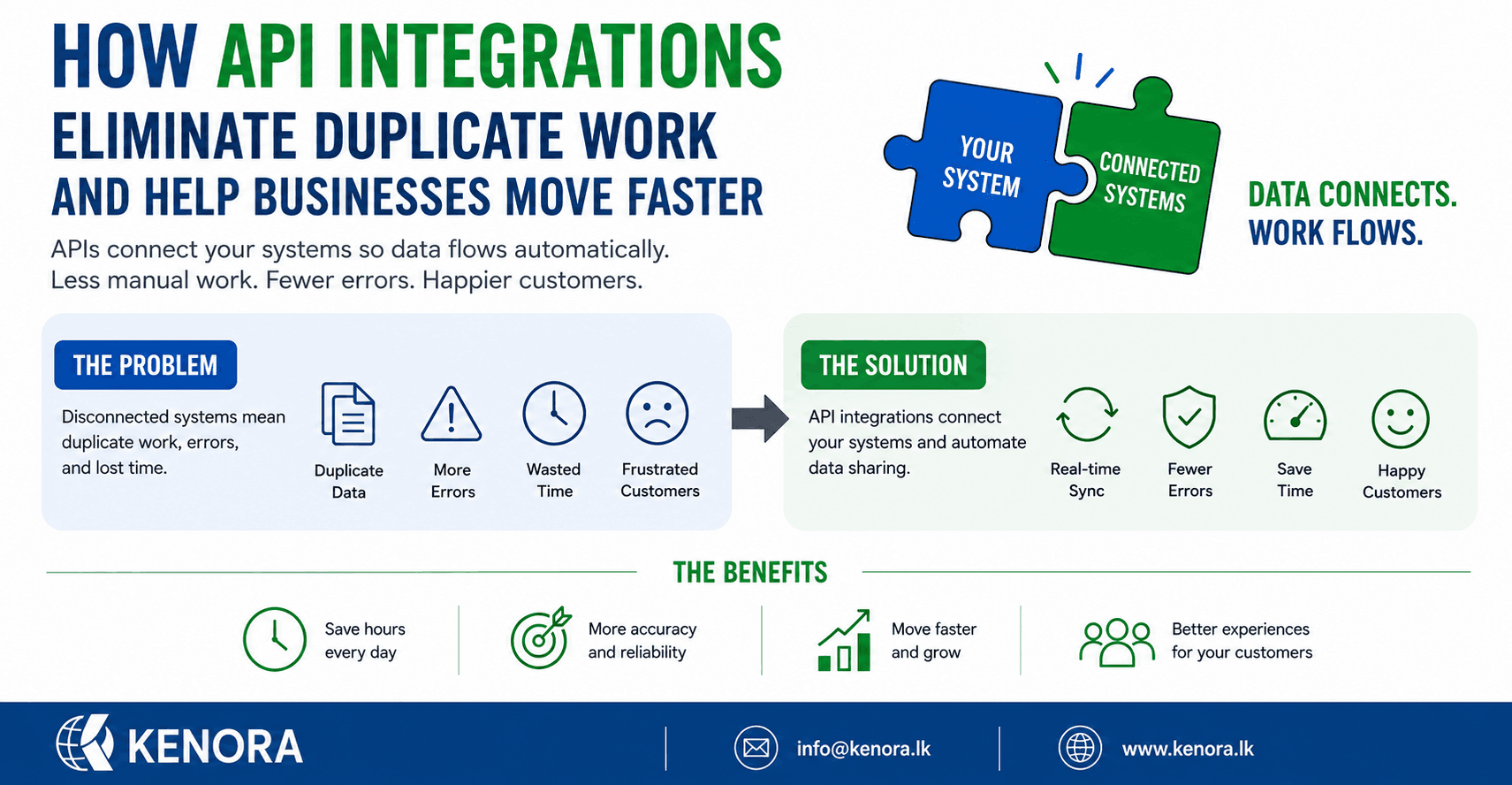
Why software that doesn't talk to itself is quietly costing you hours, accuracy, and customer trust.
Why Are We Still Typing the Same Thing Twice?
Picture a customer placing an order on your website. The sales team gets an email about it. Someone then retypes the customer's details into the CRM. A little later, another person copies those same details into the accounting system. The warehouse team updates inventory by hand. Finance puts together an invoice. Customer support opens yet another record in case the customer ever calls in.
By the time the order is fully processed, the same handful of facts name, address, product, price has been typed into four or five different systems by four or five different people.
Nobody really questions it. It's just how things have always been done.
But it's worth asking the obvious question: why are people spending their time moving information that a computer could move on its own?
Every day, companies lose thousands of productive hours to work that adds no real value. Not because their employees lack skill, and not because the technology to fix it doesn't exist. It's because their systems were never taught to talk to each other. That disconnect is exactly what API integrations are built to solve.
The Modern Business Runs on More Software Than Ever
Most companies today lean on software for nearly everything: customer relationship management, accounting, inventory, HR, marketing, payments, project tracking, support, internal chat. Each tool is usually excellent at its one job.
The trouble starts when those tools operate in isolation. Every department has the data it needs sitting right in front of it, but none of the platforms know what the others are doing. So employees end up becoming the connective tissue between systems, spending time re-entering information instead of talking to customers or thinking about strategy.
Software was supposed to make work simpler. Too often, a pile of disconnected tools just creates more of it.
The Real Cost of Copy-and-Paste Work
On its own, retyping a customer's name or an order number doesn't look like a big deal. It takes a minute, maybe two. But this kind of work adds up quietly in the background.
Say ten employees each lose twenty minutes a day moving data between systems. That's already more than three hours gone every single day, for one company. Multiply that across weeks and months and you're looking at hundreds, sometimes thousands, of working hours disappearing every year into a task that produces nothing new.
And time isn't the only thing at stake. Every manual entry is a chance for a mistake to slip in: a transposed digit, a misspelled name, the wrong invoice total, an old phone number that never got updated. One small slip can ripple through several departments before anyone notices.
Duplicate work doesn't just waste hours. It adds risk to everything that touches that data afterward.
So What Exactly Is an API?
The term sounds technical, but the idea behind it is simple.
Think of two people who speak completely different languages. Neither can understand the other, until a skilled translator steps in. Suddenly the conversation flows both ways without anyone struggling to be understood.
An API, short for application programming interface, does something similar for software. It lets two different systems exchange information automatically, without a person sitting in the middle typing everything by hand. Orders, invoices, customer records, stock levels, payments, appointments all of it can move directly from one platform to another.
No copying. No retyping. No second version of the truth sitting in a spreadsheet somewhere. Just accurate information landing exactly where it needs to be.
A Day in the Life, Before and After Integration
Here's what a fairly ordinary business day looks like without integration. A customer submits an order. Sales gets an email. Someone enters the customer's details into the CRM. Finance builds an invoice from scratch. Operations manually updates the stock count. Support creates a brand-new profile for a customer who technically already exists elsewhere in the system.
Now picture that same order flowing through a connected setup instead.
- Customer places an order before: email lands in the sales inbox; after: website updates the CRM automatically
- Customer record created before: typed into the CRM by hand; after: already synced, no typing needed
- Invoice prepared before: copied again into accounting software; after: finance system generates it instantly
- Inventory updated before: warehouse staff adjust stock manually; after: stock levels adjust in real time
- Support has customer history before: new profile created from scratch; after: history is visible immediately
Nobody is moving information around anymore. They're simply using it. That's not just a small efficiency gain, it's a genuinely different way of running a business.
Better Decisions Start With Better Information
Leadership teams make calls every day: whether to reorder stock, whether a campaign is actually working, which products are pulling their weight, which customers need attention before they walk away.
All of those decisions rely on having accurate numbers in front of you. When data lives in five disconnected systems, reports have to be assembled by hand, and by the time anyone actually reads them, the numbers may already be stale.
Connected systems change that. Data updates itself. Dashboards refresh in real time. Decision-makers get to see what's happening while there's still time to act on it. In a lot of ways, the speed of your information becomes the speed of your business.
Customers Feel the Difference Before You Explain It
Plenty of businesses assume integrations are purely an internal upgrade. In practice, customers often notice the results first.
- Orders get processed faster
- Invoices show up right away instead of days later
- Support already knows the customer's history when they call
- Shipping and delivery updates happen automatically
- Fewer errors mean fewer frustrating follow-up calls
Customers don't see the API calls happening behind the scenes. They just notice that everything feels smoother than it used to. And a smooth experience is one of the quietest ways to earn someone's trust.
Your Team Gets Its Time Back
A common worry about automation is that it replaces people. In reality, it replaces repetitive busywork, not the people doing it.
Employees still solve problems, build relationships with customers, read the numbers, and come up with new ideas. What automation removes is the part of the job nobody enjoyed anyway: retyping the same fields into a second, third, or fourth system.
When people spend less time copying data, they spend more time actually improving the business. Good technology should make people more capable, not compete with them for relevance.
One Connected System, One Version of the Truth
One of the more frustrating problems a growing company runs into is conflicting numbers. Sales reports one figure, finance reports another, operations has a third, and everyone is quietly convinced their own number is the correct one.
API integrations solve this by design. Instead of keeping several separate copies of the same information, the business works from one connected pool of data. Customer records stay in sync, inventory reflects reality, and financial numbers match across every department.
When everyone is looking at the same picture, decisions get made faster and with a lot less arguing over whose spreadsheet is right.
Does Every Business Actually Need This?
Not necessarily, at least not right away. A small company running on one or two tools probably won't notice much benefit from a full integration setup.
But growth changes the math. As more software gets added, more departments come online, and more people need access to the same data, manual processes start to buckle under their own weight. That's usually the point where integration stops being a nice-to-have and turns into something closer to a necessity.
Recognizing that shift early tends to make the next stage of growth a lot less painful.
The Bottom Line
Businesses rarely become inefficient overnight. It happens one manual step at a time: one copied spreadsheet, one duplicated customer record, one report someone had to build by hand, one app that never got connected to the rest.
Individually, none of it looks like a big problem. Added together, it quietly eats the hours that could have gone toward serving customers, improving the product, or actually growing the company.
API integrations solve a problem that's simple to describe, even if it's often ignored: they let systems talk to each other so people don't have to do it for them. The payoff isn't just speed. It's fewer errors, better collaboration, more reliable numbers, happier customers, and a business that can grow without generating a fresh pile of manual work every time it does.
The best technology tends to work quietly in the background, freeing people up to do the work only they can do.