
AI Is Changing How Mobile Products Are Built
From smarter features to faster development, AI is changing how mobile apps are made and how people use them.
Imagine opening an app that knows what you need. It helps you finish a task, and it remembers your preferences, so you never have to repeat yourself.
A few years ago, that sounded like science fiction. Today, AI is helping developers bring ideas like this into real mobile products.
But the biggest change is not only what AI can do inside an app. It is also changing how developers design, build, and test the apps we use every day.
AI is now part of the mobile development process, and businesses have new chances to create better digital experiences.
Developers Can Build Faster With AI
Building a mobile app takes more than writing code. Developers plan features, design screens, connect different systems, test on many phones, and fix problems along the way.
AI tools can now help with many of these jobs.
Say a developer is working on a shopping app. They can ask AI to create a first version of the product search feature. AI can also suggest code, explain error messages, and offer different ways to solve a problem.
This saves time, especially at the start of a project.
But AI cannot turn an idea into a finished product on its own. Developers still need to check the code, make sure every feature works together, and confirm that the app really fits what users need.
The real win is simple. Developers spend less time on routine work and more time on the decisions that matter.
Mobile Apps Are Becoming More Personal
Think about how you use apps. Sometimes you want a quick answer. Sometimes you need help finding something or finishing a task.
AI gives developers new ways to make an app useful for many different people. For example:
- A learning app can explain a hard topic in simpler words.
- A travel app can plan a trip around your interests.
- A shopping app can understand a request like, "Find a comfortable bag for a weekend trip."
Instead of digging through menus and filters, people can just ask in their own words.
That does not mean every app needs a chatbot. Sometimes one small AI feature that solves one clear problem does more good than five complicated ones.
The key is to know what your users really need.
Good mobile apps do not just add more features. They make everyday tasks easier.
AI Is Moving Directly Onto Mobile Devices
Here is one of the most interesting shifts. Some AI features can now run right on your phone, instead of sending every request to a cloud server. This is called on-device AI.
It has some clear benefits. Features can respond faster, work with a weak internet connection or none at all, and keep more personal information off outside servers.
For example, an app could use on-device AI to summarize your notes, recognize what is in a photo, or help you work with files stored on your phone.
Security is a big part of this story. On October 7, 2026, Google announced AISeal, a new security design for Android. It creates a protected, locked area on the phone where personal information used by AI can be kept apart from the rest of the system. Google says it is starting with protected storage for personal data, and chip makers like MediaTek and Qualcomm are on board to support it.
It shows how seriously the industry now takes privacy, as AI gets closer to our daily phone use.
Still, on-device AI has limits. Some models need more memory and power than a phone can give, and harder tasks often work better in the cloud.
So developers have to choose based on the app's purpose, cost, speed, and privacy needs.
Testing Still Matters More Than Ever
AI can help write code faster. That does not mean the finished app will be free of problems.
A feature may work well on one phone and break on another. An update may cause a surprise bug. An AI feature may even give a wrong answer or misunderstand what a user asked.
Developers can use AI to suggest test cases, review code, and spot weak points. That helps teams find problems earlier.
But human review and proper testing are still a must. This matters most for apps that handle payments, personal details, or business data. One small mistake can cost you your users' trust.
The goal should not be to launch as fast as possible. The goal is to launch an app that works well and gives people a reason to come back.
The Challenges Businesses Should Consider
AI brings exciting chances, but it also brings new questions. Here are four to ask before you start.
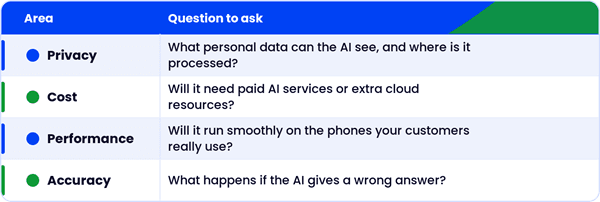
Ask these early, not after the app is already live.
Also, remember that AI is not always the answer. If a simple search bar solves the problem, adding an AI system may only add cost and extra work.
Use technology where it brings real value.
What This Means for the Future of Mobile Apps
AI is changing how apps are built and what users expect from them. Developers can speed up parts of their work. Businesses can find new ways to help customers and improve their services.
If you are planning a mobile app, now is a good time to explore. But do not start with the latest trend.
Start with a problem.
Learn what your users need. Decide if AI can help. Then pick the right tools, plan for security, and test with care.
At Kenora Technologies, we believe good mobile products begin with understanding the people who will use them. With careful planning, modern tools, and proper testing, businesses can build apps that work well today and are ready for tomorrow.
Final Thoughts
AI will keep changing mobile development, but technology alone does not make an app successful.
The best products will mix helpful AI features with simple design, reliable performance, and a real understanding of users.
The goal is not just to build apps faster or to add more AI.
It is to build mobile experiences that make people's lives easier.