
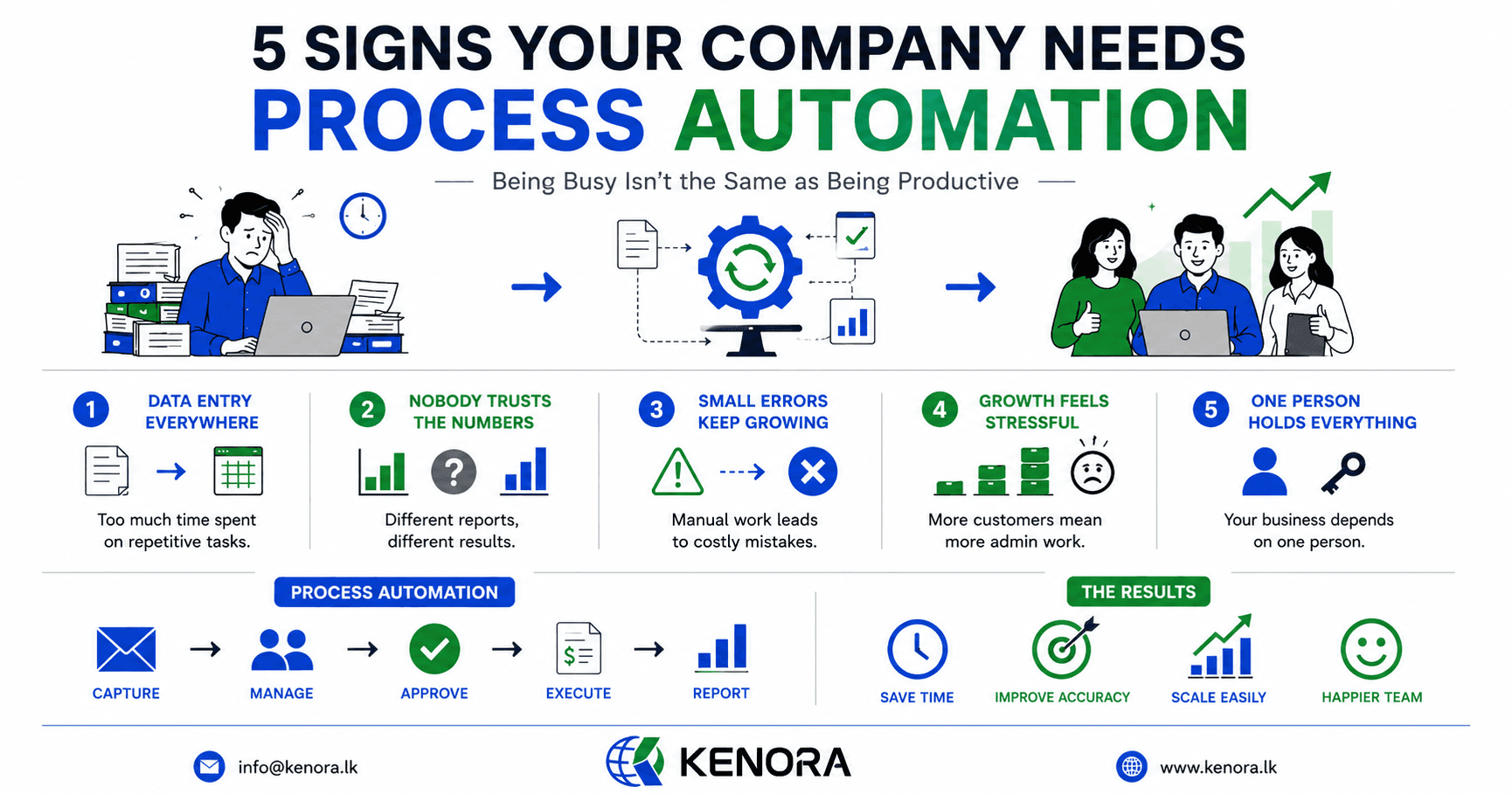
Why being busy is not the same thing as being productive.
Busy Isn't the Same as Productive
Walk into almost any growing company and you'll hear the same thing on repeat. We're busy. Sales is busy. Operations is busy. Finance is busy. Everyone is staying late and juggling more than they should, and on the surface, that looks like a company firing on all cylinders.
But here's a question most leaders never stop to ask: are people busy because the business is growing, or because it's doing too much work by hand?
There's a real difference between the two. Growth creates meaningful work. Manual process creates repetitive work. One builds value. The other quietly drains it.
Most businesses treat inefficiency as the cost of doing business. Delays, duplicate data entry, endless follow-up emails: these get filed away as just how things are. In reality, they're usually the first warning signs that automation has stopped being a nice-to-have and become a necessity.
Here are five signs worth paying attention to.
1. Your Best People Are Stuck Doing Data Entry
Picture an experienced salesperson you just hired. You expect them to build relationships, chase opportunities, and close deals. Instead, they spend half their day updating spreadsheets, copying customer details between systems, and writing the same status email for the third time this week.
They're working hard. They're just not selling.
This happens more than most leaders realize, and rarely because anyone planned it that way. Talented people slowly turn into part-time data clerks simply because the systems around them don't talk to each other. The cost isn't just a few lost hours. It's lost potential: the deals that didn't get made because the person who could have made them was stuck in a spreadsheet instead.
People do their best work when they get to use judgment, creativity, and expertise. Automation exists to take the repetitive work off their plate so they can actually do that. If your team spends a meaningful chunk of the week on administrative busywork, that's usually the clearest sign automation will pay off fast.
2. Nobody Can Agree on the Real Numbers
Ask three different departments the same question and see if you get three different answers. If you do, you're far from alone.
Most organizations build information silos without ever meaning to. Customer details live in one tool, sales numbers in another, financials sit somewhere else, project updates hide in a spreadsheet nobody remembers to update, and support tickets live in yet another system entirely.
Once information gets this scattered, people stop working and start searching. Meetings run long because half the room is checking different numbers. Reports contradict each other. Decisions slow down because nobody feels fully confident they're looking at the latest version of the truth.
Automation fixes this by connecting systems and syncing data in real time, so people stop acting as human messengers between platforms. What you end up with is a single source of truth that the whole company can actually trust, instead of five versions of probably right.
3. Small Mistakes Keep Turning Into Big Problems
Humans make mistakes. That's not the problem. The problem shows up when a business leans heavily on manual data handling, where every typo, missing digit, or duplicate record has somewhere to hide.
A wrong email address here. A skipped approval there. A missed deadline nobody catches until a customer calls to ask where their order is. None of these feel like a crisis on their own. Stacked together over months, they get expensive: incorrect invoices, delayed shipments, frustrated customers, and hours spent cleaning up messes that never needed to happen in the first place.
Automation won't make every error disappear. What it does is shrink the number of places where errors can creep in. When data moves automatically between systems instead of being retyped by hand five times, consistency goes up, and consistency is what makes a business reliable instead of just lucky.
4. Growth Feels Like a Threat Instead of a Win
More customers should be good news. More revenue should feel like momentum. And yet plenty of businesses experience growth as pure stress, because every new customer brings more emails, more approvals, more paperwork, more follow-up. The process underneath never changed, so the workload just keeps multiplying on top of it.
Eventually teams hit a wall. The business wants to keep growing, but operations can't keep pace, and the instinct is usually to hire more people to absorb the load.
Sometimes that's the right call. But often the real problem isn't a headcount shortage, it's a process that was never built to scale in the first place. Automation lets a business handle more demand without a proportional jump in administrative work. The goal isn't fewer people; it's freeing the people you already have to spend their time on work that actually grows the business, instead of work that just keeps the lights on.
5. The Business Only Works Because One Person Is Holding It Together
Every company has key people. There's a difference, though, between someone being valuable and a business being dangerously dependent on them.
Picture this: one employee takes two weeks off, and suddenly nobody knows how a certain report gets built. Customer requests pile up because only that one person knew the process. Important tasks simply stop, because the knowledge of how to do them lived in someone's head and nowhere else.
That's not loyalty to a great employee. That's risk sitting in plain sight. Automation helps document and standardize routine workflows so the knowledge lives inside the process itself, not trapped in one person's inbox or memory. The business becomes more resilient as a result, and resilience tends to be the benefit nobody thinks about until the day they desperately need it.
Why So Many Companies Wait Anyway
Even with all five signs staring them in the face, most businesses still put automation off. Usually for one of three reasons.
We've always done it this way. Familiar processes feel comfortable, even the broken ones. People build workarounds, get used to them, and eventually stop questioning whether there's a better path. What started as a temporary fix quietly becomes permanent.
We're too busy right now. This one is almost funny if it weren't so common: businesses get too busy to fix the exact thing that's making them busy. Leadership knows something needs to change, but the next deadline always wins. Weeks turn into months, months turn into years, and the inefficiency just stays.
Automation sounds expensive. Most leaders weigh the cost of implementing automation against doing nothing, as if doing nothing were free. It isn't. The better question is never how much will this cost us? It's how much is the manual version already costing us every month, once you add up lost productivity, slow decisions, human error, and frustrated customers. Usually, that number is bigger than people expect.
Automation Isn't About Replacing People
One of the most persistent myths about automation is that it exists to cut jobs. In practice, good automation does the opposite: it removes the repetitive parts of a job so people can spend their energy on the parts that actually need a human touch, communication, judgment, creativity, and problem-solving.
The goal was never fewer people. It's better use of the people you already have. In a competitive market, time is one of the few resources you can't buy more of, so the businesses that protect it tend to win.
You Don't Need to Be a Big Company to Benefit
Automation isn't reserved for large enterprises with deep pockets. If anything, smaller and mid-sized businesses often feel the impact the most, simply because they're working with tighter resources. Every hour saved actually matters. Every fixed process shows up clearly in the numbers. Automation lets a smaller team operate with the kind of consistency and efficiency that used to be reserved for much bigger companies.
Final Thoughts
Most businesses don't reach for automation until things become completely unmanageable, and by then they've already burned through time, money, and opportunities they can't get back.
The smarter move is catching the warning signs early. If your team is buried in repetitive tasks, if information is scattered across five different tools, if small mistakes keep turning into expensive ones, if growth feels more stressful than exciting, or if your operations quietly depend on one or two people staying put, your business is probably already overdue for automation.
The goal was never to make people work harder. It's to build systems that finally let them work smarter, because sustainable growth has never come from asking people to do more. It comes from clearing away the work that was never worth doing by hand in the first place.